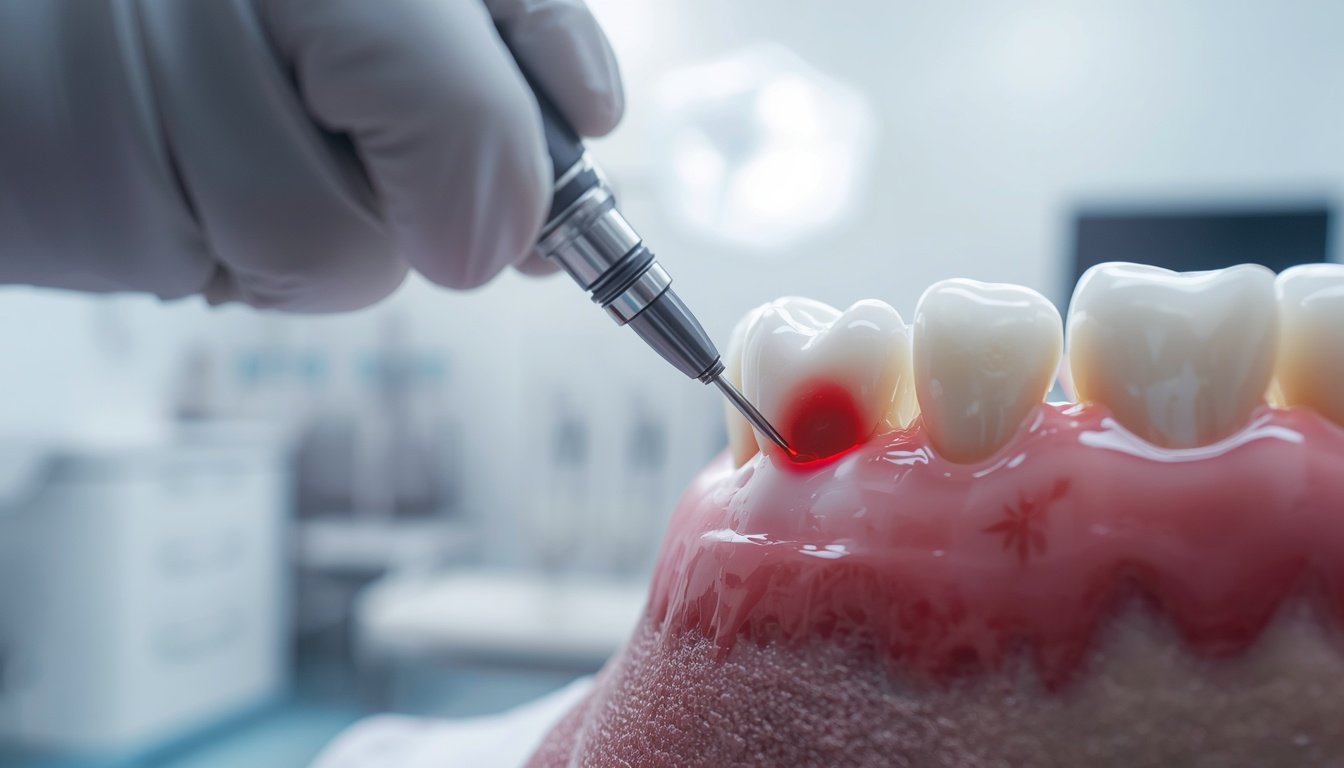
If you have a cavity, you may be wondering whether there is a way to treat tooth decay without relying entirely on the traditional dental drill. This is where laser dentistry for cavities may be an option.
So, can laser dentistry be used to treat cavities?
Yes. Selected cavities can be treated with dental lasers, particularly with certain hard-tissue lasers designed to remove decayed tooth structure. However, laser dentistry is not automatically suitable for every cavity. The appropriate treatment depends on the size, depth, location and condition of the tooth.
Research has evaluated lasers such as Er and Er,Cr for caries removal. A recent systematic review found that these lasers can be used for caries removal, while a 2025 meta-analysis found that some clinical outcomes were not significantly different from conventional bur-based treatment and noted that the evidence quality for some outcomes remains limited.
At The Dental Crowns in Noida, laser dentistry is offered as part of a broader range of dental treatments, including restorative and root canal care.
Quick Answer: Can Laser Dentistry Treat Cavities?
Yes, laser dentistry can be used to treat selected cavities.
A dental laser can be used to remove certain areas of decayed tooth structure before the tooth is restored with an appropriate filling or other restoration. Depending on the clinical situation, the dentist may use a laser alone for a particular part of the procedure or combine laser technology with conventional dental instruments.
However, laser treatment does not mean that every cavity can or should be treated with a laser.
Your dentist needs to examine the tooth and determine:
- How deep the cavity is
- Where the cavity is located
- How much healthy tooth structure remains
- Whether the pulp is affected
- Whether the tooth requires a filling or another restoration
- Whether conventional treatment would be more appropriate
The American Dental Association’s caries-management resources emphasize evidence-based diagnosis and treatment planning rather than assuming that one technology is appropriate for every cavity.
What Is Laser Dentistry?
Laser dentistry uses concentrated light energy for selected dental procedures.
Different dental lasers have different applications. Some are designed primarily for soft tissues, while certain lasers can interact with hard dental tissues.
Depending on the type of laser and the treatment being performed, laser technology may be used for selected procedures involving:
- Tooth decay
- Gums
- Soft tissues
- Root canal-related procedures
- Tooth sensitivity
- Certain oral surgical procedures
The Dental Crowns’ laser dentistry service describes the use of advanced laser technology for selected dental treatments, including cavity-related procedures.
The important point is that “laser dentistry” is a broad term. The type of laser, its settings and the clinical objective all matter.
How Does Laser Cavity Treatment Work?
If a dentist determines that laser treatment is appropriate for your cavity, the process generally involves several stages.
1. Dental Examination
The dentist first examines the affected tooth.
Depending on the suspected extent of decay, dental X-rays or other diagnostic methods may also be required.
The purpose is to determine whether the decay is limited to the tooth’s outer structures or has progressed deeper.
2. Treatment Planning
The dentist decides whether laser treatment is appropriate.
A small, accessible cavity may be managed differently from a deep cavity that is close to the dental pulp.
3. Removal of Decayed Tooth Structure
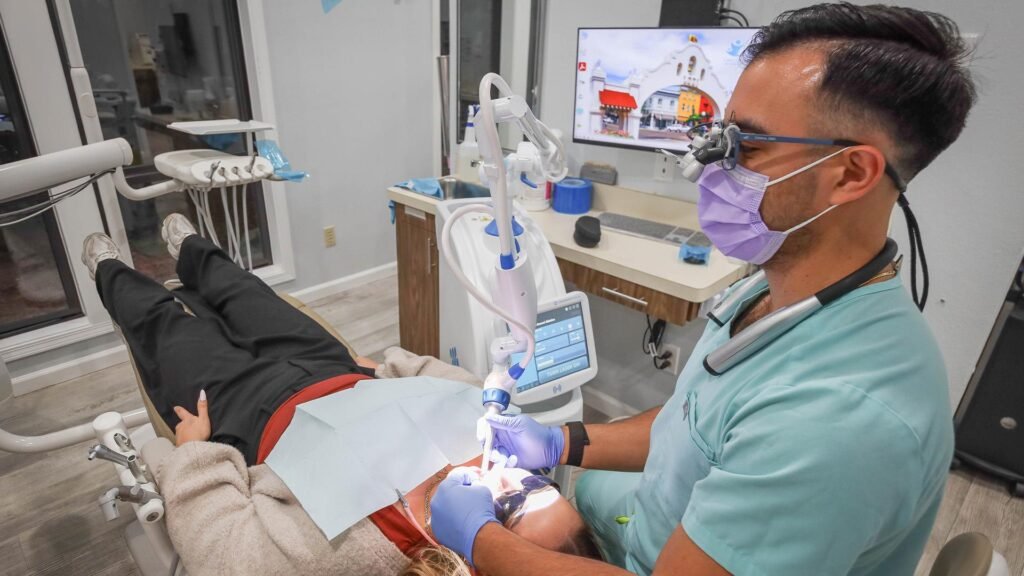
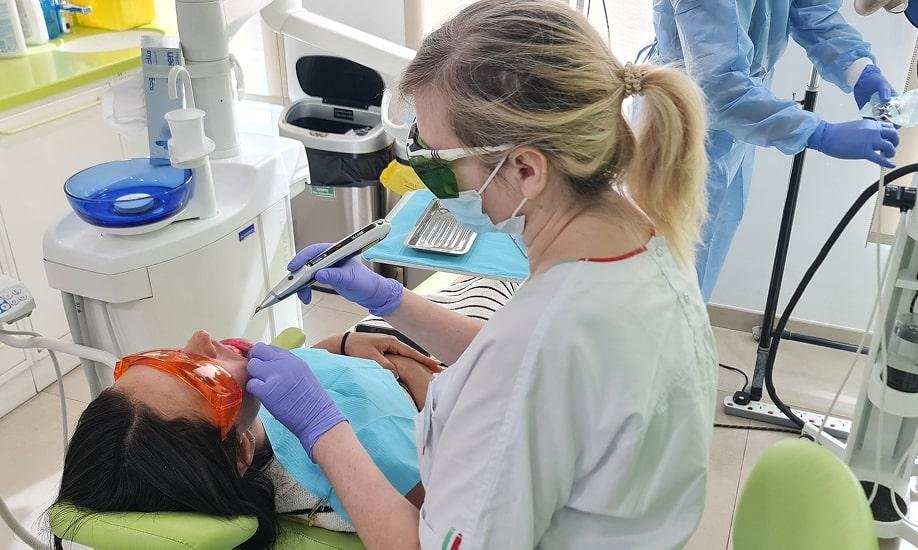
With an appropriate hard-tissue laser, laser energy can be used to remove selected areas of decayed tooth structure.
The exact technique depends on the laser system, tooth structure and clinical circumstances.
4. Tooth Restoration
After the decay has been removed, the tooth generally needs to be restored.
Depending on the amount of tooth structure lost, this may involve a suitable filling or another restorative treatment.
This is important because the laser itself does not replace the restoration. The decayed portion must be removed and the tooth must be appropriately repaired.
Is Laser Cavity Treatment Better Than a Dental Drill?
This is one of the most common questions patients ask.
The answer is not necessarily.
Laser dentistry has potential advantages in selected cases, but it should not be viewed as universally superior to conventional cavity treatment.
A 2025 meta-analysis comparing laser-assisted caries removal with conventional burs found no statistically significant difference for some evaluated outcomes, including restoration survival and pulp vitality, although the evidence quality for these outcomes was considered low.
An earlier systematic review also concluded that evidence supporting laser treatment as equally effective as rotary instruments for removing carious tissue was limited.
Therefore, the better question is not:
“Is laser better than a drill?”
Instead, ask:
“Is laser treatment appropriate for my particular cavity?”
Your dentist can answer this after examining the tooth.
What Are the Potential Benefits of Laser Dentistry for Cavities?
When appropriately indicated, laser cavity treatment may offer several potential benefits.
1. Precise Treatment
Laser technology can be used to target specific areas of dental tissue.
This can allow the dentist to work carefully around healthy tooth structure.
2. Potentially Less Vibration
One reason some patients are interested in laser dentistry is the absence of the same type of mechanical vibration associated with a conventional dental drill.
This may make the experience more comfortable for some patients.
3. Reduced Noise Compared With a Traditional Drill
The characteristic high-pitched sound of a dental drill can make some patients anxious.
Laser equipment operates differently and may reduce the type of drilling noise associated with conventional cavity preparation.
4. Possible Reduction in the Need for Anesthesia in Selected Cases
Some laser procedures may require less local anesthesia depending on the cavity and the patient’s sensitivity.
However, this should not be interpreted as meaning that laser cavity treatment is always anesthesia-free.
Your dentist determines whether anesthesia is appropriate.
5. Minimally Invasive Approach in Selected Cases
When clinically appropriate, laser technology can support a conservative approach to removing affected tooth structure.
However, the amount of tooth structure that must be removed depends on the actual condition of the tooth.
Does Laser Cavity Treatment Hurt?
Many patients search for painless cavity treatment because they are nervous about dental procedures.
Laser treatment may be more comfortable for some patients, but it would be inaccurate to promise that every laser procedure is completely painless.
Your experience can depend on:
- The size of the cavity
- The depth of decay
- Tooth sensitivity
- The location of the cavity
- The type of laser
- The treatment technique
- Individual pain sensitivity
- Whether local anesthesia is required
If you are concerned about discomfort, discuss anesthesia and pain-management options with your dentist before treatment.
Can Laser Dentistry Remove Deep Cavities?
It depends on the condition of the tooth.
A deep cavity may extend close to the pulp, the living tissue inside the tooth. In such situations, simply removing the visible decay with a laser may not be the complete treatment.
If the decay has progressed to the pulp and the tooth becomes infected or inflamed, root canal treatment may be necessary.
The American Association of Endodontists describes root canal treatment as a procedure used to treat inflamed or infected pulp by removing the affected tissue, cleaning the root canal system and sealing the tooth.
You can learn more about treatment options through our Painless Root Canal Treatment in Noida.
Laser Dentistry vs Conventional Cavity Treatment
| Feature | Laser Cavity Treatment | Conventional Treatment |
|---|---|---|
| Decayed tissue removal | Possible with suitable lasers | Commonly performed using dental burs |
| Noise | Different from traditional drilling | Characteristic dental-drill sound |
| Vibration | May be reduced | Mechanical vibration is common |
| Anesthesia | May be reduced in selected cases | May be required depending on treatment |
| Suitability | Depends on cavity and laser | Widely applicable |
| Restoration | Usually still required | Usually still required |
| Best option | Depends on clinical assessment | Depends on clinical assessment |
The choice should be based on the patient’s diagnosis rather than simply choosing the newest technology.
When Might Laser Dentistry Be Considered for a Cavity?
A dentist may consider laser-assisted treatment when the clinical situation and available equipment make it appropriate.
Factors that may be considered include:
Small or Moderate Areas of Decay
Certain cavities may be suitable for hard-tissue laser treatment.
Patient Comfort
For patients who are particularly concerned about vibration or the sound of conventional drilling, laser treatment may be discussed as an option when clinically suitable.
Location of the Cavity
The accessibility and position of the decay can influence whether a laser can be used effectively.
Amount of Healthy Tooth Structure
The dentist needs to determine how much tooth structure can be preserved while completely managing the decay.
When May Conventional Treatment Be More Appropriate?
Laser dentistry is not a replacement for every conventional dental procedure.
A traditional approach may be more appropriate depending on:
- The depth of decay
- The location of the cavity
- The size of the restoration required
- The condition of the tooth
- The equipment available
- The dentist’s clinical assessment
- The need for additional procedures
Evidence reviews have found that laser caries removal can be clinically useful but that the evidence does not establish laser treatment as universally superior to conventional methods.
This is why an examination is important before deciding on treatment.
Can Laser Dentistry Prevent Cavities?
Laser technology has also been studied for caries prevention, particularly in relation to enamel and early carious changes.
A systematic review of prophylactic laser use found evidence from controlled trials that certain laser approaches, particularly when combined with other preventive interventions, may affect caries incidence or fluoride uptake. However, the authors noted limitations including risk of bias and differences between studies.
Another 2024 systematic review and meta-analysis reported potential benefits of low-power CO₂ laser treatment for preventing early enamel caries, but also noted limitations and heterogeneity among the available studies.
This does not mean that laser treatment replaces basic cavity prevention.
Daily brushing with fluoride toothpaste, cleaning between teeth, controlling frequent sugar intake and regular dental examinations remain important parts of maintaining oral health.
What Happens If a Cavity Is Left Untreated?
A cavity may start as a relatively small area of tooth decay, but untreated decay can progress.
Depending on the severity, untreated decay may lead to:
- Increasing tooth sensitivity
- Toothache
- Food getting trapped around the tooth
- A larger area of tooth damage
- Infection of the dental pulp
- Abscess formation
- Need for root canal treatment
- Significant loss of tooth structure
- Extraction in severely damaged teeth
Early evaluation can therefore help determine whether a relatively conservative restoration is possible.
If the tooth has already suffered significant structural damage, a dental crown treatment may sometimes be recommended to protect and restore it.
Can a Cavity Need a Dental Crown After Laser Treatment?
Not every cavity requires a crown.
A filling may be sufficient when enough healthy tooth structure remains.
However, if a tooth has extensive decay, a large restoration, significant structural weakness or has undergone root canal treatment, a dentist may recommend a crown.
You can read more about Dental Crown Treatment Near Noida Sector 78 to understand when a crown may be considered.
How Much Does Laser Cavity Treatment Cost in Noida?
There is no single price for laser cavity treatment.
The total cost may depend on:
- Number of teeth being treated
- Size and depth of the cavity
- Type of laser used
- Whether anesthesia is required
- Type of filling material
- Whether additional dental procedures are required
- Complexity of the case
- Follow-up treatment
Therefore, an online price should not be considered a substitute for a dental examination.
If you are looking for laser dentistry in Noida, a consultation can help determine whether laser-assisted cavity treatment is appropriate for your tooth and what treatment options are available.
The Dental Crowns provides advanced clinical laser dentistry in Noida as well as restorative, general and surgical dental services.
Laser Dentistry for Cavities in Noida
If you live in Sector 74, Sector 75, Sector 76, Sector 77, Sector 78 or Sector 79 Noida, you may be searching for convenient dental care close to home.
The Dental Crowns is located at:
Shop No. 16, 1st Floor, Civitech Stadia, Sector 79, Noida, Uttar Pradesh 201301.
The clinic offers laser dentistry alongside treatments such as root canal treatment, dental implants, dental crowns and other dental services.
You can explore the clinic’s complete dental services before scheduling a consultation.
Frequently Asked Questions
Can laser dentistry be used to treat cavities?
Yes. Selected cavities can be treated using appropriate dental lasers. However, suitability depends on the location, depth and extent of tooth decay and the dentist’s assessment.
Can a laser remove tooth decay?
Yes. Certain hard-tissue dental lasers can be used to remove decayed tooth structure. Research has evaluated lasers such as Er and Er,Cr for caries removal.
Is laser cavity treatment painless?
Laser treatment may be more comfortable for some patients, but it cannot be guaranteed to be completely painless for everyone. Anesthesia may still be appropriate depending on the tooth and procedure.
Is laser treatment better than a dental drill?
Not necessarily. Current evidence does not establish laser cavity treatment as universally superior to conventional methods. The appropriate technique depends on the individual tooth and clinical situation.
Can laser dentistry treat deep cavities?
It depends on how deep the decay has progressed. If the dental pulp is infected or significantly inflamed, root canal treatment may be required instead of simple cavity removal.
Can laser dentistry prevent cavities?
Certain laser approaches have been studied for caries prevention, but lasers should not replace established preventive dental care such as fluoride use, oral hygiene and regular dental examinations.
How long does laser cavity treatment take?
Treatment time varies according to the size and location of the cavity, the type of laser used and the restoration required. Your dentist can provide a more accurate estimate after examining the tooth.
Is laser dentistry safe?
Dental lasers can be used safely when the appropriate equipment, settings and safety protocols are followed by trained dental professionals. The correct laser and treatment approach depend on the clinical procedure.
Do I still need a filling after laser cavity treatment?
Usually, removing decay is only one part of cavity treatment. The tooth generally needs an appropriate restoration after the decayed structure has been removed.
Where can I get laser dentistry in Noida?
The Dental Crowns offers advanced clinical laser dentistry at Civitech Stadia, Sector 79, Noida. Patients can consult the dental team to determine whether laser treatment is suitable for their specific condition.
Final Takeaway
Can laser dentistry be used to treat cavities? Yes—but it is not the right choice for every cavity.
Dental lasers can be used for selected caries-removal procedures, and they may provide advantages such as reduced vibration and potentially improved comfort in appropriate cases. However, conventional dental instruments remain important, and current evidence does not show that lasers are universally superior for cavity treatment.
The most important step is getting the cavity properly examined.
If you have tooth sensitivity, a visible hole, pain while chewing, food getting stuck between your teeth or a suspected cavity, schedule a dental examination rather than waiting for the problem to become more severe.
Looking for laser dentistry in Noida?
The Dental Crowns provides laser dentistry along with root canal treatment, dental crowns, dental implants and other dental services.
Clinic: Shop No. 16, 1st Floor, Civitech Stadia, Sector 79, Noida, Uttar Pradesh 201301.
Phone: +91 89202 71787