When tooth decay reaches the inner part of a tooth, it can cause pain, sensitivity and inflammation. Depending on the severity of the damage, a dentist may recommend a pulpotomy or a root canal treatment to preserve the natural tooth and prevent further complications.
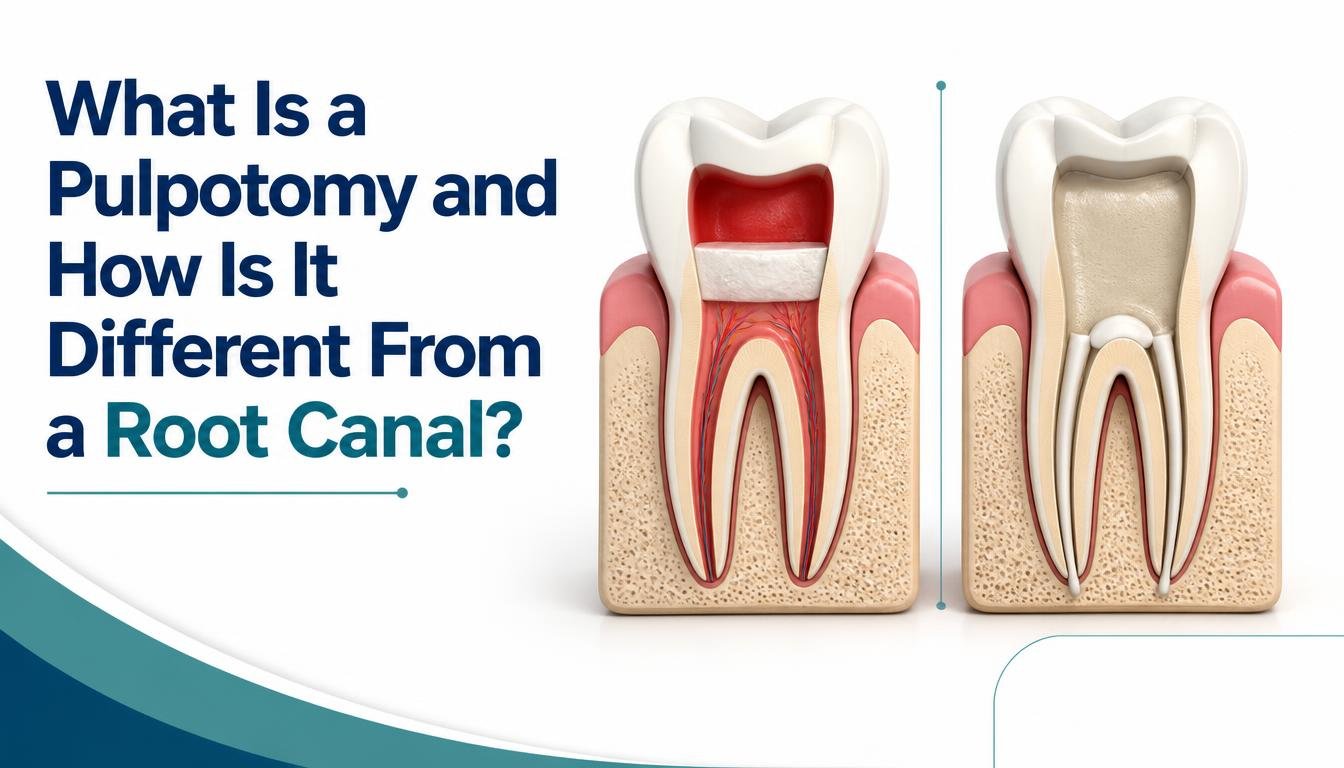
But what is a pulpotomy and how is it different from a root canal? Although both procedures treat problems involving the dental pulp, they differ in how much pulp tissue is removed and which teeth or conditions may benefit from treatment.
A pulpotomy is commonly used to treat certain damaged baby teeth in children. A conventional root canal treatment, on the other hand, generally involves removing the affected pulp from both the crown and root canals of a tooth.
Understanding the difference between these procedures can help parents and adults make informed decisions about their dental health. In this guide, we explain how each treatment works, when it may be recommended, what to expect during recovery and how a dentist determines the most appropriate option.
What Is a Pulpotomy?
A pulpotomy is a dental procedure in which a dentist removes inflamed or damaged pulp tissue from the crown of a tooth while preserving the pulp inside its roots when clinically appropriate.
The dental pulp is the soft inner tissue containing nerves, blood vessels and connective tissue. It helps nourish a developing tooth and responds to temperature and other stimuli.
When deep tooth decay reaches the pulp, bacteria can cause inflammation and discomfort. In selected cases, a pulpotomy can remove the affected tissue while allowing the remaining pulp to stay healthy.
This procedure is particularly common in pediatric dentistry because baby teeth play an important role in chewing, speech development and maintaining space for permanent teeth.
When Is a Pulpotomy Recommended?
A dentist may consider a pulpotomy when:
- A deep cavity affects the pulp in a baby tooth.
- The pulp in the crown is inflamed but the remaining pulp may be suitable for preservation.
- A child has a damaged primary molar that needs to remain functional until its natural replacement.
- Examination and dental X-rays indicate that the tooth may be suitable for vital pulp therapy.
- Preserving the tooth is preferable to removing it, based on its condition and expected lifespan.
A pulpotomy is not appropriate for every tooth with deep decay. If the pulp is extensively infected, dead or associated with other signs of disease, the dentist may recommend a different treatment.
What Is Root Canal Treatment?
Root canal treatment, also known as conventional endodontic treatment, is a procedure used to treat an inflamed or infected dental pulp when the tooth can be saved.
During the procedure, the dentist accesses the inside of the tooth, removes the affected pulp tissue, cleans and shapes the root canal system, and seals it with suitable filling materials.
A permanent restoration, such as a dental filling or crown, may be required to protect the treated tooth. The type of restoration depends on how much healthy tooth structure remains.
Root canal treatment is commonly performed on permanent teeth affected by deep decay, cracks, dental injuries or other causes of pulp damage. In selected cases, it may also be appropriate for primary teeth.
If you want to understand this procedure in more detail, read about root canal treatment at The Dental Crowns.
Pulpotomy vs Root Canal: What Is the Difference?
The primary difference is how much of the dental pulp is removed and whether the treatment aims to preserve healthy pulp tissue inside the roots.
| Feature | Pulpotomy | Conventional root canal |
|---|---|---|
| Main procedure | Removes affected pulp from the crown | Removes affected pulp from the crown and root canals |
| Remaining pulp | Root pulp is preserved when suitable | Pulp tissue within the treated canal system is removed |
| Common use | Selected baby teeth and certain immature permanent teeth | Infected or irreversibly inflamed pulp in suitable permanent teeth |
| Main objective | Preserve healthy remaining pulp and maintain the tooth | Treat pulp disease and preserve the tooth |
| Treatment suitability | Depends on pulp condition and clinical findings | Depends on the tooth’s condition, restorability and diagnosis |
| Final restoration | Filling or crown, depending on the tooth | Filling or crown, depending on the tooth |
Neither procedure is automatically better than the other. The correct choice depends on the diagnosis, the tooth involved and whether the remaining pulp can be preserved safely.
How Is a Pulpotomy Performed?
A pulpotomy generally involves the following steps.
1. Examination and diagnosis
The dentist examines the affected tooth, asks about symptoms and may take dental X-rays to evaluate the tooth and surrounding tissues.
2. Local anaesthesia
Local anaesthesia is used to numb the treatment area and help keep the procedure comfortable.
3. Removal of decay
The dentist removes the decayed tooth structure to access the pulp chamber.
4. Removal of affected pulp
The damaged pulp tissue in the crown is removed. The dentist then evaluates the remaining pulp and controls bleeding as appropriate.
5. Placement of a protective material
A suitable dental material is placed over the remaining pulp to support treatment and protect the tissue.
6. Sealing and restoration
The tooth is sealed with an appropriate restoration. A stainless-steel crown may be recommended for certain baby molars, especially when substantial tooth structure has been lost.
The exact steps and materials depend on the child’s age, the tooth’s condition and the dentist’s clinical assessment.
How Is Root Canal Treatment Performed?
A conventional root canal procedure usually includes these steps:
- Diagnosis: The dentist evaluates the tooth and determines whether root canal treatment is appropriate.
- Anaesthesia: The affected area is numbed.
- Access: A small opening is created to reach the pulp chamber.
- Pulp removal: Inflamed or infected pulp tissue is removed from the pulp chamber and root canals.
- Cleaning and shaping: The canal system is cleaned, disinfected and shaped.
- Filling and sealing: The canals are filled with suitable material and sealed.
- Final restoration: A filling or crown is placed, depending on the remaining tooth structure.
Some root canal treatments can be completed in one appointment, while others require multiple visits. The number of appointments depends on the complexity of the case and the presence of infection or other complications.
Is a Pulpotomy Only for Children?
No. Although pulpotomy is widely associated with treating baby teeth, it is not exclusively a pediatric procedure.
In selected cases, a partial or complete pulpotomy may be considered for a permanent tooth, including certain immature permanent teeth or teeth with specific pulp conditions.
The American Academy of Pediatric Dentistry recognises vital pulp therapy as an option for selected primary and permanent teeth. The dentist must evaluate the pulp diagnosis, tooth development, symptoms and clinical findings before recommending it.
Therefore, it is not accurate to assume that every permanent tooth requires a conventional root canal or that every baby tooth can be treated with a pulpotomy.
Does a Pulpotomy Hurt?
A pulpotomy is generally performed under local anaesthesia, which helps minimise pain during treatment. Children may feel pressure or vibration, but the dentist takes steps to make the procedure as comfortable as possible.
Some tenderness or sensitivity may occur after treatment. This should be monitored according to the dentist’s instructions.
If a child develops worsening pain, swelling, fever or difficulty eating after a pulpotomy, contact the treating dentist promptly.
Does Root Canal Treatment Hurt?
Modern root canal treatment is performed with local anaesthesia and is designed to relieve pain caused by inflamed or infected pulp.
The tooth and surrounding tissues may feel tender for a few days following treatment, particularly if there was significant inflammation before the procedure. Persistent or worsening symptoms should be assessed by a dentist.
Delaying treatment for a painful or infected tooth can allow the problem to progress. Early dental evaluation helps determine the most appropriate way to manage the condition.
What Is the Difference Between a Pulpotomy and a Pulpectomy?
Pulpotomy and pulpectomy are related procedures, but they are not the same.
A pulpotomy removes affected pulp tissue from the crown while retaining suitable pulp tissue in the roots.
A pulpectomy involves removing pulp tissue from both the crown and the root canals. In primary teeth, the dentist may use a suitable root filling material designed for that purpose.
A pulpectomy may be considered when the pulp in a baby tooth is irreversibly inflamed or non-vital and the tooth is suitable for treatment.
The choice between a pulpotomy, pulpectomy and other options depends on the tooth’s condition and the clinical diagnosis.
How Do Dentists Decide Which Treatment Is Best?
Choosing between a pulpotomy and root canal treatment requires an individual dental assessment. The dentist considers several factors:
- Pulp condition: Whether the pulp is healthy, reversibly inflamed, irreversibly inflamed or non-vital.
- Extent of infection: Whether infection appears limited or has affected tissues around the root.
- Type of tooth: Whether it is a baby tooth, an immature permanent tooth or a fully developed permanent tooth.
- Tooth restorability: Whether enough healthy tooth structure remains to restore the tooth successfully.
- X-ray findings: Whether there are signs of changes around the roots or other relevant abnormalities.
- Long-term needs: Whether preserving the tooth is practical and beneficial for the patient.
A dentist may recommend a different procedure if examination findings do not support a pulpotomy. Treatment should always be based on clinical evidence rather than symptoms alone.
How Can You Help Prevent Pulp Damage?
Preventing deep cavities and dental injuries can reduce the risk of pulp inflammation.
Helpful habits include:
- Brush twice daily with fluoride toothpaste.
- Clean between the teeth regularly.
- Limit frequent sugary snacks and drinks.
- Arrange routine dental check-ups.
- Seek treatment for cavities before they progress.
- Use appropriate protective equipment during contact sports.
- Arrange a dental examination if tooth pain or prolonged sensitivity develops.
For children, early dental visits and age-appropriate oral hygiene can help detect decay before it reaches the pulp.
Conclusion
Understanding what a pulpotomy is and how it differs from a root canal can help you make sense of the treatment options your dentist recommends.
A pulpotomy removes affected pulp tissue from the crown while preserving suitable pulp inside the roots. Conventional root canal treatment removes affected pulp from the pulp chamber and root canal system, then cleans and seals the tooth.
Both procedures aim to manage pulp disease and preserve a tooth when possible, but they are suitable for different clinical situations.
If you or your child has tooth pain, deep decay or sensitivity that does not settle, arrange a dental examination instead of waiting for the symptoms to worsen. A qualified dentist can assess the tooth, explain the available options and recommend an appropriate treatment plan.
Looking for professional dental care? Visit The Dental Crowns to explore available dental services and discuss your treatment needs with the dental team.
Disclaimer: This article is intended for general educational purposes and does not replace an individual examination, diagnosis or treatment advice from a qualified dental professional.
Frequently Asked Questions
1. What is a pulpotomy in simple terms?
A pulpotomy is a dental procedure that removes damaged pulp from the crown of a tooth while preserving suitable pulp tissue in the roots.
2. Is a pulpotomy the same as a root canal?
No. A pulpotomy removes pulp tissue from the crown only, whereas conventional root canal treatment removes affected pulp from the crown and root canal system.
3. Why do children need a pulpotomy?
Children may need a pulpotomy when deep tooth decay affects the pulp of a baby tooth, but the remaining pulp can potentially be preserved. The dentist must confirm that the tooth is suitable for treatment.
4. Can adults have a pulpotomy?
Yes. Selected permanent teeth may be suitable for partial or complete pulpotomy. The decision depends on the pulp diagnosis, tooth development and clinical findings.
5. Is a pulpotomy better than a root canal?
Neither treatment is universally better. A pulpotomy may be suitable when remaining pulp tissue can be preserved, while conventional root canal treatment is generally used when the affected pulp needs to be removed from the root canal system.
6. Does a pulpotomy require a crown?
Sometimes. A crown may be recommended for a baby molar or another tooth with substantial structural damage. The final restoration depends on the tooth and the amount of healthy structure remaining.
7. How long does a pulpotomy take?
The duration varies with the tooth, the patient’s needs and the complexity of the procedure. Your dentist can provide a more accurate estimate after examination.
8. What happens if a damaged tooth is left untreated?
Untreated pulp disease may progress, potentially leading to worsening pain, infection, swelling or tooth loss. Prompt dental evaluation helps establish the appropriate treatment.
9. What is the difference between pulpotomy and pulpectomy?
A pulpotomy removes affected pulp from the crown, while a pulpectomy removes pulp tissue from both the crown and root canals.
10. How do I know whether I need a pulpotomy or root canal?
A dentist determines the appropriate treatment after reviewing your symptoms, examining the tooth and, when needed, taking dental X-rays. There is no reliable way to choose between these procedures based on symptoms alone.