If you have persistent tooth pain, sensitivity to hot or cold, pain while biting, swelling, or tenderness around a tooth, you may be wondering whether you need a root canal. For people searching for root canal diagnosis near Sector 75 Noida, the first step is not automatically starting treatment—it is identifying the actual cause of the symptoms.
A proper root canal diagnosis usually combines your dental history, clinical examination, pulp sensibility tests, examination of the gums and surrounding tissues, and dental imaging when clinically appropriate. The American Association of Endodontists notes that accurate endodontic diagnosis involves bringing together subjective symptoms, objective clinical findings, and radiographic information rather than relying on one test alone.
For patients in Sector 75 and nearby Noida areas, understanding these diagnostic tests can make a dental consultation less confusing and help you know what to expect.
Quick Answer: What Tests Are Used for Root Canal Diagnosis?
Depending on your symptoms, a dentist may use some combination of:
- Dental and medical history
- Visual examination of the tooth
- Cold sensitivity testing
- Heat testing in selected cases
- Electric pulp testing
- Percussion testing
- Palpation of the surrounding tissues
- Periodontal probing
- Bite testing
- Examination for cracks or fractures
- Dental X-rays
- Additional imaging such as CBCT when clinically justified
Not every patient needs every test. The appropriate diagnostic approach depends on your symptoms, examination findings, previous dental treatment, and the condition of the affected tooth.
The American Dental Association recommends that dental radiographs be selected according to the patient’s individual clinical needs rather than using a one-size-fits-all approach.
Why Is Diagnosis Important Before Root Canal Treatment?
Tooth pain does not automatically mean that a root canal is required.
A similar type of discomfort can occur because of:
- Deep tooth decay
- Pulp inflammation
- A cracked tooth
- A damaged filling
- Gum or periodontal disease
- Dental trauma
- An abscess
- Problems with a previous dental restoration
- Referred pain from another tooth
This is why a dentist needs to identify which tooth is responsible and determine what is happening inside and around it.
The AAE explains that endodontic diagnosis involves evaluating several types of information and using multiple diagnostic procedures to establish a pulpal and/or periapical diagnosis.
If you are considering treatment, you can also explore Painless Root Canal Treatment at The Dental Crowns to understand the clinic’s approach to root canal care.
1. Dental History and Discussion of Your Symptoms
The diagnosis often begins before any testing is performed.
Your dentist may ask:
- When did the pain begin?
- Is the pain constant or occasional?
- Does hot or cold food trigger it?
- How long does the sensitivity last?
- Does chewing make the tooth hurt?
- Does the pain occur without any obvious trigger?
- Have you had an injury to the tooth?
- Has the tooth previously received a filling or root canal?
- Have you noticed swelling?
- Have you taken any pain medication?
Your description of the pain can provide important diagnostic clues.
For example, a brief sensitivity to a stimulus and pain that lingers after a stimulus may lead to different diagnostic considerations. However, symptoms alone are not enough to establish a definitive diagnosis.
2. Visual Examination of the Tooth
Your dentist will usually examine the tooth and surrounding mouth tissues.
The examination may look for:
- Deep cavities
- Broken or chipped tooth structure
- Cracks
- Discoloration
- Existing fillings
- Crowns
- Gum swelling
- Sinus tracts or drainage
- Changes around the gumline
- Signs of previous dental treatment
The dentist may also compare the affected tooth with nearby teeth to identify differences.
This simple examination can help determine which additional tests may be useful.
3. Cold Test for Tooth Sensitivity
A cold test is one of the commonly used pulp sensibility tests in endodontic diagnosis.
During the test, a controlled cold stimulus is applied to the tooth and the patient’s response is observed.
The dentist may assess:
- Whether the tooth responds
- How quickly the response begins
- Whether the sensation disappears quickly
- Whether the sensation continues after the stimulus is removed
- How the response compares with neighboring control teeth
The AAE describes cold and electric pulp testing as pulp sensibility tests rather than direct measurements of pulp blood flow or true vitality.
A cold test should therefore be interpreted alongside the patient’s symptoms and other clinical findings.
4. Heat Testing in Selected Cases
Heat testing may sometimes be considered when a patient’s symptoms are particularly associated with hot food or drinks.
The dentist applies a controlled thermal stimulus and observes the response.
Heat testing is not necessarily required for every patient. The dentist decides whether it can provide useful additional information based on the clinical situation.
The goal of pulp testing is not simply to determine whether a tooth hurts. Instead, the response is interpreted together with other findings to help identify the source and nature of the problem.
5. Electric Pulp Testing
An electric pulp tester may also be used in certain cases.
This test applies a controlled electrical stimulus to the tooth and records whether the patient perceives a sensation.
It is important to understand that an electric pulp test does not measure the exact health level of the pulp.
The AAE’s diagnostic material explains that electric pulp testing is primarily a response test and should be interpreted as part of a broader diagnostic assessment.
Dentists may compare the suspected tooth with nearby teeth to help interpret the response.
6. Percussion Test
Have you ever experienced pain when biting down on a particular tooth?
Your dentist may perform a percussion test by gently tapping the tooth.
The purpose is to evaluate how the tooth and surrounding tissues respond to pressure.
A painful response can indicate inflammation involving the tissues around the root, although it does not independently prove that a root canal is necessary.
The AAE identifies percussion as one of the periradicular diagnostic tests used during endodontic assessment.
7. Palpation of the Surrounding Area
Your dentist may gently press the gum and tissues around the suspected tooth.
This can help identify:
- Tenderness
- Swelling
- Changes in the tissues
- Areas associated with inflammation
- Possible involvement around the root
Palpation is generally interpreted together with percussion, pulp testing, examination and imaging.
8. Periodontal Probing
A tooth can sometimes have symptoms that resemble an endodontic problem even though the primary issue involves the gums or supporting tissues.
For this reason, periodontal probing may be performed.
The dentist checks the depth around the tooth using a periodontal probe.
This can help identify:
- Localized deep periodontal pockets
- Gum-related problems
- Possible root fractures in selected cases
- Periodontal involvement around the tooth
The AAE notes that periodontal examination can be important when distinguishing pulpal and periodontal conditions that may mimic one another.
9. Bite Test
If your main complaint is pain when chewing or biting, a dentist may perform a controlled bite test.
The purpose is to determine whether pressure on particular parts of the tooth reproduces your symptoms.
This can be useful when investigating certain cracked-tooth or tooth-structure problems.
Because cracked teeth can produce symptoms similar to pulpal disease, the dentist may combine bite testing with visual examination, magnification, transillumination and imaging where appropriate.
10. Dental X-Ray for Root Canal Diagnosis
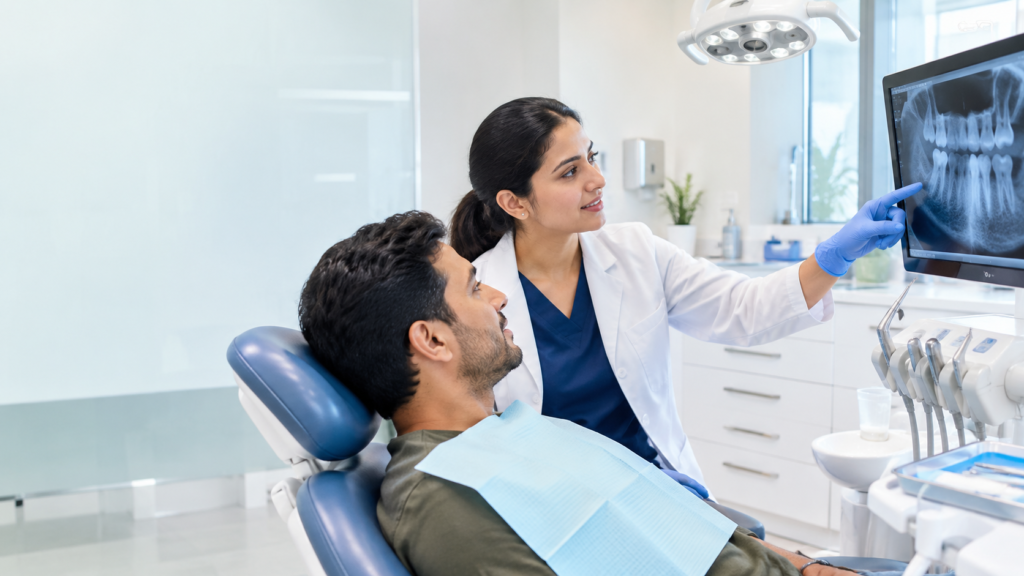
Dental X-rays can provide information that cannot always be seen during a normal visual examination.
A dentist may use radiographs to evaluate:
- Tooth roots
- Root shape
- Existing restorations
- Deep decay
- Bone around the root
- Previous root canal treatment
- Changes around the root
- The overall anatomy relevant to treatment planning
However, an X-ray should not be interpreted in isolation.
The ADA specifically states that diagnosis and treatment planning should not be based solely on radiographic evidence. Its current guidance emphasizes performing a clinical examination and determining whether imaging is necessary for the individual patient.
11. Periapical X-Ray
A periapical radiograph focuses on the tooth and the area surrounding its root.
It can help the dentist examine:
- The complete tooth
- Root structure
- Surrounding bone
- Possible changes around the root
- Root canal anatomy
- Existing dental treatment
Periapical radiographs are commonly relevant when investigating suspected endodontic problems.
The AAE identifies diagnostic-quality intraoral radiographs as an important component of evaluating suspected endodontic conditions.
12. Bitewing X-Ray
A bitewing radiograph is particularly useful for evaluating certain areas between teeth and the crowns of the teeth.
Depending on the clinical situation, it may help identify:
- Interproximal decay
- Existing restorations
- Changes that may not be obvious during a visual examination
Whether a bitewing is appropriate depends on what the dentist is trying to investigate.
13. CBCT Scan: Is It Always Needed?
A cone-beam computed tomography, or CBCT, scan creates a three-dimensional image.
It may provide additional information in selected complex cases, but it is not automatically required for every root canal diagnosis.
For example, additional 3-D imaging may be considered when conventional examination and 2-D imaging do not provide enough information for a particular clinical question.
The ADA’s 2026 recommendations emphasize using CBCT and other dental radiography based on clinical need and balancing diagnostic benefit against radiation exposure.
This means your dentist should determine whether a CBCT would actually add useful diagnostic information in your case.
Root Canal Diagnosis: What Happens During the Appointment?
If you visit a dentist for suspected root canal problems near Sector 75 Noida, your appointment may follow a process such as:
Step 1: Discuss your symptoms
You explain where the pain is, what triggers it and how long it lasts.
Step 2: Clinical examination
The dentist examines the tooth, gums and surrounding tissues.
Step 3: Compare nearby teeth
Control teeth may be tested to help interpret the response from the suspected tooth.
Step 4: Perform appropriate diagnostic tests
These may include cold testing, electric pulp testing, percussion, palpation, periodontal probing or bite testing.
Step 5: Take appropriate dental imaging
An X-ray or other imaging may be recommended when clinically necessary.
Step 6: Establish the diagnosis
The dentist considers the combined evidence rather than relying on one test.
Step 7: Discuss treatment options
Depending on the findings, treatment could include monitoring, restorative treatment, root canal treatment, periodontal treatment, or another appropriate approach.
Does Every Toothache Require a Root Canal?
No.
A toothache can have several possible causes, and only a dental examination can determine what is happening.
For example, sensitivity may be associated with decay, exposed dentin, a restoration problem or pulp inflammation. Pain on biting may be associated with several different dental conditions.
This is why patients should avoid assuming that they need a root canal simply because they have tooth pain.
The Dental Crowns’ existing guidance similarly emphasizes consultation and diagnosis before deciding that root canal treatment is necessary.
When Should You Seek a Dental Examination?
Consider arranging a dental examination if you experience:
- Persistent toothache
- Prolonged hot or cold sensitivity
- Pain while chewing
- Pain when biting
- Swelling around a tooth
- Gum tenderness
- A dark or discolored tooth
- A chipped or cracked tooth
- Recurring dental pain
- A previously treated tooth that has become painful again
Some symptoms require more urgent attention.
If dental pain is accompanied by rapidly increasing facial swelling, difficulty breathing, difficulty swallowing, or significant swelling around the mouth or neck, seek urgent medical or dental care.
Root Canal Diagnosis Near Sector 75 Noida: What Should You Ask Your Dentist?
Before starting treatment, you can ask:
1. What is causing my tooth pain?
Ask the dentist to explain the suspected source of the symptoms.
2. Do I definitely need root canal treatment?
Understanding the diagnosis can help you understand why RCT is being recommended.
3. Which tests were performed?
Ask what the clinical tests and imaging showed.
4. Do I need an X-ray or CBCT?
Your dentist can explain what information the imaging is expected to provide.
5. Can the tooth be restored?
A root canal is only one part of treatment planning. The dentist should also evaluate whether the tooth can be appropriately restored.
6. Will I need a dental crown after RCT?
Depending on the tooth and the amount of remaining structure, a final restoration may be recommended.
You can learn more about Dental Crown Treatment and Services at The Dental Crowns.
Why Choose a Nearby Dental Clinic for Diagnosis?
For residents of Sector 75 Noida, accessibility can be useful when dental treatment requires more than one appointment.
Patients may compare clinics based on factors such as:
- Location
- Diagnostic approach
- Available dental services
- Dentist’s qualifications
- Treatment options
- Follow-up arrangements
- Emergency accessibility
- Overall treatment planning
The Dental Crowns is located at Civitech Stadia, Sector 79, Noida, and its listed services include root canal treatment, dental crowns, dental implants, bridges, dentures, braces, veneers, teeth whitening and laser dentistry.
Residents searching for root canal treatment near Sector 75 Noida may therefore consider nearby Sector 79 as well when comparing available dental services.
Root Canal Diagnosis Near Sector 75 Noida – FAQs
How is a root canal diagnosed?
A root canal-related condition is diagnosed using a combination of symptoms, clinical examination, pulp sensibility tests, periradicular tests, periodontal assessment and appropriate dental imaging.
Is an X-ray always required for root canal diagnosis?
Not necessarily. The dentist determines whether imaging is clinically necessary based on your symptoms and examination findings. The ADA recommends selecting dental radiographs according to individual clinical needs.
What does a cold test tell the dentist?
A cold test evaluates the tooth’s response to a thermal stimulus. It is a pulp sensibility test and must be interpreted alongside other findings.
What is an electric pulp test?
It is a test that applies a controlled electrical stimulus to the tooth and records whether the patient perceives a response. It does not directly measure the exact health of the pulp.
Can a cracked tooth look like a root canal problem?
Yes. Cracked teeth and pulpal conditions can produce overlapping symptoms, which is why dentists may use several tests to identify the source.
Is CBCT necessary for every root canal?
No. CBCT is generally considered when additional 3-D information is clinically useful. Current ADA recommendations emphasize selecting imaging based on individual clinical needs.
Does tooth pain always mean I need an RCT?
No. Tooth pain can have several causes. A dentist should determine the cause before recommending root canal treatment.
Can I get a root canal near Sector 75 Noida?
Patients in Sector 75 can explore dental clinics in Sector 75 and nearby Noida sectors. The Dental Crowns provides root canal treatment at its clinic in Sector 79, Noida.
Final Takeaway
If you are searching for root canal diagnosis near Sector 75 Noida, remember that diagnosis involves more than simply taking an X-ray or asking where the tooth hurts.
Depending on your symptoms, a dentist may perform a clinical examination, cold or heat testing, electric pulp testing, percussion, palpation, periodontal probing, bite testing and dental imaging.
The most important point is that no single test should automatically determine whether you need a root canal. The dentist considers your symptoms, clinical findings and imaging together to develop an appropriate diagnosis and treatment plan.
If you have persistent tooth pain, sensitivity, swelling or pain while chewing, consider scheduling a professional dental examination rather than trying to diagnose the problem yourself.
For patients around Sector 75 Noida, you can explore The Dental Crowns’ dental services and Painless Root Canal Treatment to learn more about available treatment options.