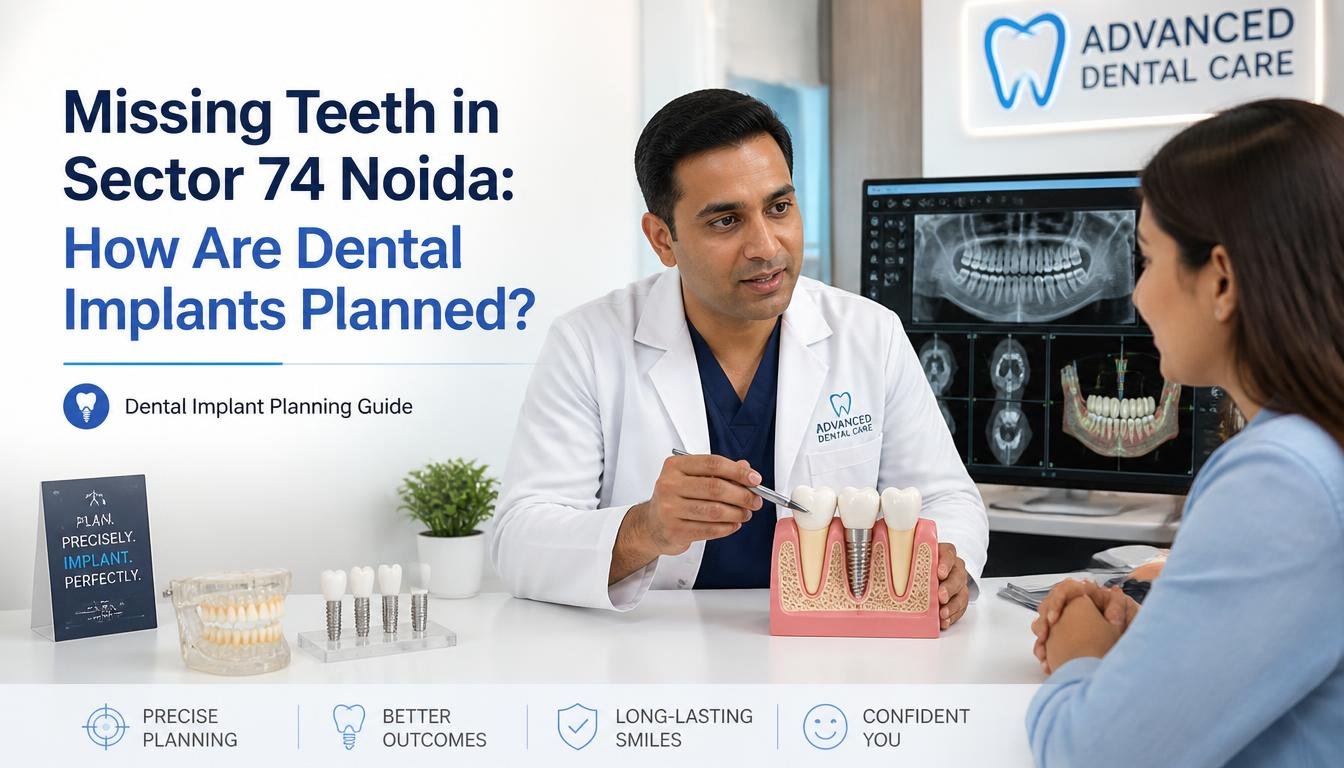
Having one or more missing teeth can affect chewing, speech, appearance, and the way your remaining teeth function. If you live in Sector 74 Noida and are considering dental implants, one of the most important questions is not simply “How much does a dental implant cost?” but “How is my dental implant treatment planned?”
Dental implant treatment involves more than placing an implant into the jaw. Before treatment begins, a dentist needs to assess the missing-tooth area, gums, jawbone, neighbouring teeth, bite, and overall oral condition. Diagnostic imaging may also be recommended to understand the anatomy of the proposed implant site.
For patients looking for dental implants near Sector 74 Noida, understanding the planning process can make a consultation much easier and help you know what questions to ask.
The Dental Crowns provides dental implant treatment in Noida and lists implants among its surgical dentistry services. Its clinic is located at Civitech Stadia, Sector 79, Noida.
What Are Dental Implants?
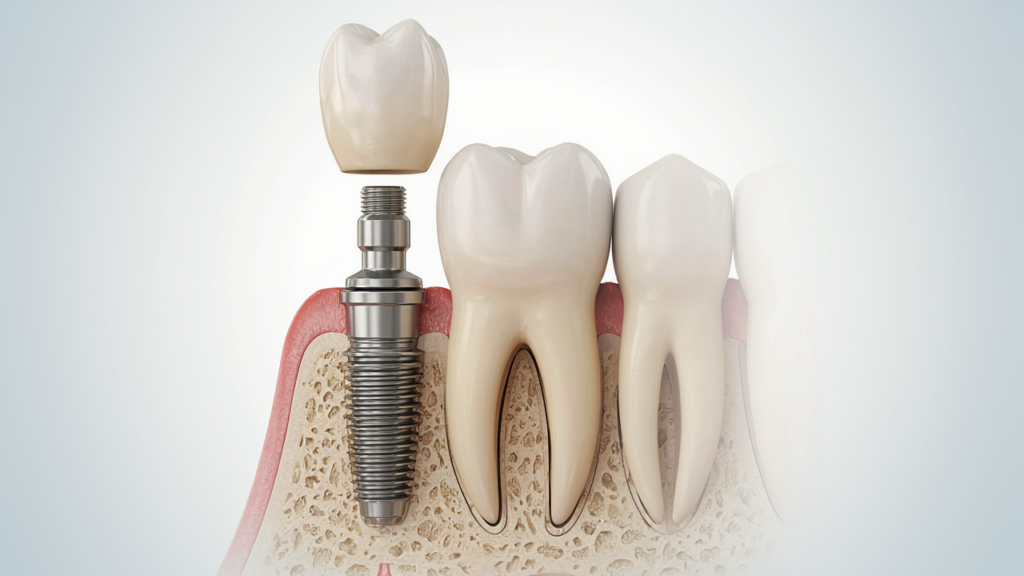
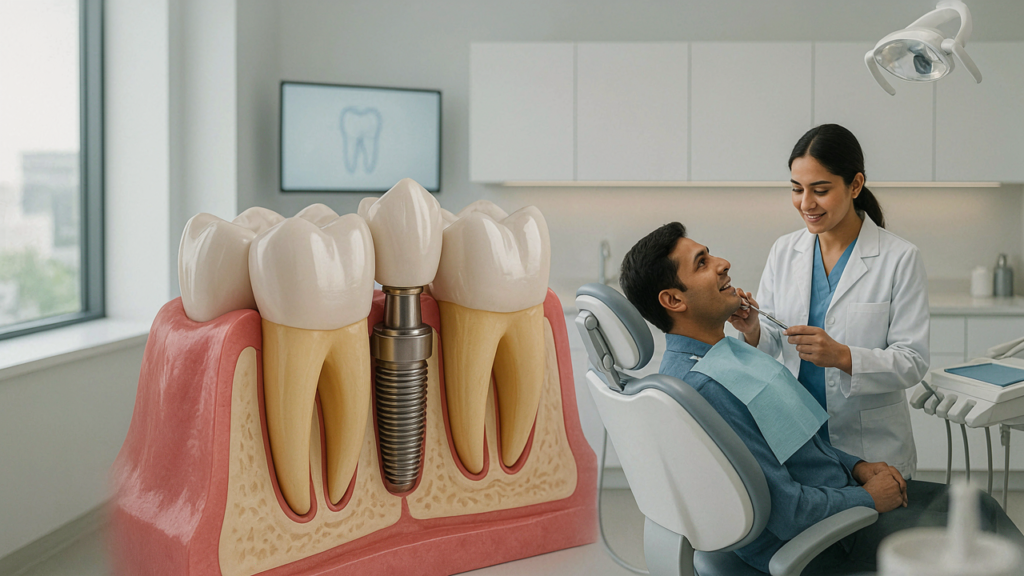
A dental implant is a tooth-replacement component designed to replace the root portion of a missing tooth. It is placed into the jawbone and can subsequently support a restoration such as a dental crown.
A conventional implant-supported tooth generally involves three main components:
- Dental implant – the implant fixture placed into the jawbone.
- Abutment – the connector between the implant and restoration.
- Dental crown – the visible tooth-shaped restoration that replaces the missing tooth.
The exact design of treatment depends on the patient’s dental condition, the number and location of missing teeth, available bone, gum health, bite, and the planned final restoration.
The Dental Crowns’ dedicated implant service describes dental implants as a solution for replacing missing teeth and emphasizes individualized treatment planning.
How Are Dental Implants Planned for Missing Teeth in Sector 74 Noida?
Dental implant planning generally begins with diagnosis rather than surgery.
Here is what the process may involve.
1. Initial Dental Consultation
The first stage is a comprehensive dental examination.
Your dentist may assess:
- The location of the missing tooth
- How long the tooth has been missing
- The condition of the gums
- The condition of neighbouring teeth
- The available jawbone
- Your bite and tooth alignment
- Existing dental restorations
- Signs of infection or inflammation
- Your overall oral-health requirements
The purpose of this assessment is to determine whether an implant is appropriate and what type of treatment plan may be required.
If you are searching for dental implants in Sector 74 Noida, it is useful to bring previous dental records or X-rays to your consultation if you have them.
2. Assessment of the Jawbone
One of the most important parts of implant planning is assessing the bone at the proposed implant site.
When a tooth is lost, the bone surrounding the former tooth root can change over time. The amount and shape of available bone can therefore influence implant planning.
Your dentist may need to determine:
- Whether there is sufficient bone for the proposed implant
- The width of the available bone
- The height of the bone
- The position of important anatomical structures
- Whether additional procedures may be necessary
A patient who has had a missing tooth for several years may therefore require a different treatment plan from someone who has recently lost a tooth.
This is one reason why an individualized assessment is important.
Is Imaging Needed Before Dental Implant Placement?
Diagnostic imaging can play an important role in implant treatment planning.
Depending on the case, your dentist may recommend dental X-rays or three-dimensional imaging such as a CBCT scan.
Imaging can help the dental team evaluate the proposed implant site and surrounding anatomy before surgery.
The exact type of imaging required depends on the patient’s individual case and the information needed for treatment planning.
A scan should not be viewed as a substitute for a clinical examination. Instead, imaging and clinical findings are considered together when developing a treatment plan.
3. Checking Gum Health Before Dental Implants
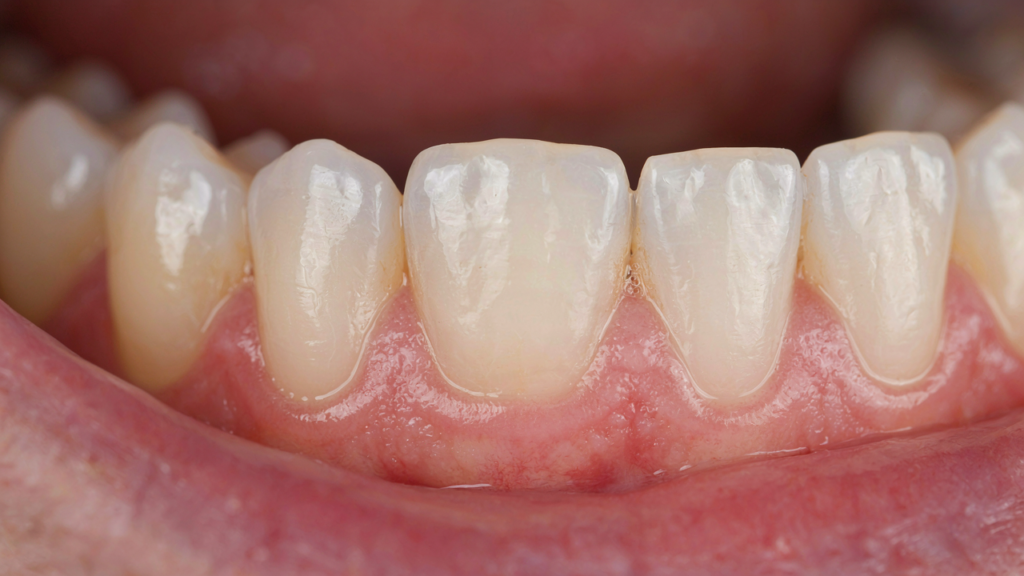
Healthy gums are an important part of successful oral rehabilitation.
If you have gum inflammation, periodontal disease, significant plaque accumulation, or another active oral-health problem, your dentist may recommend addressing that issue before proceeding with implant treatment.
During the consultation, your dentist may therefore evaluate:
- Gum condition
- Signs of periodontal disease
- Oral hygiene
- Bone support around neighbouring teeth
- Existing infections
- Overall periodontal health
This is particularly important because the implant will eventually function within the same oral environment as your natural teeth.
4. Evaluating the Teeth Around the Missing Tooth
The missing-tooth area is not considered in isolation.
Your dentist may also examine the teeth next to the gap and the opposing teeth.
For example, the treatment plan may need to consider:
- Position of neighbouring teeth
- Existing crowns or fillings
- Tooth alignment
- Bite relationships
- Tooth wear
- Signs of infection
- Space available for the final crown
This helps the dentist plan not only where the implant should be placed but also how the final replacement tooth should look and function.
5. Planning the Position of the Dental Implant
Once the clinical examination and diagnostic information are available, the dentist can plan the proposed implant position.
The implant needs to be positioned according to the patient’s anatomy and the requirements of the final restoration.
The planning process may consider:
- Bone availability
- Implant size
- Implant position
- Angle and depth
- Location of neighbouring structures
- Space required for the crown
- Aesthetic requirements
- Functional requirements
The objective is not simply to place an implant wherever there is a gap. The implant position needs to work with the surrounding anatomy and the planned restoration.
6. Planning the Dental Crown
The implant is only one part of the finished replacement tooth.
The final dental crown also needs to be planned.
Your dentist and restorative team may consider:
- Crown shape
- Crown size
- Tooth shade
- Position of the gumline
- Bite
- Relationship with neighbouring teeth
- Smile aesthetics
- Material options
This is particularly important when the missing tooth is visible when you smile.
For patients who need information about dental crowns, The Dental Crowns also provides crown-related treatments.
What Happens If There Is Not Enough Bone for an Implant?
Not every patient has the same amount of bone at a missing-tooth site.
If the available bone is insufficient for the planned implant, the dentist may discuss additional treatment options.
Depending on the location and clinical situation, these can include procedures intended to improve the available foundation for implant placement.
The need for such treatment cannot be determined accurately without examining the patient and reviewing appropriate diagnostic information.
Therefore, if you have been told that you have bone loss after tooth extraction, ask your dentist:
- How much bone is available?
- Is bone augmentation necessary?
- Can the implant be placed immediately or later?
- How could additional treatment affect the overall timeline?
- What alternatives are available?
7. Deciding Whether Immediate or Delayed Implant Placement Is Appropriate
The timing of implant placement can vary.
In some situations, an implant may be considered shortly after tooth removal. In other situations, the dentist may recommend allowing the area to heal before implant placement.
The decision can depend on factors such as:
- Condition of the extraction site
- Presence of infection
- Bone quality and quantity
- Gum condition
- Tooth location
- Overall treatment plan
There is therefore no universal rule that every missing tooth should receive an implant immediately.
Your dentist should determine the timing after evaluating the individual site.
8. Planning for Healing and Osseointegration
After implant placement, the implant needs time to integrate with the surrounding bone.
This biological process is known as osseointegration.
The healing period can vary between patients and depends on factors including the implant site, bone condition, treatment complexity, and individual healing.
During this stage, your dentist will determine when the implant is ready for the next restorative step.
This means that dental implant treatment may involve several stages rather than being completed in a single appointment.
How Long Does Dental Implant Treatment Take?
There is no single treatment timeline for every patient with missing teeth in Sector 74 Noida.
The total treatment period can depend on:
- Number of missing teeth
- Location of the missing teeth
- Bone condition
- Gum health
- Whether extraction is required
- Whether additional procedures are required
- Implant stability
- Healing and osseointegration
- Type of final crown or restoration
Some straightforward cases may progress faster than more complex cases.
Patients should therefore be cautious about assuming that every implant treatment can be completed within exactly the same number of days or weeks.
A personalized consultation provides a more useful estimate.
Dental Implants vs Dental Bridges for Missing Teeth
Dental implants are not the only way to replace a missing tooth.
Depending on the patient’s circumstances, alternatives may include:
- Dental bridges
- Dentures
- Implant-supported restorations
A traditional dental bridge generally uses neighbouring teeth for support, whereas a dental implant is designed to replace the root portion of the missing tooth.
The appropriate option depends on the patient’s oral condition, treatment goals, budget, anatomy, and clinical assessment.
You can read more about the differences between implants and bridges in our guide: Dental Implants vs Dental Bridges
The Dental Crowns also provides Dental Bridges Treatment in Noida as part of its restorative dental services.
What Can Affect Dental Implant Cost in Sector 74 Noida?
The cost of dental implants is not determined by the implant alone.
The total treatment cost may depend on:
- Number of implants
- Implant system selected
- Type of abutment
- Crown material
- Diagnostic imaging
- Tooth extraction, if required
- Bone-related procedures, if required
- Complexity of the case
- Laboratory charges
- Follow-up requirements
If you are comparing dental implant cost in Sector 74 Noida, make sure you understand what each quotation includes.
For example, one quotation may include the implant, abutment and crown, while another may quote only one component.
The Dental Crowns has also published a detailed guide explaining factors that can affect dental implant costs in Noida Sector 74. Read: Dental Implant Cost in Noida Sector 74
Questions to Ask Before Getting Dental Implants Near Sector 74 Noida
Before starting treatment, consider asking your dentist:
1. Am I a suitable candidate for a dental implant?
Your dentist can assess your gums, bone, bite, oral health and treatment requirements.
2. Do I need a CBCT scan?
Ask why a particular diagnostic scan is recommended and what information it provides for your treatment.
3. Do I have sufficient bone?
If not, ask whether bone-related treatment is required.
4. What type of implant will be used?
Ask about the implant system and why it is appropriate for your case.
5. Which crown will be placed?
Discuss the available crown materials and their suitability.
6. How long will my complete treatment take?
Ask for an estimated timeline based on your individual treatment plan rather than a generic estimate.
7. What is included in the quoted cost?
Confirm whether the price includes:
- Consultation
- Imaging
- Implant
- Abutment
- Crown
- Surgery
- Additional procedures
- Follow-up appointments
8. What alternatives do I have?
A professional consultation should allow you to understand whether an implant, bridge, denture, or another treatment option is appropriate for your situation.
Dental Implant Planning for Patients From Sector 74, 75, 76, 77 and 78 Noida
Although this article focuses on missing teeth in Sector 74 Noida, patients from nearby areas may also search for dental implants in:
- Sector 75 Noida
- Sector 76 Noida
- Sector 77 Noida
- Sector 78 Noida
- Sector 79 Noida
The Dental Crowns is located in Civitech Stadia, Sector 79, Noida, and provides dental implants along with general, cosmetic and surgical dental services.
For patients in surrounding sectors, choosing a clinic that is convenient for both the initial consultation and subsequent follow-up appointments can be practical.
What If a Missing Tooth Was Caused by Infection?
Sometimes a tooth is lost because of severe decay, infection, trauma, or another dental problem.
If another tooth is currently painful, swollen, or infected, it should be evaluated rather than assuming that an implant is immediately required.
In some situations, preserving a natural tooth may be possible.
For example, root canal treatment can sometimes be used to treat an infected tooth and preserve the natural tooth when the tooth is clinically restorable.
The Dental Crowns provides Painless Root Canal Treatment in Noida as one of its dental services.
This is why diagnosis should come before deciding on tooth extraction or implant placement.
How Should You Care for Dental Implants After Treatment?
Once your implant restoration has been completed, maintaining good oral hygiene remains important.
Your dentist may recommend:
- Brushing twice daily
- Cleaning between the teeth
- Following specific implant-care instructions
- Attending regular dental examinations
- Maintaining healthy gums
- Avoiding habits that could damage the restoration
- Following your dentist’s recommendations for professional cleaning
Dental implants should not be treated as completely maintenance-free.
Your dentist can advise you about the appropriate follow-up schedule for your particular restoration.
Why Proper Dental Implant Planning Matters
Dental implant treatment is a combination of diagnosis, surgical planning and restorative planning.
For someone with missing teeth in Sector 74 Noida, the process may involve:
Consultation → Oral examination → Diagnostic imaging → Bone and gum assessment → Implant planning → Implant placement → Healing → Abutment/restoration → Final dental crown → Follow-up care
Every patient’s pathway can be different.
The important point is that implant placement should be based on the patient’s anatomy and dental requirements rather than a standard one-size-fits-all procedure.
Dental Implants Near Sector 74 Noida: Book a Consultation
If you have one or more missing teeth and are considering dental implants, the first step is a professional dental evaluation.
At The Dental Crowns, patients can discuss their missing-tooth concerns and receive an individualized assessment of possible tooth-replacement options.
The clinic is located at:
The Dental Crowns
Shop No. 16, 1st Floor, Civitech Stadia
Sector 79, Noida, Uttar Pradesh 201301
Phone: +91 89202 71787
Before starting treatment, discuss your oral health, available bone, gum condition, implant options, expected treatment stages, costs, alternatives and aftercare with your dentist.
Frequently Asked Questions
Is a dental implant suitable for everyone with a missing tooth?
No. Suitability depends on factors such as oral health, gum condition, available bone, bite, overall treatment requirements and other individual considerations. A dental professional needs to assess your situation before recommending an implant.
How is a dental implant planned?
Planning generally involves a clinical examination, assessment of the gums and jawbone, evaluation of neighbouring teeth and bite, appropriate diagnostic imaging, and planning for the final restoration.
Do I need a CBCT scan before a dental implant?
Not every patient necessarily requires the same type of imaging. Your dentist can recommend appropriate imaging based on the clinical situation and the information needed for treatment planning.
Can dental implants replace multiple missing teeth?
Implant treatment can be used in different tooth-replacement situations, including some cases involving multiple missing teeth. The number and position of implants required depend on the individual treatment plan.
How long does a dental implant take?
The overall timeline varies. Bone condition, gum health, healing, implant stability, additional procedures and the type of final restoration can all affect treatment duration.
Are dental implants better than bridges?
Neither option is universally appropriate for every patient. Implants and bridges have different treatment requirements, benefits, limitations and costs. Your dentist can compare the options based on your oral condition.
What happens if I don’t have enough bone?
Your dentist may discuss additional procedures intended to improve the foundation for implant placement, or alternative treatment options may be considered. The appropriate approach depends on your anatomy and clinical findings.
Can a dental crown be placed over an implant?
Yes. A dental crown can be used as the visible restoration supported by a dental implant in appropriate single-tooth replacement cases.
Where can patients from Sector 74 Noida get dental implant treatment?
The Dental Crowns provides dental implant treatment at its clinic in Civitech Stadia, Sector 79, Noida. Patients from Sector 74 and surrounding Noida sectors can contact the clinic for a consultation and individual assessment.