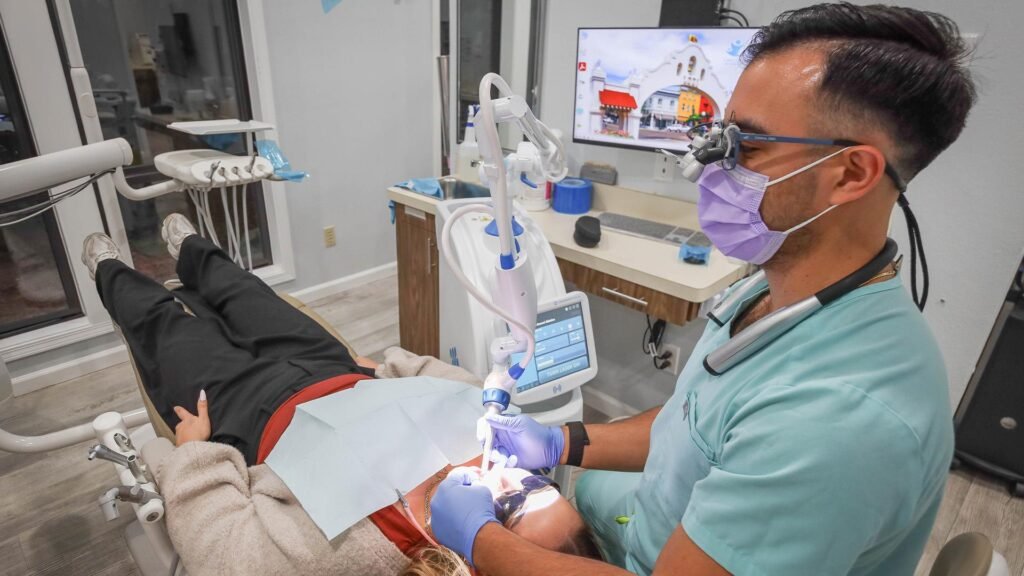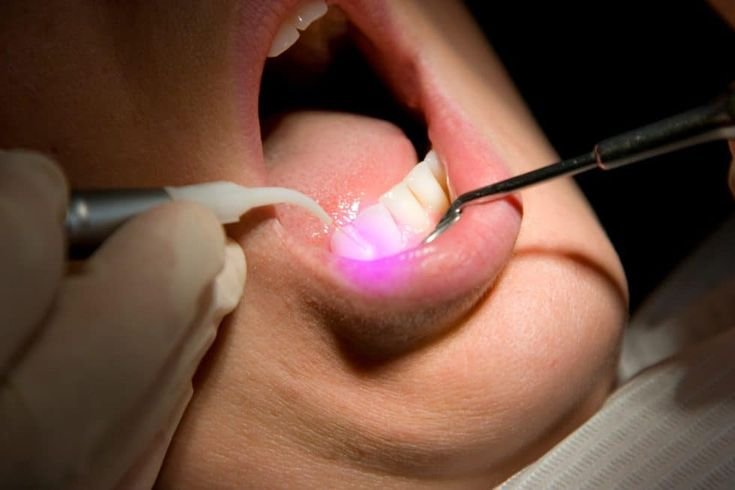


If the thought of dental drills, injections, bleeding, or lengthy recovery makes you nervous about visiting a dentist, laser dentistry near Noida Sector 77 may offer a more comfortable alternative for certain dental procedures. Modern dental lasers use concentrated light energy to work on specific hard or soft tissues with a high degree of precision.
Laser dentistry does not completely replace conventional dental instruments. Instead, it can complement traditional techniques where clinically appropriate. Current evidence and professional guidance describe applications in areas such as periodontal treatment, cavity management, endodontic disinfection, soft-tissue procedures, and some restorative treatments.
For residents of Sector 77 and nearby areas, The Dental Crowns provides advanced clinical laser dentistry as part of its range of dental services. Its clinic is located at Civitech Stadia, Sector 79, Noida, making it accessible to patients from Sector 77 and surrounding sectors.
What Is Laser Dentistry?
Laser dentistry is a modern dental treatment technique that uses focused light energy to interact with dental tissues. Depending on the type of laser and the treatment, it can be used on soft tissue, hard tissue, or both.
Unlike the common misconception that lasers are suitable for every dental procedure, they are generally used as an adjunct or alternative technique for selected procedures. Cleveland Clinic also notes that dental lasers complement rather than completely replace traditional dental instruments.
Laser technology can be considered for procedures such as:
- Gum treatment and reshaping
- Selected cavity and hard-tissue procedures
- Root canal disinfection
- Treatment of certain soft-tissue conditions
- Dental sensitivity management
- Some cosmetic dental procedures
- Selected periodontal procedures
- Certain restorative preparations
The exact application depends on the patient’s dental condition, the type of laser available, and the dentist’s clinical assessment.
How Does Laser Dentistry Improve Dental Treatment Near Noida Sector 77?
1. Greater Precision During Treatment
One of the biggest advantages of dental lasers is their ability to target specific areas of tissue. This can help dentists perform selected procedures while minimizing unnecessary interaction with surrounding tissues.
Research reviews have identified precision and minimally invasive treatment among the potential advantages of contemporary laser technology in dentistry.
For patients searching for advanced dental treatment near Noida Sector 77, this precision can be particularly useful when the dentist needs to work on a small or sensitive area.
2. Potentially Less Discomfort
Dental anxiety is common, especially when patients associate dentistry with drills, vibrations, needles, or discomfort.
Depending on the procedure, laser dentistry may reduce discomfort and the need for local anesthesia. A recent systematic review found that laser-assisted procedures can provide reduced patient discomfort in some applications, although results vary according to the procedure and laser system used.
The Dental Crowns specifically offers advanced clinical laser dentistry with a focus on comfortable and minimally invasive treatment.
3. Reduced Bleeding in Certain Soft-Tissue Procedures
When lasers are used for appropriate soft-tissue procedures, their energy can help coagulate blood vessels during treatment. This can result in less bleeding compared with some conventional techniques.
The Indian Dental Association describes dental lasers as useful in soft-tissue procedures and notes potential benefits including minimized bleeding, reduced need for sutures in certain procedures, bacterial reduction, and faster healing.
However, the amount of bleeding and recovery time depends on the specific procedure and individual patient.
4. Minimally Invasive Dental Treatment
Modern dentistry increasingly focuses on preserving healthy tooth and gum structures whenever possible.
Laser technology can support minimally invasive approaches in selected cases. A recent FDI-related review describes applications of lasers in caries management, endodontics, periodontal treatment, prosthodontics, and other areas while emphasizing appropriate training, safety, and evidence-based use.
This makes laser dentistry an interesting option for patients looking for minimally invasive dental treatment in Noida Sector 77.
5. Better Bacterial Control in Selected Treatments
Dental lasers can also have applications in bacterial reduction and disinfection.
For example, lasers may be used as an adjunct during root canal treatment to help disinfect areas of the root canal system. Cleveland Clinic notes that dental lasers can be used to help kill bacteria during root canal procedures.
If you are experiencing severe tooth pain or infection, however, laser treatment should not be assumed to be a replacement for a complete root canal procedure. A dentist needs to examine the tooth and determine the appropriate treatment.
You can also explore our Painless Root Canal Treatment and other restorative dentistry options.
6. Faster and More Comfortable Healing in Certain Cases
Another potential benefit of laser treatment is improved healing following selected soft-tissue procedures.
The FDI review identifies wound-healing and biological responses as areas where laser technology can provide clinical benefits, while also emphasizing that outcomes depend on the laser type, settings, and clinical protocol.
Therefore, rather than promising that every laser treatment heals faster, it is more accurate to say that certain laser procedures may support a smoother recovery.
7. Useful for Patients With Dental Anxiety
If you avoid dental appointments because of the sound and vibration associated with traditional drills, laser dentistry may make some treatments more comfortable.
The absence of the traditional drill sensation in selected procedures can be helpful for patients who are particularly anxious about dental treatment.
However, not every dental procedure can be performed with a laser. Your dentist should first determine whether laser treatment is clinically suitable.
What Dental Problems Can Laser Dentistry Treat?
Laser technology has a wide range of potential applications in dentistry.
Gum Disease
Dental lasers can be used in selected periodontal procedures to remove or manage diseased tissue and assist with bacterial control.
Patients with swollen, bleeding, or infected gums may benefit from a professional periodontal evaluation before deciding whether laser treatment is appropriate.
Dental Cavities
Certain dental lasers can be used for selected hard-tissue procedures, including caries removal.
A recent systematic review found that erbium lasers can effectively remove carious tissue in appropriate circumstances, although clinical studies vary and conventional rotary instruments remain important in dental care.
Root Canal Treatment
Lasers can be used as an adjunct for root canal disinfection. Their purpose may include improving bacterial control within the treated canal system.
For patients searching for laser root canal treatment near Noida Sector 77, it is important to understand that the laser is generally one component of treatment rather than a replacement for proper cleaning, shaping, filling, and sealing of the root canal.
Gum Reshaping
Laser technology can be used for selected soft-tissue procedures, including gum contouring and reshaping.
This may be useful when excessive gum tissue affects the appearance of the smile or when soft-tissue modification is required as part of another dental procedure.
Dental Sensitivity
Some dental lasers have also been investigated for dentin hypersensitivity. The Indian Dental Association notes that laser interaction with tissue may help reduce sensitivity in appropriate cases.
Laser Dentistry vs Traditional Dental Treatment
A common question among patients is: Is laser dentistry better than traditional dentistry?
The answer is not always one or the other.
Traditional dental instruments remain highly effective and are still necessary for many treatments. Lasers can provide additional options for selected procedures.
| Feature | Laser Dentistry | Conventional Dentistry |
|---|---|---|
| Precision | High precision for suitable procedures | Effective and well established |
| Bleeding | May reduce bleeding in selected soft-tissue procedures | Depends on procedure |
| Anesthesia | May reduce the need in selected cases | Often required depending on treatment |
| Tissue preservation | Can support minimally invasive treatment | Also possible with modern techniques |
| Recovery | May be faster for certain procedures | Depends on treatment |
| Applicability | Procedure and laser dependent | Broad range of applications |
| Technology | Requires specialized equipment and training | Widely available |
The most appropriate method should be selected after a professional examination rather than based solely on whether a treatment uses a laser.
Our recent guide on Laser Dentistry Near Noida Sector 76: Is It Better Than Traditional Dentistry? also explains why laser and conventional dentistry should be viewed as complementary approaches rather than simple competitors.
Why Choose The Dental Crowns for Laser Dentistry Near Noida Sector 77?
For patients living in Sector 77, choosing a dental clinic nearby can make regular dental care more convenient.
The Dental Crowns offers advanced clinical laser dentistry in Noida and lists laser dentistry among its surgical dentistry services. The clinic is located at Shop No. 16, 1st Floor, Civitech Stadia, Sector 79, Noida.
The clinic highlights:
- Advanced laser technology
- Minimally invasive treatment
- Patient-focused dental care
- Comfortable treatment experience
- Comprehensive dental services
Patients can also explore related services such as dental implants, dental crowns, root canal treatment, braces, veneers, teeth whitening, dentures, and tooth-coloured restorations.
What Happens During a Laser Dental Appointment?
A typical appointment may involve several steps:
Step 1: Dental Examination
The dentist examines your teeth, gums, and overall oral health.
Step 2: Diagnosis
Depending on your symptoms, dental imaging or other diagnostic procedures may be recommended.
Step 3: Treatment Planning
The dentist determines whether conventional treatment, laser-assisted treatment, or a combination of techniques is most suitable.
Step 4: Laser Procedure
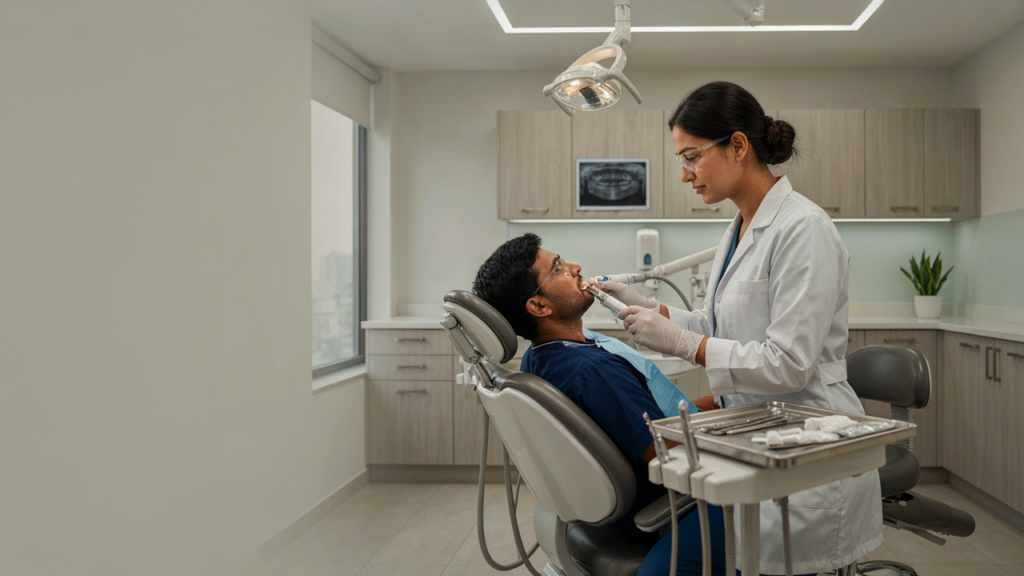
If laser treatment is appropriate, the dentist uses the selected laser system and settings for the specific procedure.
Step 5: Aftercare
You receive instructions regarding eating, brushing, medication, oral hygiene, and follow-up care where necessary.
The exact process varies considerably according to the dental problem being treated.
Is Laser Dentistry Completely Painless?
Laser dentistry is often promoted as “painless dentistry,” but it is important to keep expectations realistic.
Many laser procedures can be more comfortable than conventional approaches, and some may require less anesthesia. However, no dental procedure can be guaranteed to be completely painless for every patient.
Pain and sensitivity depend on:
- Type of dental procedure
- Location of treatment
- Severity of infection or disease
- Laser wavelength and settings
- Individual pain sensitivity
- Whether anesthesia is required
The goal is to make treatment as comfortable and minimally invasive as clinically appropriate.
Is Laser Dentistry Safe?
When performed by a properly trained dental professional using appropriate equipment and safety protocols, dental laser treatment can be a safe clinical option for indicated procedures.
Professional guidance emphasizes appropriate training, laser safety, and evidence-based selection of laser applications.
Patients should therefore ask their dentist:
- Is laser treatment appropriate for my condition?
- What type of laser will be used?
- Why is laser treatment recommended?
- Are there conventional alternatives?
- What should I expect during recovery?
Who May Benefit From Laser Dentistry?
Laser dentistry may be worth discussing with your dentist if you:
- Experience dental anxiety
- Have gum problems
- Need selected soft-tissue treatment
- Require certain periodontal procedures
- Need treatment involving bacterial disinfection
- Have dental sensitivity
- Want minimally invasive treatment where appropriate
- Prefer modern technology for suitable dental procedures
Children, adults, and older patients may all be candidates for laser treatment, but suitability should always be determined individually.
How Much Does Laser Dentistry Cost Near Noida Sector 77?
The cost of laser dentistry in Noida varies depending on the procedure.
Factors affecting the cost can include:
- Type of dental treatment
- Type of laser used
- Number of teeth involved
- Severity of the dental problem
- Whether additional treatment is required
- Diagnostic procedures
- Dentist’s expertise and clinical protocol
For this reason, it is better to obtain a personalized estimate after examination rather than relying on a generic online price.
How to Find the Right Laser Dentist Near Noida Sector 77
Before choosing a clinic, consider:
Check the Dentist’s Experience
Ask whether the dentist has appropriate training and experience with the specific laser procedure you require.
Understand the Treatment Plan
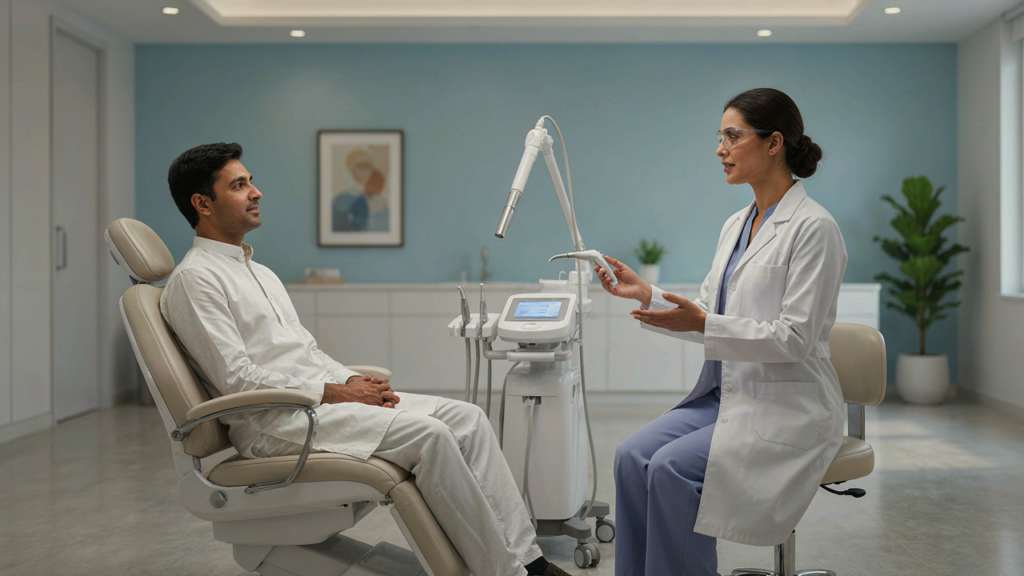
A good dentist should explain why laser treatment is recommended and what alternatives are available.
Look for Modern Equipment
The technology used should be appropriate for the procedure being performed.
Consider Overall Dental Care
Don’t choose a clinic solely because it offers lasers. Look for comprehensive diagnosis, sterilization, communication, follow-up care, and evidence-based treatment.
Choose a Convenient Location
For residents of Sector 77, a clinic in nearby Sector 79 can provide convenient access for consultations and follow-up appointments.
Frequently Asked Questions About Laser Dentistry Near Noida Sector 77
Does laser dentistry replace dental drills?
No. Dental lasers complement conventional dental instruments and cannot replace them for every dental procedure.
Is laser dentistry painful?
Many laser procedures are designed to reduce discomfort, but the experience depends on the procedure and individual patient.
Can lasers be used for root canals?
Yes. Lasers may be used as an adjunct to help disinfect root canals, but conventional root canal procedures may still be required.
Can laser dentistry treat gum disease?
Lasers have applications in periodontal treatment, but the appropriate treatment depends on the severity and type of gum disease.
Does laser dentistry cause bleeding?
Certain soft-tissue laser procedures may reduce bleeding because laser energy can help coagulate blood vessels.
Is laser treatment suitable for children?
Laser dentistry can be used in pediatric dentistry for selected procedures, but the dentist should determine suitability based on the child’s age, condition, and treatment requirements.
How long does laser dental treatment take?
Treatment time depends on the procedure. Some treatments can be completed relatively quickly, while complex dental conditions may require multiple appointments.
Is laser dentistry available near Sector 77 Noida?
Yes. Patients from Sector 77 can explore laser dentistry options at nearby dental clinics, including The Dental Crowns in Sector 79, Noida.
Conclusion: Is Laser Dentistry a Good Option Near Noida Sector 77?
Laser dentistry can improve dental treatment by providing precision, minimally invasive techniques, potentially less discomfort, reduced bleeding in selected procedures, and useful bacterial-control applications.
However, laser treatment is not automatically better for every dental problem. The right treatment depends on your diagnosis, the procedure required, the laser technology available, and your dentist’s clinical judgment.
If you are searching for laser dentistry near Noida Sector 77, The Dental Crowns in Sector 79 offers advanced clinical laser dentistry along with comprehensive general, cosmetic, and surgical dental services.
Book a dental consultation today to find out whether laser dentistry is suitable for your specific dental needs.
Helpful Resources
For readers who want to learn more about dental laser technology, these authoritative resources provide additional information: