
If the thought of dental drills, scalpels, bleeding or lengthy recovery makes you nervous about visiting a dentist, laser dentistry may offer a more comfortable approach for certain dental procedures. But what exactly can dental lasers treat?
Which dental problems can be treated with laser dentistry? Depending on the type of laser, the condition being treated and the dentist’s clinical assessment, lasers may be used for gum disease, selected cavity treatments, root canal disinfection, gum reshaping, frenectomy, dental sensitivity, certain oral lesions and some cosmetic dental procedures.
Laser dentistry is not a replacement for every conventional dental treatment. Instead, it is an advanced technology that can complement traditional dental techniques and allow dentists to work precisely on specific areas of the mouth.
At The Dental Crowns in Noida, laser dentistry is offered as part of the clinic’s advanced dental care services. If you are experiencing gum problems, tooth sensitivity, cavities or another dental concern, a dental examination can help determine whether laser treatment is appropriate for your condition.
Quick Answer: What Dental Problems Can Be Treated With Laser Dentistry?
Laser dentistry may be used for several dental and oral conditions, including:
- Gum disease and certain periodontal problems
- Selected gum surgeries and gum reshaping
- Certain cavities and tooth decay
- Root canal disinfection
- Dental or tooth sensitivity
- Frenectomy and tongue-tie procedures
- Certain mouth ulcers and soft-tissue lesions
- Selected oral tissue procedures
- Teeth whitening in specific treatment protocols
- Preparing teeth or gums for certain restorations
The exact application depends on the type of laser, the patient’s dental condition and the dentist’s treatment plan. The Cleveland Clinic also notes that dental lasers can be used for soft-tissue and hard-tissue applications, including gum disease, selected cavity treatment, root canal disinfection, sensitivity management and certain restorative procedures.
1. Gum Disease and Periodontal Problems
One of the most common areas where dental lasers may be used is gum treatment.
Gum disease develops when bacteria and plaque accumulate around the teeth and gums. Early gum disease may cause redness, swelling and bleeding, while more advanced periodontal disease can lead to gum recession, deep periodontal pockets, bone loss and loose teeth.
Laser technology can be used in selected periodontal procedures to target infected or diseased tissue and bacteria around the teeth.
However, laser treatment does not mean that conventional periodontal treatment is no longer necessary. The American Dental Association identifies scaling and root planing as an important nonsurgical treatment for periodontitis, while the evidence for lasers varies according to the specific technique and clinical situation.
If you have bleeding gums, persistent bad breath, swollen gums or loose teeth, a dentist should evaluate the underlying cause before deciding whether laser treatment is suitable.
Related service: Explore Laser Dentistry at The Dental Crowns
2. Certain Cavities and Tooth Decay
Another question patients frequently ask is: Can laser dentistry treat cavities?
In selected cases, dental lasers can be used to remove decayed tooth structure and prepare an area for restoration. Hard-tissue dental lasers can interact with tooth structures and may be used as part of certain cavity treatments.
The goal of modern cavity treatment is not simply to remove as much tooth structure as possible. The American Dental Association’s restorative caries guideline emphasizes conservative approaches that preserve healthy tooth structure where clinically appropriate.
Whether a cavity can be treated with a laser depends on factors such as:
- Depth and size of the cavity
- Location of the decay
- Condition of the remaining tooth structure
- Whether the pulp has been affected
- Type of laser available
- Required restoration
A dental examination is therefore necessary before choosing laser treatment for tooth decay.
For patients who need a restoration after decay has been removed, a tooth-coloured restoration may be considered depending on the condition of the tooth.
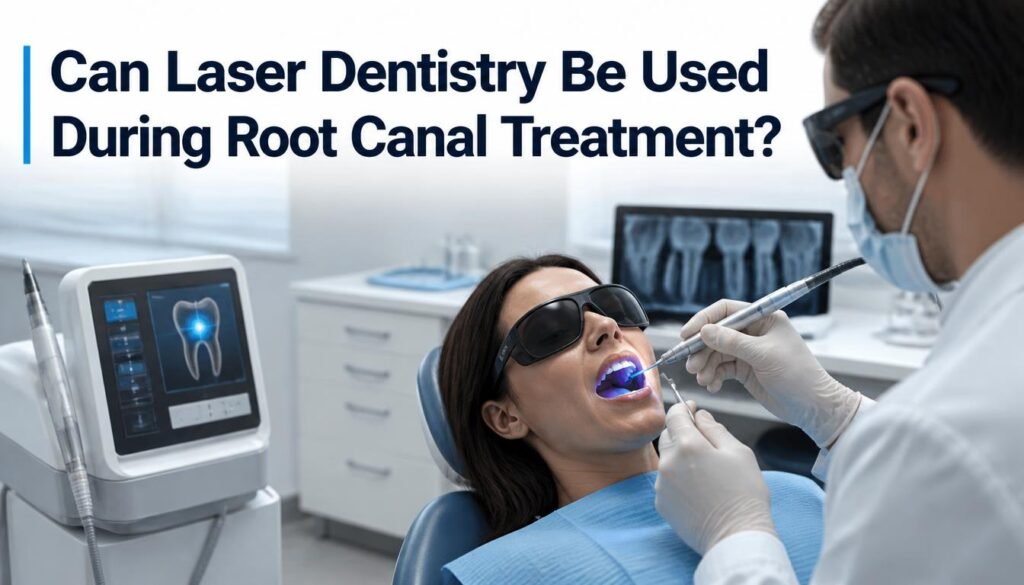
3. Root Canal Disinfection
Can lasers be used during a root canal?
Yes, in selected cases, laser technology may be used as an adjunct to root canal treatment, particularly for disinfection.
During root canal treatment, the infected or inflamed pulp is removed, the root canals are cleaned and disinfected, and the canals are sealed.
A laser can be used to help target bacteria within areas of the root canal system that can be difficult to access.
However, laser technology does not automatically replace the complete root canal procedure. Proper diagnosis, cleaning, shaping, disinfection and sealing remain important components of endodontic treatment.
The Cleveland Clinic notes that lasers may be used to disinfect the area during root canal treatment.
If you have persistent tooth pain, swelling, prolonged sensitivity or pain while chewing, you may need an evaluation for root canal treatment.
You can learn more about the clinic’s Painless Root Canal Treatment in Noida.
4. Tooth Sensitivity
Do you experience a sharp sensation when drinking something cold, eating hot food or consuming sweets?
Dental sensitivity can occur when the protective enamel or gum tissue no longer adequately protects the underlying dentin.
In selected cases, laser treatment may help reduce sensitivity by affecting the microscopic channels, known as dentinal tubules, that contribute to sensitivity.
However, sensitivity can have many causes, including:
- Tooth decay
- Gum recession
- Worn enamel
- Cracked teeth
- Aggressive brushing
- Teeth grinding
- Recent dental treatment
Therefore, simply treating sensitivity without identifying its cause may not solve the underlying problem.
A dental examination can help determine why your teeth are sensitive and whether laser treatment is appropriate.
5. Gum Reshaping and Selected Gum Procedures
Uneven or excessive gum tissue can sometimes affect the appearance of a smile. In selected cases, dental lasers can be used to reshape gum tissue with precision.
Laser gum procedures may be considered for situations such as:
- Uneven gum contours
- Excess gum tissue
- Certain cosmetic gum procedures
- Selected periodontal procedures
Because every smile and gum condition is different, your dentist needs to evaluate the gum line, tooth proportions and overall oral health before recommending treatment.
For patients interested in improving both tooth and gum appearance, laser treatment may sometimes be incorporated into a broader smile makeover plan.
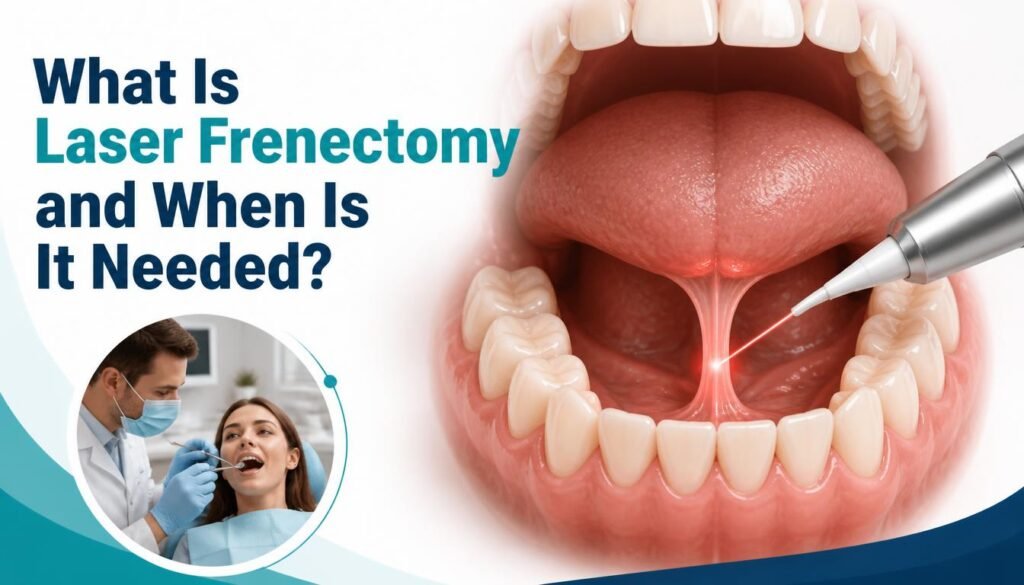
6. Frenectomy and Tongue-Tie Treatment
A frenectomy involves removing or modifying a frenum, which is a small fold of tissue connecting parts of the mouth.
For example, a restrictive lingual frenum may contribute to tongue-tie. Depending on the patient’s age and clinical condition, a dentist may recommend a frenectomy.
Lasers can be used for selected soft-tissue procedures such as frenectomy.
The potential advantages of laser soft-tissue treatment can include precise tissue removal and reduced bleeding in appropriate cases. However, suitability depends on the patient’s anatomy and the dentist’s assessment.
7. Certain Mouth Ulcers and Oral Lesions
Dental lasers may also have applications in treating or removing certain soft-tissue lesions.
Depending on the lesion, a dentist may use a laser for:
- Selected oral lesions
- Certain abnormal tissue growths
- Some mouth ulcers
- Soft-tissue procedures
- Tissue removal or biopsy procedures
It is important not to assume that every mouth ulcer or growth should be treated with a laser.
A sore, lump or lesion that does not heal normally should be examined by a qualified dental professional so that the correct diagnosis can be made.
8. Teeth Whitening
Laser or light-based technology may be used in some professional teeth-whitening protocols to activate or enhance whitening agents.
However, laser dentistry is not synonymous with teeth whitening, and not every whitening treatment requires a laser.
The correct whitening method depends on the condition of your teeth, the type of discoloration and your dentist’s treatment protocol.
If your main concern is tooth discoloration, your dentist can assess whether professional whitening or another cosmetic treatment would provide the most appropriate result.
9. Preparing Teeth and Gums for Dental Restorations
In certain situations, lasers may also be used to reshape soft tissue or prepare areas around teeth before restorations.
For example, laser technology can sometimes help dentists achieve access and tissue control around a tooth that requires a restoration.
Depending on the condition of the tooth, the final restoration could involve a filling, crown or another dental restoration.
If your tooth is severely damaged or weakened, a dental crown may be recommended after the underlying dental problem has been addressed.
What Are the Benefits of Laser Dentistry?
Laser dentistry has become popular because it can offer specific advantages in appropriate cases.
Potential benefits may include:
Precise Treatment
Laser energy can be directed toward a specific treatment area, allowing the dentist to target tissue precisely.
Reduced Bleeding
Certain soft-tissue laser procedures may cause less bleeding because the laser can seal small blood vessels as it works.
Minimal Tissue Trauma
When appropriately used, laser treatment can allow the dentist to work on targeted tissue while limiting unnecessary damage to surrounding areas.
Potentially Faster Healing
Some laser procedures may support tissue healing and recovery, although healing time depends on the procedure and individual patient.
Patient Comfort
Some laser procedures may reduce discomfort and the need for anesthesia, although this varies by treatment.
Reduced Dental Anxiety
For patients who are nervous about the sound and vibration of conventional dental instruments, certain laser procedures may provide a more comfortable experience.
The Cleveland Clinic describes precision, reduced bleeding and potentially shorter healing time among possible benefits, while also emphasizing that lasers complement rather than completely replace traditional dental instruments.
Is Laser Dentistry Completely Painless?
One of the biggest misconceptions about laser dentistry is that every laser procedure is completely painless.
The reality is more nuanced.
Some laser procedures can be very comfortable and may require less anesthesia, but the level of discomfort depends on:
- The dental problem
- The type of laser
- The treatment area
- The depth of treatment
- Individual sensitivity
- Whether conventional instruments are also required
Your dentist should explain what you can expect before treatment.
At The Dental Crowns, the clinic describes its advanced laser dentistry approach as focused on patient comfort, precision and minimally invasive treatment.
Is Laser Dentistry Better Than Traditional Dental Treatment?
Not necessarily.
Laser dentistry should not be viewed as a universal replacement for traditional dentistry.
Different dental conditions require different treatment approaches. In some cases, a laser may be an excellent adjunct; in others, conventional instruments or procedures may be more appropriate.
For example, the ADA’s clinical guidance continues to recognize conventional treatments such as scaling and root planing for periodontitis, while evidence regarding laser use varies by specific application.
The best treatment is the one that correctly addresses the underlying dental problem while preserving oral health and function.
Who May Be a Candidate for Laser Dentistry?
Laser dentistry may be considered for patients who require selected:
- Gum treatments
- Soft-tissue procedures
- Cavity treatments
- Root canal disinfection
- Gum reshaping
- Frenectomy
- Sensitivity treatment
- Cosmetic dental procedures
However, not every patient is a candidate for every laser procedure.
Your dentist will consider your oral health, diagnosis, treatment goals and the type of laser available before recommending treatment.
Laser Dentistry in Noida: What Should You Ask Your Dentist?
If you are searching for laser dentistry in Noida, don’t choose a clinic based only on the word “laser.”
Before treatment, ask:
- What dental problem is being treated?
- Can my condition actually be treated with a laser?
- Which type of laser will be used?
- Is the laser being used alone or along with conventional treatment?
- Will I need local anesthesia?
- How long will the procedure take?
- What should I expect during recovery?
- Are there alternative treatment options?
- What will the total treatment cost be?
- What happens if laser treatment is not suitable for my case?
These questions can help you understand whether laser dentistry is genuinely appropriate for your specific dental condition.
Why Choose The Dental Crowns for Laser Dentistry in Noida?
The Dental Crowns provides advanced dental care in Sector 79, Noida, including laser dentistry, root canal treatment, dental implants, crowns, bridges and other general, cosmetic and surgical dental services.
The clinic’s laser dentistry service focuses on using advanced laser technology for selected dental procedures while prioritizing patient comfort and precise treatment.
Patients from nearby areas such as Noida Sector 75, Sector 76, Sector 77, Sector 78 and Sector 79 can consult the dental team to determine whether laser dentistry is suitable for their particular condition.
Clinic Address: Shop No. 16, 1st Floor, Civitech Stadia, Sector 79, Noida, Uttar Pradesh 201301.
Frequently Asked Questions About Laser Dentistry
What dental problems can be treated with laser dentistry?
Depending on the laser and clinical situation, laser dentistry may be used for gum disease, selected cavities, root canal disinfection, tooth sensitivity, gum reshaping, frenectomy, certain oral lesions and some cosmetic procedures.
Can laser dentistry treat cavities?
Yes, selected cavities may be treated using hard-tissue dental lasers. However, the suitability of laser treatment depends on the location and severity of tooth decay and the dentist’s treatment plan.
Can a laser be used during a root canal?
Yes. A laser can be used as an adjunct to root canal treatment, particularly for disinfection. It does not necessarily replace the complete root canal procedure.
Can laser dentistry treat gum disease?
Lasers may be used in selected periodontal procedures. However, the appropriate treatment depends on the severity of gum disease, and conventional periodontal treatment may still be required.
Is laser dentistry painless?
Some laser procedures can be more comfortable than conventional techniques and may require less anesthesia, but no dental procedure should automatically be described as completely painless for every patient.
Is laser dentistry safe?
Dental lasers can be safely used by appropriately trained dental professionals when the correct equipment and protocols are used. Eye protection and appropriate safety measures are important during laser procedures.
How much does laser dentistry cost in Noida?
The cost varies according to the dental problem, treatment area, type of laser procedure and whether additional treatment is required. A consultation is necessary to determine the appropriate treatment and cost.
Is laser dentistry suitable for children?
Some laser procedures can be used for children, but suitability depends on the child’s age, dental condition and the specific treatment required. A pediatric dental assessment is recommended.
Final Thoughts
So, which dental problems can be treated with laser dentistry?
Laser dentistry can be used for a growing range of dental applications, including selected gum treatments, cavities, root canal disinfection, sensitivity management, gum reshaping, frenectomy, certain soft-tissue conditions and some cosmetic procedures.
However, laser dentistry is not a one-size-fits-all treatment. The right approach depends on the diagnosis, severity of the problem and the dentist’s clinical judgment.
If you are experiencing gum bleeding, tooth sensitivity, cavities, persistent tooth pain or another dental concern, an early dental examination can help identify the right treatment before the condition becomes more complicated.
For patients looking for laser dentistry in Noida, you can explore The Dental Crowns’ Laser Dentistry Service or view all dental services.
Book a consultation with The Dental Crowns to find out whether laser dentistry is suitable for your dental problem.
References: