Yes, laser dentistry can be used alongside conventional dental treatment in selected cases. Dental lasers are not necessarily a replacement for traditional dental instruments. Instead, they can provide dentists with an additional technology for specific procedures involving the gums, teeth and other oral tissues.
Modern dentistry often combines different technologies and techniques according to the patient’s diagnosis and treatment requirements. Depending on the procedure, a dentist may use a dental laser for a particular part of treatment while using conventional instruments for other steps.
For example, laser technology may be considered during selected gum procedures, cavity-related treatments, root canal disinfection, soft-tissue procedures and certain restorative treatments. The appropriate approach depends on the type of laser available, the dental condition and the dentist’s clinical assessment.
At The Dental Crowns in Noida, laser dentistry is offered alongside conventional dental services, including root canal treatment, dental implants, dental crowns and other general, cosmetic and surgical treatments.
What Is Laser Dentistry?
Laser dentistry uses concentrated light energy to interact with oral tissues.
Different dental lasers have different applications. Some are primarily designed for soft-tissue procedures, while certain systems can also interact with hard dental tissues.
Rather than thinking of laser dentistry as simply replacing a dental drill, it is more accurate to view the laser as an additional clinical tool that may be used when appropriate.
Depending on the procedure, dental lasers may be used for:
- Gum reshaping
- Selected gum treatments
- Soft-tissue procedures
- Certain cavity-related procedures
- Root canal disinfection
- Treatment of dental sensitivity
- Selected restorative procedures
- Certain cosmetic dental procedures
The suitability of laser treatment should always be determined after an appropriate dental examination.
Why Combine Laser Dentistry With Conventional Treatment?
A major advantage of having both options available is that treatment does not have to be based solely on one technology.
A dentist can determine which technique is appropriate for each stage of treatment.
For example, a treatment plan may involve:
Diagnosis → X-rays/digital imaging → Conventional treatment → Laser-assisted procedure → Restoration → Follow-up
This combination can be useful because different dental procedures require different instruments and techniques.
Laser technology may be particularly useful for selected soft-tissue procedures, while conventional dental instruments may remain necessary for procedures such as tooth preparation, restoration placement or other aspects of comprehensive dental care.
Can Laser Dentistry Be Used With Root Canal Treatment?
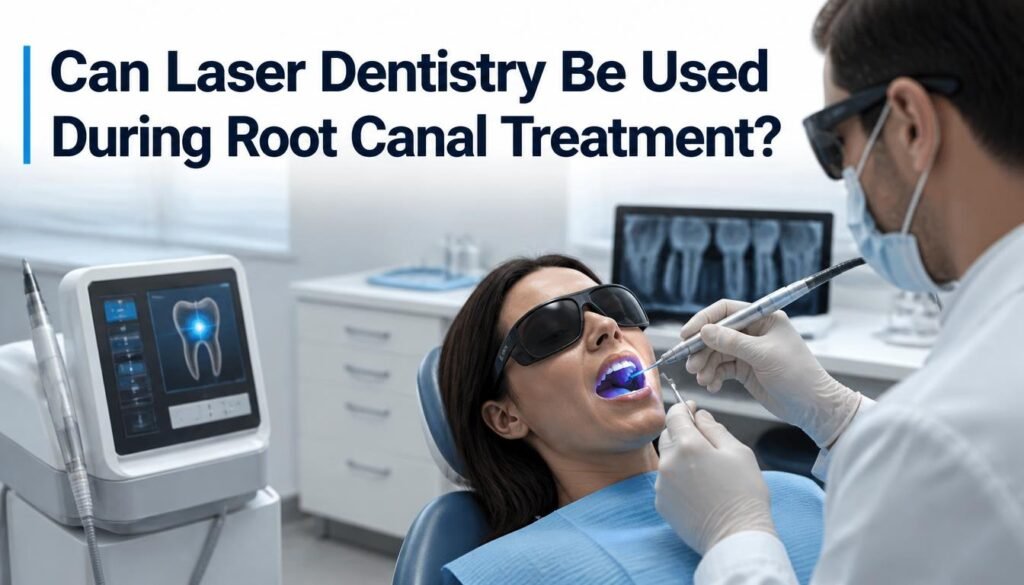
Yes, laser technology may be used as an adjunct to conventional root canal treatment in selected cases.
Root canal treatment involves removing infected or inflamed tissue from inside the tooth, cleaning and shaping the root canal system, disinfecting it and subsequently sealing the canals.
A laser may be considered as an additional method for disinfection in certain endodontic procedures.
Recent research continues to investigate the role of adjunctive laser therapy in endodontic treatment. A 2026 systematic review and meta-analysis examined whether laser therapy used alongside conventional endodontic treatment could improve healing of periapical lesions.
However, laser treatment should not automatically be considered a replacement for conventional root canal treatment.
If you want to learn more about the relationship between lasers and root canal procedures, see our related guide on Can Laser Dentistry Be Used During Root Canal Treatment?.
For patients considering root canal treatment, you can also explore our Painless Root Canal Treatment service.
Can Lasers Be Used Alongside Dental Crowns?
Laser dentistry may sometimes be incorporated into treatment involving a dental crown, particularly when gum or soft-tissue management is required.
However, not every dental crown requires laser treatment.
A conventional crown procedure may involve:
- Examination of the tooth
- Diagnosis and treatment planning
- Tooth preparation
- Impression or digital scanning
- Temporary restoration when required
- Fabrication of the permanent crown
- Crown fitting and cementation
- Follow-up and bite adjustment
If soft-tissue modification or another laser-appropriate procedure is needed, the dentist may incorporate laser technology into the treatment plan.
The laser therefore complements the overall treatment rather than automatically replacing conventional crown procedures.
Can Laser Dentistry Be Used for Gum Treatment?
Gum-related procedures are among the areas where dental lasers may be useful.
Depending on the diagnosis and laser system, a dentist may use laser technology for selected procedures involving gum tissue.
Potential applications can include:
- Gum reshaping
- Selected periodontal procedures
- Soft-tissue removal
- Gum contouring
- Treatment of certain oral soft-tissue conditions
Laser use may offer benefits such as precise tissue interaction and reduced bleeding in some soft-tissue procedures.
However, the suitability of laser treatment depends on the severity and type of gum condition.
A dentist may recommend conventional periodontal treatment, laser-assisted treatment, or a combination depending on the clinical situation.
Can a Dental Laser Replace a Conventional Dental Drill?
Not in every situation.
This is one of the most important points patients should understand.
Certain dental lasers can interact with hard tissues, but conventional instruments continue to have important applications in modern dentistry.
Evidence also does not support treating lasers as universally superior to conventional drills.
For example, a Cochrane review examining lasers versus conventional drills for caries removal found insufficient evidence to conclude that lasers were better for removing dental decay. The review did find some evidence of reduced pain and anesthesia requirements with lasers, but the overall evidence quality was considered low.
Therefore, the dentist should select the technology based on the specific procedure and patient’s condition, rather than simply choosing the newest technology.
Laser Dentistry vs Conventional Dental Treatment
| Factor | Laser Dentistry | Conventional Treatment |
|---|---|---|
| Technology | Uses focused laser energy | Uses established dental instruments |
| Soft-tissue procedures | Useful for selected procedures | Widely used |
| Hard-tissue procedures | Possible with certain laser systems | Commonly used |
| Root canal treatment | May be used as an adjunct | Core treatment approach |
| Gum procedures | May assist in selected cases | Frequently used |
| Cavity treatment | Possible with selected lasers | Conventional drills commonly used |
| Bleeding | May be reduced in selected soft-tissue procedures | Depends on procedure |
| Anesthesia | May be reduced for some procedures | Depends on treatment |
| Suitability | Procedure-specific | Broad range of applications |
| Replacement for all dental treatment | No | No single technique replaces all dental care |
The key takeaway is that laser and conventional dentistry do not necessarily have to compete with each other.
In appropriate cases, they can be complementary.
What Are the Benefits of Combining Laser and Conventional Dentistry?
When clinically appropriate, combining technologies may offer several potential advantages.
1. More Treatment Options
Having access to both laser and conventional techniques allows the dentist to select an approach based on the patient’s needs.
2. Targeted Tissue Treatment
Dental lasers can provide controlled interaction with selected tissues during appropriate procedures.
3. Potentially Less Bleeding
Some soft-tissue laser procedures can reduce bleeding because of the laser’s interaction with tissue.
4. Comfort During Selected Procedures
Some laser procedures may involve less vibration or discomfort compared with certain conventional techniques. However, patient experiences vary.
5. Treatment Flexibility
A dentist can use conventional instruments where they are most appropriate and laser technology where it offers a suitable clinical advantage.
6. Comprehensive Dental Care
Patients may be able to receive different types of dental treatment under one comprehensive treatment plan.
Is Laser Dentistry Completely Painless?
Not necessarily.
Laser dentistry is often promoted as a comfortable or minimally invasive treatment option, but “painless” should not be interpreted as a guarantee that every laser procedure will involve zero discomfort.
The level of discomfort depends on:
- Type of dental procedure
- Type of laser
- Treatment area
- Severity of the dental problem
- Patient sensitivity
- Need for anesthesia
- Individual healing response
The Dental Crowns describes its advanced clinical laser dentistry service as designed to provide comfortable treatment and reduce discomfort in selected procedures.
Your dentist should explain whether anesthesia or other pain-control methods will be required before treatment.
Who May Be a Candidate for Laser-Assisted Dental Treatment?
Laser dentistry may be considered for patients requiring selected procedures involving:
- Gum tissue
- Soft-tissue treatment
- Certain cavity-related procedures
- Root canal disinfection
- Gum reshaping
- Selected restorative procedures
- Certain cosmetic dental treatments
However, not every patient is a candidate for every laser procedure.
The dentist may first perform a clinical examination and, when necessary, recommend X-rays or other diagnostic tests.
Only after evaluating your oral health can the dentist determine whether:
Laser treatment
or
Conventional treatment
or
A combination of both
is appropriate.
Is Laser Dentistry Better Than Conventional Dentistry?
There is no single answer that applies to every patient.
The question should not simply be:
“Is laser dentistry better?”
A more useful question is:
“Is laser dentistry appropriate for my particular dental problem?”
For some procedures, a laser may provide useful advantages. For other procedures, conventional instruments may remain the most appropriate option.
In many cases, the technologies can work together.
Treatment decisions should be based on diagnosis, clinical evidence, the type of procedure, available technology and the dentist’s professional assessment.
Laser Dentistry in Noida: What Should Patients Consider?
If you are searching for laser dentistry in Noida, don’t choose a treatment simply because it uses advanced technology.
Instead, consider:
Dentist’s Experience
Ask whether the dentist has experience performing the particular laser procedure you require.
Type of Laser
Different laser systems have different applications. Ask which laser will be used and why.
Comprehensive Treatment Options
A clinic that provides both laser and conventional treatment can evaluate different approaches rather than limiting treatment to one technology.
Diagnosis Before Treatment
Laser treatment should follow proper examination and diagnosis.
Clear Treatment Plan
Ask which parts of your treatment will involve the laser and which will involve conventional techniques.
Questions to Ask Your Dentist Before Laser Treatment
Before undergoing laser dental treatment, consider asking:
1. Why do I need laser treatment?
Understanding the clinical reason helps you understand its role in your treatment.
2. Which laser will be used?
Different lasers have different applications.
3. Will conventional dental instruments also be required?
In many cases, the answer may be yes.
4. Can the same procedure be performed conventionally?
Ask about the available alternatives.
5. Will I need anesthesia?
This depends on the procedure and your individual situation.
6. What are the expected benefits?
Your dentist should explain what the laser is expected to accomplish.
7. Are there any limitations?
No dental technology is appropriate for every situation.
8. What will recovery be like?
Ask about eating, brushing, medication and follow-up care.
Why Choose The Dental Crowns for Laser Dentistry in Noida?
The Dental Crowns provides Advanced Clinical Laser Dentistry alongside a broader range of dental services.
Its laser dentistry service lists applications involving gum disease, cavities, cosmetic procedures and other selected dental treatments.
The clinic also provides treatments including:
- Laser Dentistry
- Root Canal Treatment
- Dental Implants
- Dental Crowns
- Dental Bridges
- Tooth-Coloured Restorations
- Braces
- Veneers
- Dentures
- Tooth Extraction
- Wisdom Tooth Extraction
You can explore the complete Dental Services at The Dental Crowns before deciding which treatment to discuss with your dentist.
Frequently Asked Questions
1. Can laser dentistry be used alongside conventional dental treatment?
Yes. Laser dentistry can be used as a complementary technology alongside conventional treatment for selected dental procedures.
2. Can laser dentistry replace conventional dental treatment?
No. Dental lasers cannot replace all conventional dental procedures. Their use depends on the type of treatment and the patient’s condition.
3. Can laser dentistry be used during root canal treatment?
Yes. Laser technology may be used as an adjunct for selected root canal disinfection procedures. Conventional root canal treatment remains an important part of treatment.
4. Can lasers be used with dental crowns?
Laser technology may be useful for selected gum or soft-tissue procedures associated with crown treatment, but the crown itself may still require conventional preparation and placement.
5. Can a laser replace a dental drill?
Not always. Some lasers can interact with hard dental tissue, but conventional instruments remain necessary for many dental procedures.
6. Is laser dentistry painless?
Some procedures may be very comfortable, but no treatment should be assumed to be completely painless for every patient.
7. Can laser dentistry treat cavities?
Certain dental lasers can be used for selected cavity-related procedures. The appropriate method depends on the cavity and the laser system available.
8. Can laser dentistry help with gum disease?
Certain dental lasers can be used for selected gum and periodontal procedures. Treatment depends on the severity and type of gum disease.
9. Is laser dentistry suitable for everyone?
No. Laser treatment is procedure-specific and may not be appropriate for every patient.
10. Does laser dentistry make treatment faster?
Treatment time varies according to the procedure, the patient’s condition and the techniques used. Laser treatment does not automatically mean that every dental procedure will be faster.
11. Does laser dentistry reduce bleeding?
Some soft-tissue laser procedures may reduce bleeding, but the amount varies according to the procedure and patient.
12. Can laser dentistry reduce the need for anesthesia?
Some laser procedures may require less anesthesia, but this is not guaranteed. The requirement depends on the treatment.
13. Is laser dentistry expensive?
The cost depends on the procedure, technology used, complexity of treatment and clinic. Ask your dentist for a treatment-specific estimate.
14. Can laser dentistry be used for children?
Certain laser procedures may be appropriate for children, but suitability should be determined by a qualified dentist after examination.
15. Where can I find laser dentistry in Noida?
The Dental Crowns offers advanced clinical laser dentistry at its clinic in Sector 79, Noida, along with conventional dental treatments.
Final Takeaway
Can laser dentistry be used alongside conventional dental treatment?
Yes.
Laser dentistry can serve as an additional technology rather than an automatic replacement for conventional dental care.
Depending on the diagnosis, a dentist may combine laser technology with conventional instruments for procedures involving the gums, cavities, root canal treatment, soft tissues and selected restorative treatments.
The most important consideration is not whether a treatment uses a laser, but whether the technique is clinically appropriate for your specific dental condition.
If you are considering laser dentistry in Noida, discuss your symptoms, diagnosis, treatment options and expected outcomes with a qualified dental professional before beginning treatment.