

Sensitive gums can make everyday activities such as brushing, eating, drinking, and even touching your teeth uncomfortable. If your gums bleed easily, feel tender, look swollen, or react painfully during dental treatment, you may wonder whether a gentler treatment option is available.
One treatment that has gained attention in modern dentistry is laser dentistry. But can laser treatment actually help sensitive gums?
The answer depends on why your gums are sensitive. Dental lasers can be useful for certain gum and periodontal procedures, particularly when used as an adjunct to conventional periodontal treatment. However, laser dentistry is not a universal solution for every type of gum sensitivity.
At The Dental Crowns in Noida, laser dentistry is offered as part of the clinic’s surgical dentistry services. The appropriate treatment depends on an examination of your teeth, gums, oral hygiene, and underlying dental condition.
What Causes Sensitive Gums?
Sensitive gums are not a disease by themselves. They are usually a symptom of an underlying dental or gum problem.
Some common causes include:
- Plaque and tartar buildup
- Gingivitis
- Periodontitis
- Aggressive brushing
- Poor oral hygiene
- Gum recession
- Tooth sensitivity
- Food trapped around the gums
- Poorly fitting dental restorations
- Hormonal changes
- Smoking or tobacco use
- Certain medications
- Existing periodontal pockets
- Infection around the gums
If sensitivity continues for several days or is accompanied by bleeding, swelling, pus, persistent bad breath, loose teeth, or gum recession, it is important to have your gums evaluated by a dentist.
What Is Laser Dentistry?
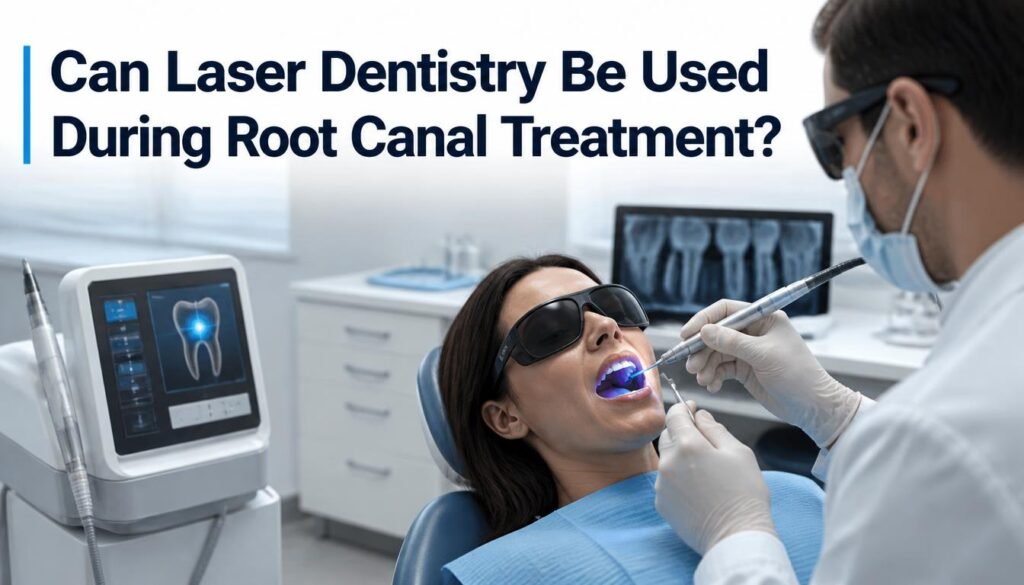
Laser dentistry uses concentrated light energy for specific dental procedures involving hard or soft tissues.
Depending on the laser system and treatment objective, dental lasers may be used for procedures involving:
- Gum tissue
- Periodontal pockets
- Gingival contouring
- Soft-tissue procedures
- Certain restorative procedures
- Treatment planning around dental restorations
- Adjunctive periodontal treatment
The exact laser wavelength, power, duration, and technique are selected according to the procedure and patient’s condition.
This means that “laser dentistry” is not one single treatment. It is a technology that can be used in different ways by a trained dental professional.
Can Laser Dentistry Help Sensitive Gums?
Yes, in selected cases—but it depends on the cause.
If sensitive gums are related to gum inflammation or periodontal disease, a dentist may consider laser therapy as part of a comprehensive treatment plan.
Research suggests that lasers can sometimes provide additional short-term clinical benefits when used alongside conventional periodontal treatment. However, the evidence is mixed, and laser treatment should generally be viewed as an adjunct rather than an automatic replacement for conventional periodontal care. A recent 2026 meta-analysis found that laser-assisted periodontal treatment may provide small additional benefits, but concluded that the effects are clinically limited and that laser treatment should be considered supplementary rather than routine.
This is why an accurate diagnosis should come before deciding whether laser dentistry is appropriate for sensitive gums.
How Can Laser Treatment Potentially Benefit Gum Health?
1. It Can Target Specific Gum Tissue
Dental lasers can be used with high precision on targeted areas of soft tissue. Depending on the procedure, this may allow the dentist to treat a specific area without unnecessarily affecting surrounding tissue.
2. It May Help With Periodontal Treatment
Periodontal disease involves infection and inflammation of the tissues supporting your teeth.
Some studies have found that laser therapy used alongside conventional periodontal treatment can improve certain clinical parameters in the short term. A systematic review found that adjunctive lasers had better outcomes in some clinical measurements, although not every study showed an additional benefit.
3. It May Support Gum-Tissue Management
Lasers can be useful for specific soft-tissue procedures where controlled tissue removal or reshaping is required.
This can be particularly useful when a dentist needs to manage gum tissue around a tooth or dental restoration.
4. It Can Help With Bleeding Control During Certain Procedures
One potential advantage of dental lasers is their ability to assist with soft-tissue procedures where bleeding control is important.
However, the benefits depend on the laser type, procedure, clinician’s technique, and individual patient factors.
5. It May Be Associated With Less Discomfort in Some Procedures
Some laser-assisted dental procedures may involve less discomfort or bleeding compared with certain conventional techniques.
However, it would be incorrect to claim that every laser dental procedure is completely painless. Your comfort depends on the specific procedure and your individual condition.
Does Laser Dentistry Treat Gum Sensitivity Directly?
Not necessarily.
This is one of the most important things patients should understand.
If your gums are sensitive because of gum disease, treating the underlying inflammation may help improve your symptoms.
But if your sensitivity is caused by:
- Exposed tooth roots
- Gum recession
- Tooth enamel wear
- Tooth decay
- Cracked teeth
- Incorrect brushing technique
- Tooth whitening
- Another dental problem
then laser treatment may not be the appropriate solution.
Your dentist first needs to identify the actual cause.
Laser Dentistry vs Conventional Gum Treatment
Laser treatment does not automatically replace conventional periodontal treatment.
Traditional periodontal care can include:
- Professional dental cleaning
- Scaling
- Root planing
- Improved oral hygiene
- Periodontal maintenance
- Medication when clinically indicated
- Surgical treatment for advanced cases
Lasers may sometimes be incorporated into this treatment plan.
For example, research evaluating adjunctive laser therapy has found some short-term improvements in periodontal pocket depth, but longer-term benefits have not always been consistent.
A 2026 meta-analysis similarly found that the available evidence supports only modest adjunctive benefits and does not establish laser therapy as a routine replacement for conventional periodontal treatment.
Therefore, the best approach is not “laser instead of traditional treatment.”
It is:
Accurate diagnosis → appropriate conventional treatment → laser when clinically beneficial.
What Happens During Laser Dentistry for Gum Problems?
The exact process varies depending on the procedure.
Generally, your dentist may follow these steps:
Step 1: Dental Examination
Your dentist examines your gums, teeth, existing restorations, and oral hygiene.
Step 2: Identify the Cause
The dentist determines whether your sensitivity is associated with gingivitis, periodontitis, gum recession, tooth sensitivity, infection, or another condition.
Step 3: Treatment Planning
If laser dentistry is appropriate, the dentist selects the appropriate laser technique based on the condition being treated.
Step 4: Laser Procedure
The laser is carefully applied to the targeted area according to the planned treatment.
Step 5: Aftercare
You may receive instructions regarding brushing, flossing, diet, oral hygiene, and follow-up appointments.
The treatment experience and recovery period vary depending on the procedure.
Is Laser Dentistry Safe for Sensitive Gums?
When used appropriately by a qualified dental professional with suitable equipment and technique, dental lasers can be used safely for various dental procedures.
However, laser treatment is not risk-free.
Potential issues can depend on the procedure and may include temporary discomfort, sensitivity, swelling, tissue changes, or other complications if inappropriate settings or techniques are used.
That is why patients should choose a dental clinic where treatment is based on a proper diagnosis rather than simply choosing a procedure because it is advertised as “laser.”
Who May Be a Candidate for Laser Gum Treatment?
Laser dentistry may be considered for patients with certain gum or periodontal conditions, depending on their diagnosis.
You may benefit from an evaluation if you experience:
- Bleeding gums while brushing
- Red or swollen gums
- Persistent gum tenderness
- Bad breath
- Gum recession
- Periodontal pockets
- Discomfort while chewing
- Loose teeth
- Recurring gum inflammation
However, not everyone with sensitive gums needs laser treatment.
A dental examination is the best way to determine whether laser treatment is appropriate.
When Should You See a Dentist for Sensitive Gums?
Occasional mild sensitivity may improve with better brushing and oral hygiene. But persistent or worsening symptoms should not be ignored.
Book a dental evaluation if you notice:
- Gums bleeding frequently
- Swollen or painful gums
- Pus around the gums
- Persistent bad breath
- Receding gums
- Loose teeth
- Pain while chewing
- Increasing tooth sensitivity
- A change in the way your teeth fit together
These symptoms can sometimes indicate periodontal disease that requires professional treatment.
How Can You Protect Sensitive Gums at Home?
Laser dentistry or any professional dental treatment cannot replace daily oral care.
To maintain healthier gums:
Use a Soft-Bristled Toothbrush
Brush gently twice a day. Aggressive brushing can irritate the gumline and contribute to recession.
Clean Between Your Teeth
Use dental floss or another dentist-recommended interdental cleaning method to remove plaque between teeth.
Don’t Ignore Bleeding Gums
Bleeding should not automatically be considered normal. Persistent bleeding can be a sign of gum inflammation.
Schedule Regular Dental Checkups
Regular examinations can identify gum problems before they become more advanced.
Avoid Tobacco
Smoking and tobacco use can negatively affect oral and periodontal health.
Follow Your Dentist’s Instructions
If you have already been diagnosed with gum disease, follow the recommended maintenance and treatment schedule.
Is Laser Dentistry Better Than Regular Dental Treatment?
There is no simple “better” answer.
Laser dentistry can offer useful advantages for selected procedures and selected patients, but it is not automatically superior to conventional treatment in every situation.
Current research suggests that lasers may provide additional benefits in some periodontal situations, particularly in the short term, but evidence for long-term superiority remains limited.
The right treatment should therefore be based on:
Your diagnosis + severity of the condition + treatment goals + dentist’s clinical judgment.
Why Choose Professional Laser Dentistry in Noida?
If you are searching for laser dentistry in Noida, choosing a clinic with a comprehensive range of dental services can make treatment planning easier.
The Dental Crowns lists Laser Dentistry under its Surgical Dentistry services, along with implants and tooth-extraction procedures. The clinic is located at Civitech Stadia, Sector 79, Noida, Uttar Pradesh.
Patients from areas such as Sector 74, Sector 75, Sector 76, Sector 77, Sector 78, and Sector 79, Noida may consider a nearby dental consultation if they are experiencing persistent gum sensitivity.
The goal should always be to diagnose the cause of the problem first and then select the most appropriate treatment.
Frequently Asked Questions About Laser Dentistry for Sensitive Gums
1. Can laser dentistry cure sensitive gums?
Laser dentistry may help with certain underlying gum conditions, but it does not automatically cure every cause of gum sensitivity. Treatment depends on the underlying diagnosis.
2. Is laser treatment painful for sensitive gums?
Some laser procedures may cause less discomfort than certain conventional procedures, but the experience varies depending on the treatment and patient.
3. Can lasers treat gum disease?
Lasers may be used as an adjunct in periodontal treatment in selected cases. Current evidence does not support treating laser therapy as a universal replacement for conventional periodontal treatment.
4. How long does laser gum treatment take?
Treatment time depends on the number of teeth involved, the type of laser procedure, and the severity of the condition.
5. Can laser dentistry stop gum bleeding?
Laser treatment may be useful for specific gum procedures and can assist with bleeding control, but persistent gum bleeding should first be evaluated to identify its cause.
6. Is laser dentistry safe?
Dental lasers can be safely used for appropriate procedures when operated correctly by trained dental professionals. The suitability of treatment depends on the individual case.
7. Can laser treatment fix receding gums?
Laser dentistry is not a universal treatment for gum recession. Recession can have several causes and may require a different treatment approach.
8. Should I get laser treatment for sensitive gums?
Not necessarily. A dentist should first determine why your gums are sensitive and then decide whether laser dentistry is appropriate.
9. Is laser dentistry better than scaling?
Laser treatment and scaling serve different purposes. In periodontal care, lasers may sometimes be used alongside conventional treatment rather than replacing it.
10. Where can I get laser dentistry in Noida?
The Dental Crowns provides Laser Dentistry as one of its surgical dentistry services and is located in Sector 79, Noida.
Final Thoughts: Can Laser Dentistry Help Sensitive Gums?
Laser dentistry can help selected patients with certain gum and periodontal problems, but it is not a one-size-fits-all treatment for sensitive gums.
If your gums are sensitive, the most important first step is identifying the underlying cause. Depending on your condition, your dentist may recommend professional cleaning, periodontal treatment, improved oral hygiene, conventional therapy, laser-assisted treatment, or another appropriate procedure.
The latest research suggests that laser therapy can provide some additional short-term periodontal benefits in selected situations, but the evidence does not establish lasers as a universal replacement for conventional periodontal treatment.
If you have persistent gum sensitivity, bleeding, swelling, recession, or discomfort, consider scheduling a professional dental examination rather than delaying treatment.
Looking for Laser Dentistry in Noida? Explore The Dental Crowns’ Laser Dentistry service and schedule a consultation to determine whether laser treatment is suitable for your gums.
Medical References: