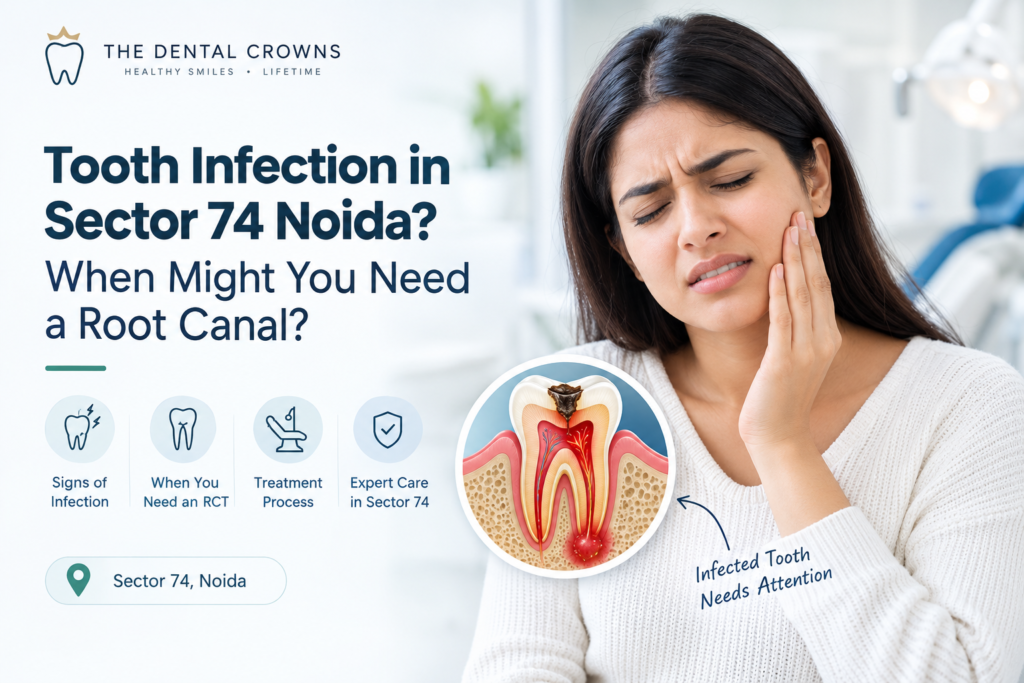
A tooth infection can begin with what seems like a minor cavity or sensitivity but may eventually affect the soft tissue inside the tooth. Persistent toothache, pain while chewing, prolonged sensitivity to hot or cold, swelling around the gums, or a pimple near the tooth can indicate that the tooth needs professional evaluation.
If you have a tooth infection in Sector 74 Noida, one of the treatments your dentist may consider is root canal treatment (RCT). However, a root canal is not planned simply because a tooth hurts. The dentist first needs to identify the source of the infection, assess the condition of the tooth and determine whether the tooth can be restored.
So, how is root canal treatment planned for an infected tooth?
Let’s understand the process step by step.
What Causes a Tooth Infection?
The inside of a tooth contains a soft tissue called the pulp. It contains nerves, blood vessels and connective tissue. Deep tooth decay, cracks, trauma or repeated dental procedures can damage or infect this tissue.
According to the American Association of Endodontists (AAE), root canal treatment may be required when the pulp becomes inflamed or infected. Common causes include deep decay, cracks or chips, repeated dental procedures and problems involving an existing restoration.
If the infection is not treated, it can potentially develop into an abscess.
Read more about root canal treatment from the American Association of Endodontists.
Signs You May Have an Infected Tooth
Not every toothache means you need a root canal. A dental examination is necessary to determine the actual cause.
However, some symptoms can indicate that the pulp inside a tooth may be damaged or infected.
These can include:
- Persistent or severe tooth pain
- Pain while biting or chewing
- Lingering sensitivity to hot or cold
- Swelling around the tooth or gums
- Tender gums
- A small pimple or bump on the gums
- Deep tooth decay
- A cracked or chipped tooth
- Tooth discoloration
- Pain that temporarily improves but later returns
The AAE also identifies severe pain when chewing, lingering temperature sensitivity, swollen or tender gums, deep decay and gum pimples among symptoms associated with teeth that may require endodontic evaluation.
It is important not to diagnose yourself based only on symptoms because tooth pain can have multiple causes.
How Is Root Canal Treatment Planned for a Tooth Infection in Sector 74 Noida?
Root canal treatment is planned according to the condition of the individual tooth.
A dentist generally considers several factors before deciding whether RCT is appropriate.
1. Dental Examination
The first step is a clinical examination.
Your dentist may check:
- The affected tooth
- Nearby teeth
- Gum condition
- Tooth decay
- Existing fillings or crowns
- Cracks or fractures
- Tooth sensitivity
- Pain during biting
- Swelling or signs of an abscess
- The amount of healthy tooth structure remaining
This helps the dentist understand whether the symptoms are coming from the suspected tooth and what type of treatment may be necessary.
2. Dental X-Ray and Diagnostic Assessment
An X-ray or other appropriate dental imaging may be recommended as part of the diagnostic process.
Imaging can help the dentist evaluate the roots, surrounding bone and possible changes associated with infection.
The dentist may also assess the number, position and shape of the root canals because root canal anatomy varies from tooth to tooth.
This information helps in planning the procedure rather than approaching every tooth in exactly the same way.
3. Checking Whether the Tooth Can Be Saved
One of the important questions during treatment planning is:
Can the tooth be restored after the infection is treated?
Root canal treatment is intended to remove infection from inside the tooth while allowing the natural tooth to remain in place.
However, not every severely damaged tooth can necessarily be saved. Severe fractures, inadequate remaining tooth structure or insufficient supporting bone can affect treatment options.
The AAE notes that most teeth can be treated endodontically, although some teeth may not be suitable for treatment because of factors such as severe root fracture or inadequate support.
Learn more about saving a natural tooth from the AAE.
4. Planning the Root Canal Procedure
Once the dentist determines that root canal treatment is appropriate, the procedure generally involves accessing the inside of the tooth, removing the infected or inflamed pulp, cleaning and disinfecting the root canals, shaping them and then sealing them.
The NHS describes root canal treatment as a procedure that removes infection from inside the tooth before the tooth is cleaned, filled and sealed.
Depending on the tooth and complexity of the case, treatment may require one or more appointments.
See the NHS guide to root canal treatment.
5. Deciding How the Tooth Will Be Restored
Root canal treatment addresses the infection, but the treatment plan also needs to consider how the tooth will be restored afterward.
Depending on the amount of remaining tooth structure and the tooth’s location, the dentist may recommend a filling, crown or another appropriate restoration.
A crown may be recommended when a tooth has lost significant structure and requires additional protection.
This is particularly important when discussing molars and premolars because these teeth are exposed to substantial chewing forces.
However, not every root-canal-treated tooth automatically needs a crown. The final restoration should be decided after evaluating the tooth.
You can learn more in our guide:
Do You Need a Dental Crown After Root Canal Treatment?
What Happens During Root Canal Treatment?
Although the exact procedure varies from patient to patient, root canal treatment commonly involves several key stages.
Step 1: Local Anaesthesia
The affected area is numbed before treatment.
This is done to keep the procedure comfortable for the patient.
Step 2: Accessing the Tooth
The dentist creates an opening in the tooth to access the infected or inflamed pulp and root canal system.
Step 3: Removing the Infected Pulp
The damaged pulp is removed from inside the tooth.
Step 4: Cleaning and Shaping
The root canals are carefully cleaned, disinfected and shaped so that they can be properly sealed.
Step 5: Filling and Sealing
After cleaning, the canals are filled with a suitable material and sealed to reduce the possibility of reinfection.
Step 6: Final Restoration
After the root canal, the tooth needs an appropriate permanent restoration.
Depending on the condition of the tooth, this may involve a filling or dental crown.
The AAE explains that after root canal treatment, the tooth is generally restored with a crown or filling to protect it and return it to function.
Read the AAE’s step-by-step Root Canal Explained guide.
Is Root Canal Treatment Painful?
Pain is one of the biggest concerns for people considering RCT.
Modern root canal treatment is performed using local anaesthesia. The AAE states that modern techniques and anaesthetics allow most patients to remain comfortable during treatment.
Some tenderness or sensitivity can occur for a few days after treatment, particularly when the tooth was infected or painful before the procedure.
Severe, worsening or persistent pain should be reported to your dentist.
At The Dental Crowns, patients can also explore our page about Painless Root Canal Treatment in Noida to understand our approach to root canal care.
How Long Does Root Canal Treatment Take?
There is no single treatment duration that applies to every infected tooth.
The time required can depend on:
- Which tooth is affected
- Number of root canals
- Complexity of the canal anatomy
- Severity of infection
- Presence of an abscess
- Previous dental treatment
- Whether retreatment is required
- Type of final restoration
Some root canals can be completed in one or two appointments, while more complicated cases may require additional visits.
Your dentist can provide a more accurate treatment timeline after examining your tooth.
What Happens If a Tooth Infection Is Ignored?
Ignoring an infected tooth does not necessarily make the infection disappear.
An untreated infection can continue to damage the tissues around the tooth and may lead to an abscess.
The NHS explains that an untreated infected tooth may eventually require extraction if root canal treatment cannot be carried out.
If you have swelling, severe pain, fever, difficulty opening your mouth or other concerning symptoms, seek prompt dental evaluation.
For more information about dental abscesses, see the NHS dental abscess guide.
Root Canal Treatment Near Sector 74 Noida
If you live in Sector 74 Noida and are experiencing tooth pain, sensitivity or swelling, getting the tooth evaluated early can help identify the cause before the problem becomes more complicated.
The Dental Crowns is located at Civitech Stadia, Sector 79, Noida, and serves patients from Sector 74 and surrounding Noida areas.
If you are specifically looking for treatment options near Sector 74, you can also explore:
- Root Canal Treatment Near Noida Sector 74: When Do You Need It?
- Tooth Infection in Sector 74 Noida: When Might You Need a Root Canal?
- How Much Does Root Canal Treatment Cost in Noida Sector 74?
- Dental Crown Treatment for Patients Near Sector 74 Noida
These resources can help patients understand different aspects of root canal and restorative treatment.
Why Diagnosis Matters Before RCT
A toothache does not automatically mean you need a root canal.
For example, pain can sometimes be associated with:
- Tooth decay
- A cracked tooth
- A damaged filling
- Gum problems
- Tooth sensitivity
- Bite-related issues
- Pulp inflammation
- Dental infection
That is why an examination is important before treatment.
The goal is not simply to treat the symptom but to identify the underlying dental problem and select an appropriate treatment.
Frequently Asked Questions
1. What are the first signs of a tooth infection?
Persistent toothache, pain while chewing, prolonged hot or cold sensitivity, swelling, tender gums and a pimple near the tooth can be warning signs. A dentist needs to confirm the cause.
2. Does every tooth infection require a root canal?
No. The appropriate treatment depends on the source and extent of the problem. A dentist must evaluate the tooth before recommending RCT.
3. Can a root canal save an infected tooth?
In many cases, root canal treatment can remove infected pulp and allow a restorable natural tooth to remain in the mouth. However, the dentist must determine whether the tooth is suitable for treatment.
4. Is RCT painful?
The tooth is generally numbed with local anaesthesia during treatment. Mild soreness or sensitivity may occur afterward.
5. Will I need a crown after root canal treatment?
Not necessarily. The decision depends on the tooth, remaining structure, location, chewing forces and restoration required.
6. How many appointments are required for RCT?
The number varies. Some cases can be completed in one or two appointments, while complicated cases may require more visits.
7. Can I wait if my tooth infection is not painful?
It is better not to assume that the absence of pain means the infection has disappeared. Some dental infections can have limited or changing symptoms. Professional evaluation is recommended.
8. Where can I get root canal treatment near Sector 74 Noida?
Patients in Sector 74 and nearby Noida sectors can consult a qualified dental professional for examination and treatment planning. The Dental Crowns is located at Civitech Stadia, Sector 79, Noida.
Final Takeaway
If you have a tooth infection in Sector 74 Noida, the first step should be a proper dental examination rather than assuming that every toothache requires a root canal.
A typical RCT plan may involve clinical examination, diagnostic imaging, assessment of the tooth’s restorability, cleaning and disinfection of the root canals, sealing and finally deciding on an appropriate restoration.
Early evaluation can help your dentist understand the problem and discuss suitable treatment options for your specific tooth.
If you are experiencing persistent tooth pain, swelling, prolonged sensitivity or pain while chewing, consider arranging a dental examination rather than continuing to ignore the symptoms.
The Dental Crowns – Noida
Civitech Stadia, Sector 79, Noida