Have you lost a tooth in your upper jaw and are wondering whether dental implants can be placed close to your sinuses? You are not alone. Many patients who consider replacing missing upper molars or premolars worry about the position of the sinus cavities and whether dental implant surgery is safe in this area.
Yes, dental implants can often be placed in the upper jaw near the sinuses. However, the treatment depends on the amount of available jawbone, the position of the maxillary sinuses, and your overall oral health. If there is insufficient bone to support an implant, a dentist may recommend a sinus lift procedure or bone grafting before or during implant placement.
Understanding these treatment options can help you make an informed decision about replacing missing teeth. In this guide, we explain how upper jaw dental implants work, when sinus lift surgery may be needed, and what patients should know before treatment.
What Are the Maxillary Sinuses, and Why Do They Matter for Dental Implants?
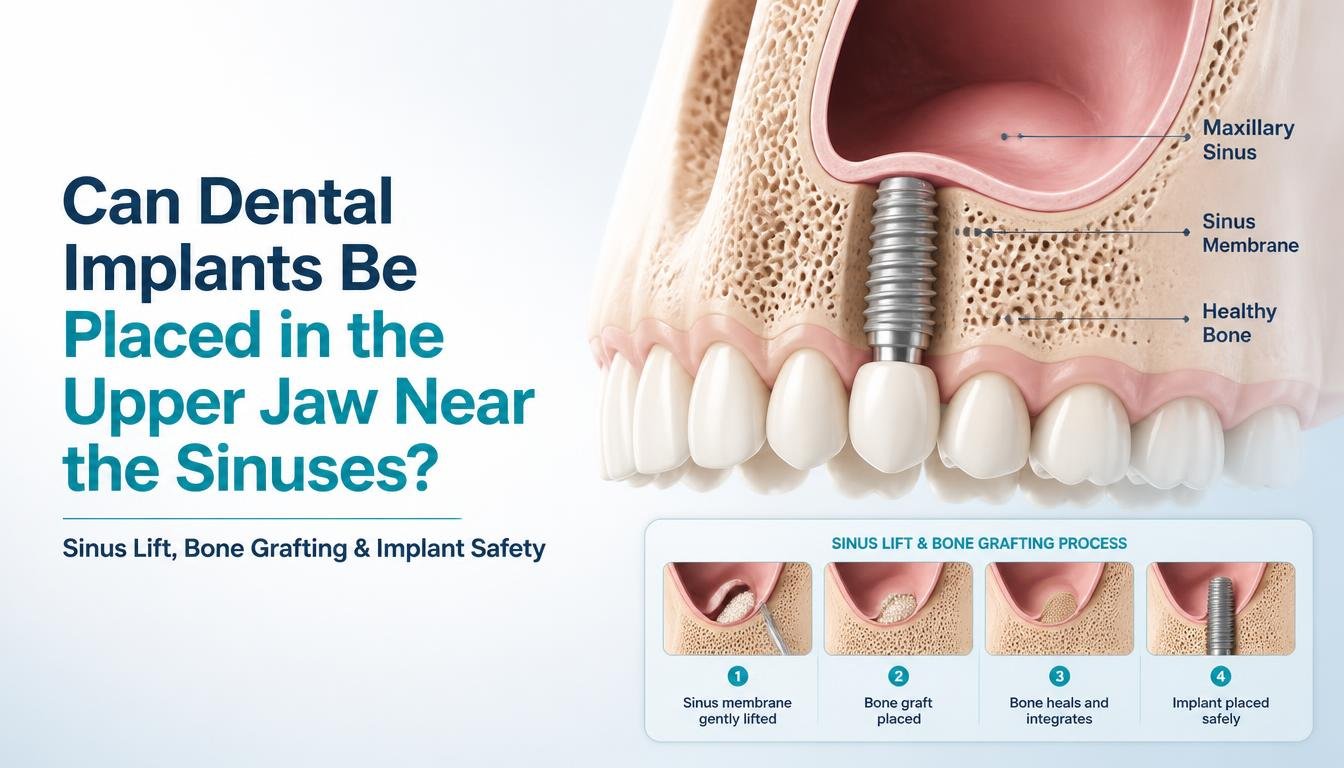
The maxillary sinuses are air-filled spaces located behind your cheeks, above the upper back teeth, and below your eyes. Their position is particularly important when planning dental implants in the upper premolar and molar regions.
When a natural tooth is lost, the jawbone in that area may gradually shrink because it no longer receives the stimulation provided by the tooth root. Over time, the sinus may also extend downward into the area where bone has been lost.
As a result, some patients have limited bone height between the gum and the sinus floor. Since a dental implant needs adequate bone for stability and healing, this can make implant placement more challenging.
A careful dental examination and appropriate imaging help determine how much bone is available and which treatment approach is suitable.
Can Dental Implants Be Placed Near the Sinuses Safely?
Yes. Dental implants can frequently be placed in the upper jaw near the maxillary sinuses when the procedure is properly planned and the patient is suitable for treatment.
The important factor is not simply how close the implant is to the sinus. The dentist must assess the bone available to support the implant, the sinus anatomy, and the planned implant position.
Depending on your condition, your dentist may recommend one of the following approaches:
- Conventional dental implant placement: Suitable when sufficient healthy bone is available to support the implant.
- Sinus lift surgery: Considered when additional bone height is needed beneath the sinus.
- Bone grafting: Used when the existing jawbone needs additional support or volume.
- Alternative implant placement: Certain patients may be suitable for shorter or angled implants that avoid the need for a sinus lift.
Not every patient needs additional surgery. The appropriate approach depends on individual clinical findings rather than a single standard treatment plan.
What Is a Sinus Lift for Dental Implants?
A sinus lift, also known as sinus augmentation or sinus grafting, is a surgical procedure that increases the available bone beneath the maxillary sinus.
During this procedure, a dental specialist gently raises the sinus membrane and places suitable bone grafting material in the space created between the membrane and the jawbone. As healing progresses, new bone develops in the grafted area, helping create a suitable foundation for dental implants.
A sinus lift may be recommended when:
- You have lost one or more upper back teeth.
- The available jawbone is too thin or short for the planned implant.
- The maxillary sinus extends close to the intended implant site.
- Bone loss has occurred after tooth extraction.
- Your dentist determines that additional bone is needed for implant stability.
The procedure is not necessary for every upper jaw implant. Your dentist will explain whether it offers a benefit in your particular case.
What Are the Different Types of Sinus Lift Procedures?
The choice of sinus lift technique depends mainly on the amount of existing bone and the additional bone height required.
1. Internal or Crestal Sinus Lift
An internal sinus lift is generally considered when some bone is already available and only a modest increase in bone height is required.
The dentist accesses the sinus floor through the implant preparation site and carefully elevates the sinus membrane. Bone grafting material may be added, and the implant may sometimes be placed during the same appointment.
This technique is often less extensive than a lateral approach, but it is not appropriate for every patient.
2. External or Lateral Sinus Lift
A lateral sinus lift may be recommended when more bone augmentation is required.
The dentist creates a small opening in the side of the upper jawbone to access and gently raise the sinus membrane. Bone grafting material is then placed beneath it.
Your dental specialist will determine which technique is appropriate after examining your jawbone and sinus anatomy.
How Do Dentists Check Whether You Need a Sinus Lift?
Before recommending upper jaw dental implants, your dentist will assess the condition of your teeth, gums, jawbone, and surrounding anatomical structures.
The evaluation may include:
1. Dental examination: Your dentist checks your gums, missing tooth area, bite, and general oral health.
2. Dental imaging: X-rays provide information about the teeth and jawbone. A cone-beam computed tomography (CBCT) scan may be recommended when a detailed three-dimensional view of the bone and sinus anatomy is needed.
3. Bone assessment: The dentist evaluates the available bone height, width, and quality at the proposed implant site.
4. Sinus assessment: The position of the sinus floor and any relevant sinus abnormalities are considered. Patients with suspected sinus disease may need additional assessment or referral.
5. Individual treatment planning: Your dentist discusses whether an implant can be placed directly, whether bone grafting is advisable, and whether alternative tooth replacement options should be considered.
This planning helps reduce avoidable complications and supports a more predictable treatment approach.
How Long Does It Take to Get Dental Implants Near the Sinuses?
The overall treatment time varies according to the amount of bone available, whether a sinus lift is required, the type of graft used, and how well healing progresses.
When sufficient bone is available, implant placement may be relatively straightforward. The implant then needs time to integrate with the surrounding bone before the final crown is attached, unless a suitable alternative loading protocol is selected by the treating dentist.
When a sinus lift is necessary, treatment may take longer because the grafted area may need several months to heal before implant placement or final restoration.
In some cases, the implant and sinus lift can be performed during the same appointment. In other cases, a staged approach is safer or more appropriate.
Your dentist should provide an estimated timeline based on your clinical examination rather than promising a fixed treatment duration.
Is Sinus Lift Surgery Painful?
Sinus lift surgery is commonly performed under local anaesthesia, which numbs the treatment area during the procedure. Sedation may be considered in selected cases.
After surgery, patients may experience temporary swelling, tenderness, bruising, mild bleeding, or a feeling of fullness around the sinus area. These symptoms generally improve as healing progresses.
Your dentist will provide instructions for managing discomfort and protecting the surgical site. Follow the prescribed medication plan and attend all recommended follow-up appointments.
If you develop severe or worsening pain, fever, increasing swelling, persistent bleeding, or unusual nasal symptoms, contact your treating dentist promptly.
What Are the Risks of Dental Implants Near the Sinuses?
As with any surgical procedure, upper jaw dental implant placement and sinus lift surgery carry potential risks.
These may include:
- Injury or tearing of the sinus membrane during a sinus lift.
- Infection or inflammation around the grafted area.
- Insufficient bone formation or delayed healing.
- Implant failure or inadequate integration with the jawbone.
- Temporary swelling, bruising, or discomfort.
- Sinus-related complications that may require additional treatment.
The likelihood of complications varies with the procedure, individual anatomy, general health, and other risk factors.
Smoking, poorly controlled diabetes, active oral infection, and certain sinus conditions may affect treatment planning or healing. Inform your dentist about your medical history, medicines, smoking habits, and any recurring sinus symptoms before surgery.
Choosing an appropriately trained dental professional, following post-operative instructions, and maintaining regular follow-up care are important parts of treatment.
Can You Avoid a Sinus Lift When Getting Upper Jaw Dental Implants?
In some cases, yes. A sinus lift is not the only possible solution for patients with limited bone in the upper jaw.
Depending on your anatomy and the number of missing teeth, your dentist may consider:
- Shorter dental implants: These may be suitable when the available bone is adequate for the proposed implant design and loading.
- Angled implants: Carefully planned implant positioning may avoid the sinus in selected cases.
- Dental bridges: A bridge may replace missing teeth using suitable adjacent teeth for support.
- Removable dentures: These can replace missing teeth without implant surgery.
Each option has advantages, limitations, and maintenance requirements. Your dentist should explain the likely benefits and risks of each alternative before you decide.
How Can You Care for Your Mouth After a Sinus Lift?
Following your dentist’s post-operative instructions is essential for healing. Although recommendations may vary depending on the surgical technique, common precautions include:
- Avoid blowing your nose for the period advised by your surgeon.
- Sneeze with your mouth open rather than forcing pressure through your nose.
- Avoid smoking during recovery and follow your dentist’s advice about when it is safe to resume normal activities.
- Eat foods that are comfortable to chew and follow any dietary restrictions.
- Keep your mouth clean according to the cleaning instructions provided.
- Take prescribed medicines exactly as directed.
- Attend follow-up appointments so your dentist can monitor healing.
Do not begin strenuous activities or resume normal routines earlier than advised if your surgeon recommends a period of rest.
Where Can You Get Dental Implant Consultation in Noida?
If you are considering replacing a missing upper tooth, a professional dental evaluation is the best starting point. A dentist can examine the area, review the available bone, and explain whether conventional implant placement, a sinus lift, or an alternative treatment may be suitable.
At The Dental Crowns in Sector 79, Noida, patients can explore dental care options and discuss their treatment needs with the clinic’s dental team.
You can learn more about the clinic’s dental implant services, explore its complete dental care services, or contact The Dental Crowns to arrange a consultation.
The clinic is located at Shop No. 16, First Floor, Civitech Stadia, Sector 79, Noida, Uttar Pradesh 201301.
Contact: +91 89202 71787
Before deciding on treatment, ask your dentist about the available bone, whether a sinus lift is required, the estimated treatment timeline, the possible risks, and the expected long-term maintenance.
Frequently Asked Questions (FAQs)
1. Can dental implants be placed in the upper jaw near the sinuses?
Yes. Dental implants can often be placed in the upper jaw near the sinuses if there is sufficient bone and the procedure is appropriately planned. A sinus lift or bone graft may be necessary when the available bone is insufficient.
2. Is a sinus lift always necessary for upper jaw dental implants?
No. A sinus lift is only recommended when additional bone height is needed for the planned implant. Patients with sufficient existing bone may not need this procedure.
3. What happens if there is not enough bone for an upper jaw implant?
Your dentist may recommend bone grafting, a sinus lift, a suitable shorter or angled implant, or an alternative tooth replacement option. The decision depends on your anatomy and treatment goals.
4. How long does a sinus lift take to heal before dental implants?
Healing time varies according to the procedure and the amount of bone augmentation required. Grafted bone may need several months to mature, and some patients can have an implant placed during the same procedure. Your dentist will determine the appropriate timeline.
5. Can dental implants damage the sinuses?
Sinus-related complications are possible, but careful assessment, appropriate implant positioning, and correct surgical technique help manage the risks. Your dentist may recommend a CBCT scan to assess the sinus anatomy when clinically indicated.
6. Is a sinus lift safe for patients with sinus problems?
It depends on the nature and severity of the sinus condition. Patients with ongoing sinus infections or other significant sinus symptoms should inform their dentist and may need an assessment by an ear, nose, and throat specialist before surgery.
7. Are dental implants near the sinuses painful?
The procedure is generally performed under local anaesthesia. Temporary discomfort, swelling, or bruising can occur during recovery, and your dentist will advise you on appropriate aftercare.
8. Can I get dental implants without bone grafting?
Yes, if enough suitable bone is available to support the implant. If bone is insufficient, grafting or another treatment approach may be needed.
9. Are dental implants better than dentures for missing upper teeth?
Dental implants and dentures serve different needs. Implants may offer fixed tooth replacement, while dentures provide a removable option without implant surgery. The best choice depends on oral health, bone availability, budget, and personal preferences.
10. Where can I consult a dentist for dental implants in Noida?
You can contact The Dental Crowns in Sector 79, Noida, to discuss your missing teeth and available treatment options. A clinical examination is needed to determine whether dental implants are suitable for you.
Final Thoughts
Dental implants can often be placed in the upper jaw near the sinuses, even when the available bone is limited. A sinus lift or bone graft may help create the support needed for implant placement, while selected patients may qualify for alternative approaches.
The most important step is to receive an individual assessment before making a decision. A dentist can evaluate your jawbone and sinus anatomy, explain the available options, and help you understand the benefits, risks, and expected treatment timeline.
If you are considering dental implants in Noida, arrange a consultation with The Dental Crowns to discuss your dental needs and determine the next appropriate step.
Medical disclaimer: This article is for general educational purposes only and does not replace an examination, diagnosis, or personalised advice from a qualified dental professional.