
Laser dentistry has become an increasingly discussed option for patients looking for precise and comfortable dental care. But one common question remains: Can laser dentistry be used alongside conventional dental treatment?
Yes. In many situations, laser dentistry can be used as a complement to conventional dental treatment rather than as a complete replacement for traditional dental instruments.
Depending on the patient’s dental condition, a dentist may combine laser technology with conventional techniques during procedures involving the gums, teeth, root canals, restorative treatment or other selected dental procedures. Cleveland Clinic also explains that dental lasers can complement traditional dental instruments rather than replacing them completely.
This approach allows the dentist to select the technology and technique that best fits the specific treatment requirement.
At The Dental Crowns in Noida, laser dentistry is one of the available dental services alongside restorative, cosmetic and surgical treatments.
What Is Laser Dentistry?
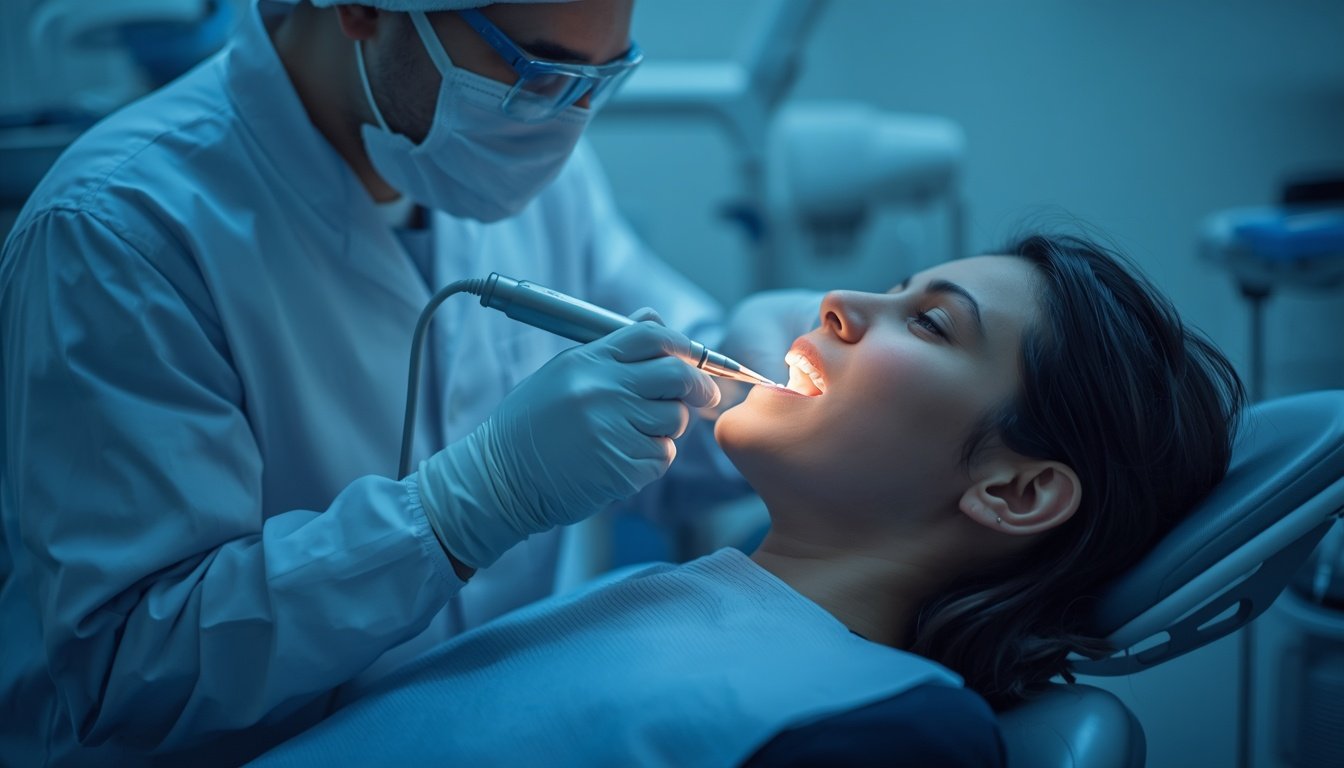
Laser dentistry uses concentrated light energy to interact with dental or oral tissues. Different dental lasers are designed for different applications. Some are primarily used for soft tissues such as the gums, while others can interact with hard tissues such as teeth.
Depending on the laser system and the procedure, laser technology may be considered for selected:
- Gum procedures
- Soft-tissue treatments
- Cavity-related procedures
- Root canal disinfection
- Gum reshaping
- Certain restorative procedures
- Selected cosmetic dental treatments
- Oral surgical procedures
However, having access to laser technology does not mean that every dental procedure should be performed with a laser.
The appropriate treatment depends on the diagnosis, the condition of the tooth or gums, the treatment objective and the dentist’s clinical assessment.
Can Laser Dentistry Be Used Alongside Conventional Dental Treatment?
Yes, Laser Dentistry Can Complement Traditional Techniques
Laser dentistry and conventional dentistry do not necessarily have to be competing approaches.
In fact, a dental treatment plan can involve both.
For example, a dentist may use a laser for a selected soft-tissue procedure while using conventional dental instruments for another part of the same treatment.
This can be particularly relevant when several dental problems need to be addressed at the same time.
For example, a patient may need:
- Treatment of gum tissue
- Tooth preparation
- Root canal treatment
- A dental crown
- Bite adjustment
- Follow-up care
Laser technology may have a role in selected parts of the treatment, while conventional techniques remain necessary for other stages.
The goal is not to use a laser simply because it is newer. The goal is to use the most appropriate technique for the dental problem.
Why Might Dentists Combine Laser and Conventional Dental Treatment?
There are several situations in which combining technologies may be considered.
1. Gum Treatment Alongside Restorative Dentistry
Healthy gums are important when restoring a damaged tooth.
If a patient needs a dental crown but also has a gum-related concern, the dentist may need to address the gum tissue before or around restorative treatment.
In selected cases, a dental laser may be used for soft-tissue management or gum reshaping.
Once the gum condition has been addressed, conventional restorative techniques may be used to prepare and restore the tooth.
If you are considering a crown, you can also explore the dental services offered by The Dental Crowns.
2. Laser Dentistry and Root Canal Treatment
Root canal treatment is another area where patients may hear about laser-assisted techniques.
A root canal involves removing infected or damaged tissue, cleaning and shaping the root canal system, disinfecting it and sealing it appropriately.
Laser technology may be used as an adjunct to conventional root canal procedures in selected cases.
It does not mean that traditional root canal instruments are automatically unnecessary.
The exact technique depends on the tooth, infection, anatomy and treatment plan.
If you want to learn more about this treatment, visit the Painless Root Canal Treatment service offered by The Dental Crowns.
3. Laser-Assisted Gum Contouring Before a Dental Crown
The appearance and health of the gum line can influence the final appearance of a dental crown, especially when a crown is being placed on a visible front tooth.
If excessive gum tissue affects the tooth’s appearance or access to the treatment area, gum contouring may sometimes be considered.
A laser may be used for selected soft-tissue procedures because it can precisely target tissue.
However, laser gum contouring is not required for every crown patient.
The dentist first needs to determine whether gum reshaping is actually necessary.
4. Laser Technology and Conventional Cavity Treatment
Certain dental lasers can be used for selected cavity-related procedures.
However, the availability of a laser does not mean that every cavity should be treated with one.
Depending on the size, depth and location of decay, conventional instruments and restorative materials may still be required.
The treatment should therefore be based on the condition of the tooth rather than the technology alone.
5. Laser Dentistry During Comprehensive Dental Treatment
Some patients require more than one dental procedure.
For example, someone may have:
- A damaged tooth
- Gum inflammation
- An existing filling
- A root canal requirement
- A missing tooth
- Cosmetic concerns
In such cases, the dentist may create a comprehensive treatment plan using several different techniques.
Laser dentistry can potentially be incorporated into selected stages where appropriate, while conventional treatment remains part of the overall plan.
This is one reason it is better to think of laser dentistry as an additional clinical technology rather than a complete replacement for conventional dentistry.
Laser Dentistry vs Conventional Dental Treatment
Patients often want to know whether laser dentistry is better than conventional dental treatment.
There is no single answer for every patient.
The two approaches can have different applications, and the appropriate option depends on the procedure.
| Factor | Laser Dentistry | Conventional Treatment |
|---|---|---|
| Soft-tissue treatment | Useful in selected procedures | Commonly used |
| Gum procedures | Can be used in selected cases | Also widely used |
| Root canal treatment | May assist with selected procedures | Fundamental treatment approach |
| Tooth preparation | Possible with selected laser systems | Commonly performed with conventional instruments |
| Bleeding control | May help in selected soft-tissue procedures | Depends on technique |
| Anesthesia | May sometimes be reduced | Depends on procedure |
| Applicability | Procedure-specific | Broad range of applications |
| Can replace all dental instruments? | No | Not applicable |
Cleveland Clinic describes dental lasers as a promising complement to standard treatment methods rather than a complete replacement for traditional dental instruments.
Does Laser Dentistry Mean You Will Not Need a Dental Drill?
Not necessarily.
This is one of the most important points for patients to understand.
Some laser systems can be used on hard dental tissues, while others are primarily intended for soft tissues.
Even when a laser is used, conventional instruments may still be necessary depending on the treatment.
For example, a patient receiving a dental crown may require conventional tooth preparation, impressions or digital scanning, crown fabrication and bite adjustment.
Therefore, choosing laser dentistry does not automatically mean that every part of the treatment will be performed without conventional dental instruments.
Can Laser Dentistry Be Used With Dental Crowns?
Yes, laser technology may be incorporated into selected stages of dental crown treatment when clinically appropriate.
A crown treatment may involve:
Step 1: Dental Examination
The dentist examines the tooth and surrounding gums and may recommend dental X-rays or other diagnostic procedures.
Step 2: Treatment Planning
The dentist determines whether the tooth requires a crown and whether additional treatment is necessary.
Step 3: Gum or Soft-Tissue Management
If required, selected laser-assisted soft-tissue procedures may be considered.
Step 4: Tooth Preparation
The tooth is prepared using the technique appropriate for the specific restoration.
Step 5: Crown Fabrication
An impression or digital scan may be used to create the dental crown.
Step 6: Crown Placement
The dentist evaluates the crown’s fit, margins, appearance and bite before final placement.
Step 7: Follow-Up
The patient receives instructions regarding oral hygiene, care and follow-up.
A laser may be relevant to one or more selected stages, but it is not automatically required for every crown procedure.
Can Laser Dentistry Be Used Alongside Root Canal Treatment?
It can be used as an adjunct in selected situations.
Root canal treatment primarily focuses on cleaning, shaping, disinfecting and sealing the root canal system.
Laser technology may be considered for certain disinfection-related applications, but it does not eliminate the need for proper root canal treatment.
Patients should therefore ask their dentist exactly what role the laser will have in their particular case.
What Are the Potential Benefits of Combining Treatment Techniques?
When clinically appropriate, combining laser and conventional techniques may provide several potential advantages.
Targeted Treatment
Laser energy can be highly focused, which may be useful for selected soft-tissue procedures.
Treatment Flexibility
The dentist can choose between laser and conventional techniques depending on the area being treated.
Potentially Reduced Bleeding
Some soft-tissue laser procedures may help control bleeding during treatment.
Patient Comfort
Certain laser procedures may be associated with less discomfort or reduced need for anesthesia, although this varies according to the procedure and patient.
Comprehensive Treatment
Using different technologies can allow the dentist to address multiple aspects of a patient’s dental condition within one overall treatment plan.
These benefits should be considered potential benefits rather than guaranteed outcomes. The result depends on the procedure, laser type, clinical technique and individual patient factors.
Is Laser Dentistry Always Necessary?
No.
Laser dentistry is not automatically necessary simply because a patient is undergoing dental treatment.
For some patients, conventional treatment may be entirely appropriate.
For others, laser technology may provide a useful option for a particular stage of treatment.
A dentist should evaluate factors such as:
- The dental diagnosis
- Tooth condition
- Gum health
- Type of treatment required
- Location of the problem
- Existing restorations
- Patient preferences
- Overall oral health
The most appropriate treatment should be selected after an examination.
Is Laser Dentistry Completely Painless?
Laser dentistry is often associated with comfortable treatment, but it is not accurate to assume that every laser procedure is completely painless.
The experience can depend on:
- Type of laser
- Treatment area
- Depth of treatment
- Dental condition
- Individual sensitivity
- Procedure being performed
- Whether conventional instruments are also required
- Whether local anesthesia is needed
The Dental Crowns describes its laser dentistry service as focused on patient comfort and minimally invasive treatment, but patients should still discuss expected discomfort and anesthesia requirements with their dentist before treatment.
Who May Be a Candidate for Laser-Assisted Dental Treatment?
Laser dentistry may be considered for patients requiring selected procedures involving:
- Gum tissue
- Soft-tissue treatment
- Certain cavity-related procedures
- Root canal disinfection
- Gum reshaping
- Selected restorative procedures
- Certain cosmetic dental treatments
However, not every patient will benefit from laser treatment.
The dentist may first perform a clinical examination and, when necessary, recommend X-rays or other diagnostic tests.
Only after evaluating the condition can the dentist determine whether laser treatment, conventional treatment or a combination of both is appropriate.
What Should You Ask Your Dentist Before Laser Treatment?
If laser dentistry has been recommended, consider asking:
- Why is laser treatment being recommended for my condition?
- What type of laser will be used?
- Can conventional treatment achieve the same objective?
- Will conventional instruments also be required?
- Will I need local anesthesia?
- What part of my treatment will involve the laser?
- Are there any alternatives?
- What should I expect during recovery?
- Are there additional costs?
- What follow-up care will I need?
Understanding the purpose of the laser can help you make an informed decision about your dental treatment.
How Laser Dentistry Fits Into Modern Dental Care
Modern dentistry involves much more than choosing between a laser and a traditional dental instrument.
A comprehensive treatment plan may combine:
- Digital diagnostics
- Dental X-rays
- Conventional dental instruments
- Laser technology
- Restorative materials
- Dental crowns
- Root canal treatment
- Dental implants
- Gum treatment
- Preventive care
- Regular follow-up
The dentist’s role is to determine which combination is appropriate for the patient’s specific needs.
This patient-specific approach is particularly important when multiple dental conditions are present.
Why Choose The Dental Crowns for Laser Dentistry in Noida?
The Dental Crowns provides a range of dental services in Noida, including laser dentistry, root canal treatment, implants, porcelain crowns, bridges, veneers and other general, cosmetic and surgical dental treatments.
The clinic’s laser dentistry service describes applications involving gum disease, cavities, root canal-related disinfection and selected cosmetic procedures.
If you are considering laser dentistry in Noida, a dental examination can help determine whether laser-assisted treatment, conventional treatment or a combination of techniques is appropriate for your condition.
Explore the complete dental services at The Dental Crowns or discuss your treatment requirements with a dental professional.
Frequently Asked Questions
1. Can laser dentistry be used alongside conventional dental treatment?
Yes. Laser dentistry can be used as a complementary technology alongside conventional dental treatment in selected cases. It does not completely replace traditional dental instruments.
2. Can laser dentistry be used with dental crowns?
Yes. Laser technology may be considered for selected gum or soft-tissue procedures associated with crown treatment, while conventional techniques may still be needed for tooth preparation and crown placement.
3. Can a laser replace a dental drill?
Not always. Some dental lasers can interact with hard tissue, but conventional instruments may still be necessary depending on the procedure.
4. Can laser dentistry be used during root canal treatment?
Laser technology may be used as an adjunct for selected root canal disinfection procedures. The dentist determines whether it is appropriate for the individual case.
5. Is laser dentistry better than conventional dentistry?
Neither approach is automatically better for every patient. The appropriate technique depends on the dental condition and treatment being performed.
6. Is laser dentistry completely painless?
Not necessarily. Some laser procedures may be comfortable and may require less anesthesia, but discomfort varies according to the procedure and patient.
7. Can laser dentistry help with gum treatment?
Yes. Certain dental lasers can be used for selected soft-tissue and gum procedures.
8. Does every dental crown require laser treatment?
No. Laser treatment is not routinely required for every dental crown.
9. Can laser dentistry make a dental crown last longer?
Laser dentistry does not guarantee longer-lasting dental crowns. Crown longevity depends on factors such as tooth condition, crown fit, material, bite, oral hygiene and regular dental care.
10. Where can I get laser dentistry in Noida?
The Dental Crowns offers laser dentistry among its dental services in Noida. Patients should undergo a professional evaluation to determine the appropriate treatment for their condition.
Final Takeaway
Can laser dentistry be used alongside conventional dental treatment?
Yes.
Laser dentistry can complement conventional dental treatment when it provides a suitable clinical option for a particular procedure. It may be incorporated into selected gum procedures, restorative treatment, root canal-related procedures and other dental applications.
However, laser dentistry should not be viewed as a universal replacement for conventional dental treatment.
The right treatment depends on the patient’s diagnosis, the condition of the teeth and gums, the procedure required and the dentist’s clinical assessment.
If you are considering laser dentistry in Noida, ask your dentist how laser technology could fit into your individual treatment plan and whether conventional techniques, laser-assisted treatment or a combination of both would be appropriate.