Laser dentistry has become an important part of modern dental care. Dental lasers can be used for selected gum procedures, soft-tissue treatments, certain cavity-related procedures, root canal disinfection and other applications. Because laser technology can offer precise treatment in appropriate situations, many patients searching for laser dentistry in Noida wonder whether it can replace conventional dental treatment completely.
The answer is no.
While laser dentistry can be useful for specific dental procedures, it also has limitations. The effectiveness of a dental laser depends on the type of laser, wavelength, energy settings, treatment area, diagnosis and the dentist’s clinical experience. Laser treatment is not automatically suitable for every patient or every dental problem.
If you are considering laser dental treatment, understanding its limitations can help you have a more informed discussion with your dentist.
What Is Laser Dentistry?
Laser dentistry uses concentrated light energy to interact with dental or oral tissues. Different wavelengths and laser systems are designed for different applications.
Depending on the technology and treatment plan, lasers may be used for:
- Selected gum procedures
- Soft-tissue treatment
- Gum reshaping
- Certain cavity-related procedures
- Root canal disinfection as an adjunct
- Treatment of some oral soft-tissue conditions
- Dental sensitivity management
- Selected surgical procedures
- Certain cosmetic dental applications
However, laser dentistry does not mean that every dental procedure can be completed using a laser alone.
The Dental Crowns provides laser dentistry as part of its range of general, cosmetic and surgical dental services. You can explore the clinic’s complete dental services before discussing which treatment may be appropriate for your condition.
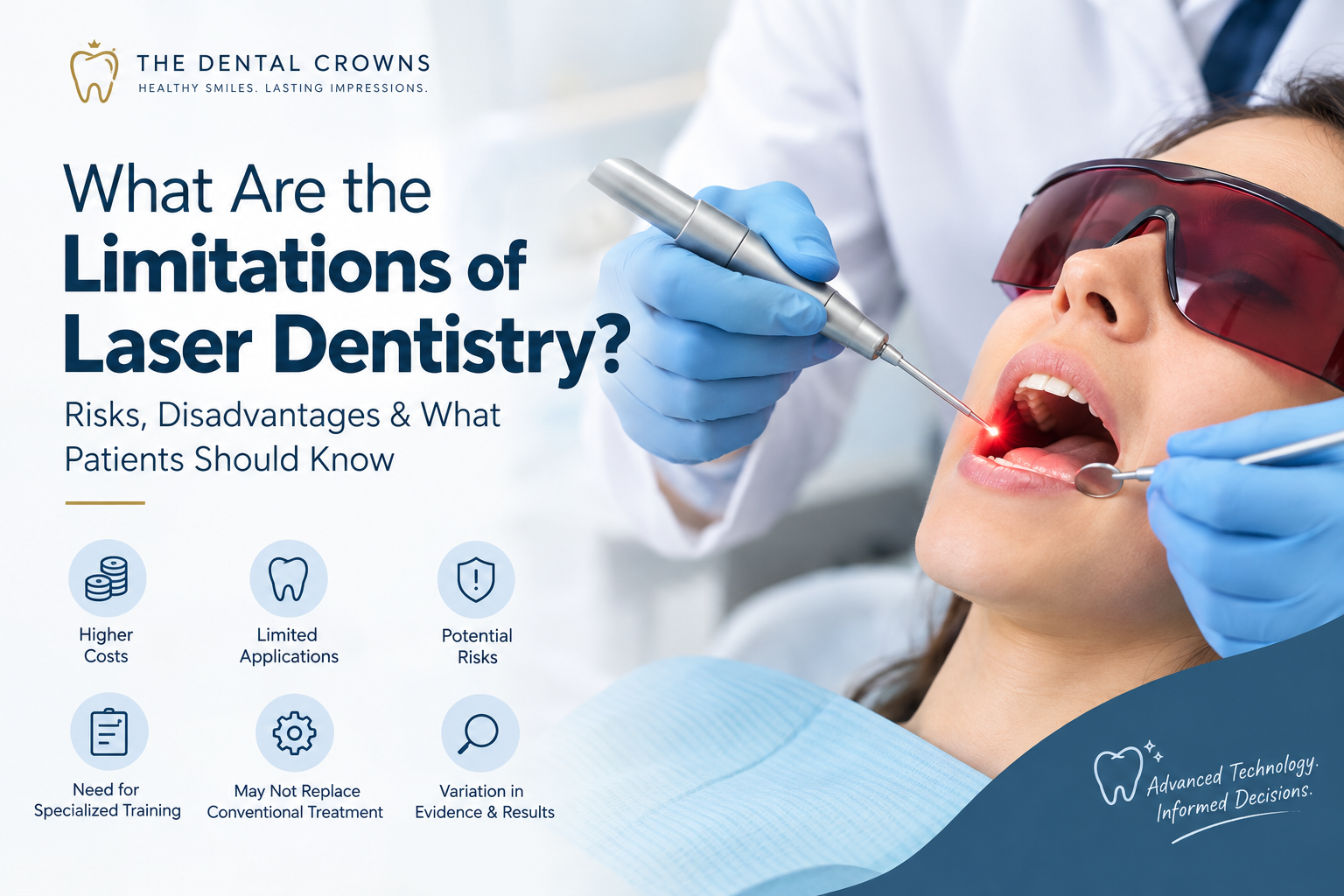
What Are the Limitations of Laser Dentistry?
1. Laser Dentistry Cannot Treat Every Dental Problem
One of the biggest limitations of laser dentistry is that it is not a universal replacement for conventional dental treatment.
Some dental problems require procedures involving mechanical instruments, dental fillings, root canal instruments, crowns, implants or other techniques.
For example, if a tooth has significant structural damage, a dentist may need to restore it with a filling, crown or another appropriate restoration. A laser alone cannot replace every step required to restore a damaged tooth.
This is why treatment should be selected according to the diagnosis rather than simply choosing the newest technology.
2. Different Lasers Have Different Applications
There is no single “dental laser” that performs every type of treatment.
Different laser systems have different wavelengths and characteristics. Their interaction with enamel, dentin, gums and other tissues can vary.
As a result, a laser that is appropriate for one procedure may not be appropriate for another.
Patients should therefore ask their dentist:
- Which laser will be used?
- Why is it being recommended?
- What part of the procedure will involve the laser?
- Will conventional dental instruments also be required?
- What results can realistically be expected?
The technology and treatment protocol matter as much as the word “laser.”
3. Laser Treatment Can Be More Expensive
Another potential limitation is cost.
Dental laser equipment can involve significant investment, maintenance and staff training. Depending on the clinic, procedure and technology used, laser-assisted treatment may therefore cost more than some conventional treatment options.
However, price should not be the only factor used to select a dental treatment.
A dentist should first determine what procedure is clinically appropriate and then explain the available treatment options and associated costs.
If you are comparing treatment options in Noida, ask for a clear explanation of what is included in the treatment cost.
4. Laser Dentistry Does Not Always Mean Completely Painless Treatment
Laser dentistry is often associated with comfortable or minimally invasive dental treatment. However, “laser” does not automatically mean that a procedure will be completely painless.
The amount of discomfort depends on:
- The procedure being performed
- The treatment area
- The patient’s sensitivity
- The severity of the dental problem
- The laser settings
- Whether conventional instruments are also required
Some laser procedures may reduce discomfort in appropriate situations, but patients should not expect every laser procedure to be completely pain-free.
For example, laser technology may be incorporated into a root canal treatment protocol, but it does not necessarily replace conventional cleaning, shaping, irrigation and sealing.
You can read more about this in our guide on laser dentistry during root canal treatment.
5. Proper Training Is Essential
Dental lasers require appropriate knowledge, training and clinical judgment.
Incorrect laser settings, excessive energy or improper application can potentially cause unwanted thermal effects or damage to tissues.
For this reason, the dentist needs to understand:
- Laser wavelength
- Energy settings
- Pulse duration
- Tissue interaction
- Treatment technique
- Safety precautions
- Appropriate indications and contraindications
Patients should feel comfortable asking about the dentist’s experience with the particular laser procedure being recommended.
6. Conventional Dental Treatment May Still Be Necessary
A common misconception is that choosing laser dentistry eliminates conventional dental treatment.
In many cases, this is not true.
Laser technology may function as an adjunct, meaning it is used alongside established treatment methods.
This is particularly relevant to root canal treatment. Laser technology may assist with disinfection in selected cases, but proper endodontic treatment still involves essential steps such as cleaning, shaping, irrigation and sealing.
Research into laser-assisted endodontic techniques has shown potential benefits in certain applications, but studies also differ in laser type, protocols and outcomes. This means patients should avoid assuming that laser treatment is automatically superior in every case.
7. Evidence Varies Depending on the Procedure
Another important limitation is that the evidence for laser dentistry is not equally strong for every application.
A systematic review investigating the use of lasers for dental-caries prevention found that the available studies had limitations including small numbers of participants, different laser types and concerns regarding risk of bias. The researchers concluded that higher-quality evidence was needed before laser treatment could be recommended as an alternative to traditional preventive approaches.
This does not mean dental lasers are ineffective.
Instead, it means the evidence should be considered procedure-specific.
A treatment that has useful evidence for one dental application should not automatically be assumed to provide the same benefit for another.
8. Treatment Protocols Are Not Always Standardized
Laser dentistry involves several variables, including:
- Laser type
- Wavelength
- Energy density
- Pulse mode
- Exposure time
- Treatment frequency
- Tissue being treated
- Treatment objective
Because these factors can differ between studies and clinical protocols, comparing laser treatments is not always straightforward.
Recent research reviews have also highlighted heterogeneity between laser systems and treatment protocols, reinforcing the need for better standardization and higher-quality research in some applications.
9. Lasers Cannot Replace Good Diagnosis
Technology cannot replace the importance of an accurate diagnosis.
Before recommending laser treatment, a dentist may need to assess:
- Your symptoms
- Tooth condition
- Gum health
- Existing restorations
- Infection
- Tooth structure
- Root anatomy
- X-rays or other diagnostic information
For example, tooth pain could result from decay, infection, a cracked tooth, gum disease, trauma or another condition. Treating the symptom with a particular technology without identifying its underlying cause is not an appropriate approach.
The diagnosis should come first; the technology should follow.
10. Laser Dentistry May Not Be Necessary for Every Patient
Another limitation is simply that not every patient needs laser treatment.
If a conventional procedure can effectively address the dental problem, the dentist may decide that laser assistance is unnecessary.
This is especially important because patients sometimes assume that newer technology automatically produces better results.
The appropriate question is not:
“Can a laser be used?”
A better question is:
“Would laser technology provide a meaningful benefit in my specific case?”
That answer can only be determined after a dental examination.
Can Laser Dentistry Cause Side Effects?
Laser treatment must be performed with appropriate safety measures.
Depending on the type of laser and procedure, incorrect use can potentially result in unwanted thermal effects or tissue damage. Eye protection and appropriate clinical protocols are therefore important when dental lasers are used.
The potential risks depend on the specific procedure, laser system and settings.
Patients should ask their dentist to explain both the expected benefits and possible risks before treatment.
Is Laser Dentistry Better Than Traditional Dentistry?
There is no single answer that applies to every dental procedure.
Laser technology can provide useful advantages in selected situations, but it does not automatically replace conventional dentistry.
The appropriate treatment depends on:
- Your diagnosis
- Severity of the condition
- Treatment objective
- Available technology
- Dentist’s expertise
- Expected benefits
- Potential risks
- Cost
- Alternative treatment options
For some procedures, laser technology may be a useful adjunct. For others, conventional treatment may remain the primary approach.
Laser Dentistry and Root Canal Treatment
Laser technology is sometimes used as an adjunct during root canal treatment.
Potential applications include:
- Supporting bacterial reduction
- Laser-assisted irrigation
- Root canal disinfection
- Selected approaches intended to support postoperative comfort
However, laser treatment should not be presented as a complete replacement for conventional root canal treatment.
The objective of root canal treatment is to clean, disinfect and seal the root canal system appropriately.
If you are experiencing persistent tooth pain, sensitivity or swelling, you can learn more about painless root canal treatment in Noida.
Laser Dentistry in Sector 74, 75, 76, 77, 78 and 79 Noida
People searching for laser dentistry near Sector 74, Sector 75, Sector 76, Sector 77, Sector 78 or Sector 79 Noida may find several treatment options online.
The Dental Crowns is located at Civitech Stadia, Sector 79, Noida, and lists laser dentistry among its dental services.
Patients from nearby sectors can discuss whether laser treatment is appropriate for their specific dental condition.
The clinic also provides treatments including dental implants, root canal treatment, crowns, bridges and other dental procedures.
You can start by visiting the The Dental Crowns services page and then discuss your treatment requirements with the dental team.
For additional information, you can also read:
- Laser Dentistry Near Noida Sector 77: Benefits and Treatment Options
- Laser Dental Treatment Near Sector 76 Noida: Benefits and Expectations
- What Should You Ask Your Dentist Before Choosing Laser Dentistry?
- Can Laser Dentistry Be Used During Root Canal Treatment?
These related articles can help patients understand how laser dentistry may be used and what questions to ask before treatment.
Questions to Ask Before Choosing Laser Dentistry
Before undergoing laser dental treatment, consider asking:
Is laser treatment actually necessary for my condition?
The dentist should explain why the technology is being recommended.
Will laser treatment replace conventional treatment?
In many situations, it may be used as an adjunct rather than a complete replacement.
Which type of laser will you use?
Different lasers have different applications.
What are the possible risks?
Ask about procedure-specific risks, recovery and expected discomfort.
How much will the treatment cost?
Request a clear treatment estimate and ask whether additional procedures may be required.
Are there conventional alternatives?
Understanding alternatives allows you to make an informed treatment decision.
What result should I realistically expect?
A good treatment discussion should include realistic expectations rather than promises of guaranteed results.
Frequently Asked Questions About the Limitations of Laser Dentistry
What is the biggest limitation of laser dentistry?
The biggest limitation is that laser dentistry is not a universal replacement for conventional dental treatment. Its usefulness depends on the dental condition, laser type, treatment protocol and clinical objective.
Is laser dentistry completely painless?
No. Some laser procedures may be comfortable, but discomfort varies depending on the procedure and individual patient.
Can laser dentistry replace a root canal?
Laser technology does not automatically replace conventional root canal treatment. It may be used as an adjunct for selected applications such as disinfection.
Is laser dentistry expensive?
The cost varies according to the procedure, clinic, technology and treatment requirements. Laser treatment may cost more in some situations because of equipment and training requirements.
Is laser dentistry safe?
When appropriate equipment, settings and safety protocols are used by trained dental professionals, laser applications can be incorporated into dental treatment. The specific risks depend on the procedure and laser technology.
Can everyone get laser dental treatment?
No. Laser treatment is not suitable or necessary for every patient. A dentist should first evaluate the dental condition.
Is laser dentistry better than conventional dentistry?
Not necessarily. Laser technology may be beneficial for selected procedures, while conventional treatment remains appropriate or necessary for many dental problems.
Does laser dentistry have any disadvantages?
Yes. Potential limitations include cost, limited indications, variation in evidence, equipment requirements, the need for specialized training and the fact that conventional treatment may still be necessary.
Final Thoughts
So, what are the limitations of laser dentistry?
Laser dentistry is a useful technology, but it is not a universal solution for every dental problem. Its limitations include restricted applications, potentially higher costs, the need for specialized equipment and training, variable evidence across different procedures, and the fact that conventional dental techniques may still be required.
The most important consideration is not whether a treatment uses a laser, but whether that treatment is appropriate for your particular dental condition.
If you are considering laser dentistry in Noida, including around Sector 74, Sector 75, Sector 76, Sector 77, Sector 78 or Sector 79, discuss your diagnosis, treatment options, expected benefits, risks and costs with a qualified dentist before proceeding.
For patients in Sector 79 and nearby areas, The Dental Crowns offers laser dentistry along with root canal treatment, dental implants, crowns and other dental services. Visit the Dental Crowns Services page to explore the available treatments.