A damaged tooth can make everyday activities like eating, drinking and speaking uncomfortable. Whether the damage happened because of tooth decay, an accident, biting something hard or an old filling, getting the tooth evaluated early can help determine whether it can be restored.
If you are searching for a damaged tooth in Sector 77 Noida, you may have come across dental crown treatment as a possible solution. But does every damaged tooth need a crown? Not necessarily.
A dental crown may be recommended when a tooth has lost significant structure and needs additional protection and support. The American Dental Association explains that crowns can strengthen weak teeth, protect broken teeth and restore teeth that have already been damaged.
For residents of Sector 77 and nearby areas, understanding when a dental crown is appropriate can help you discuss the right treatment option with your dentist.
Quick Answer: Can a Dental Crown Fix a Damaged Tooth?
Yes, a dental crown can be used to restore certain damaged, weakened, cracked, broken or heavily decayed teeth.
However, the appropriate treatment depends on how much healthy tooth structure remains and whether the tooth has problems such as deep decay or infection.
Depending on the condition of the tooth, treatment could include:
- Dental filling
- Dental bonding
- Inlay or onlay
- Dental crown
- Root canal treatment followed by a crown
- Dental extraction in cases where the tooth cannot be predictably restored
A dentist needs to examine the tooth before determining which treatment is appropriate. Cleveland Clinic notes that crowns are commonly used for weak, broken, decayed or worn teeth, while more severely damaged teeth may require other treatment.
What Is a Dental Crown?
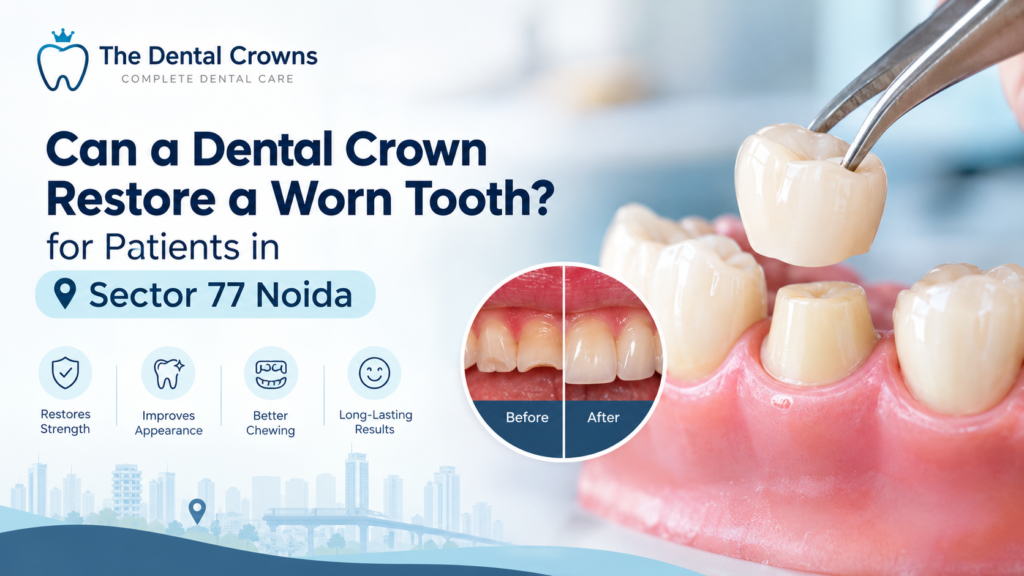
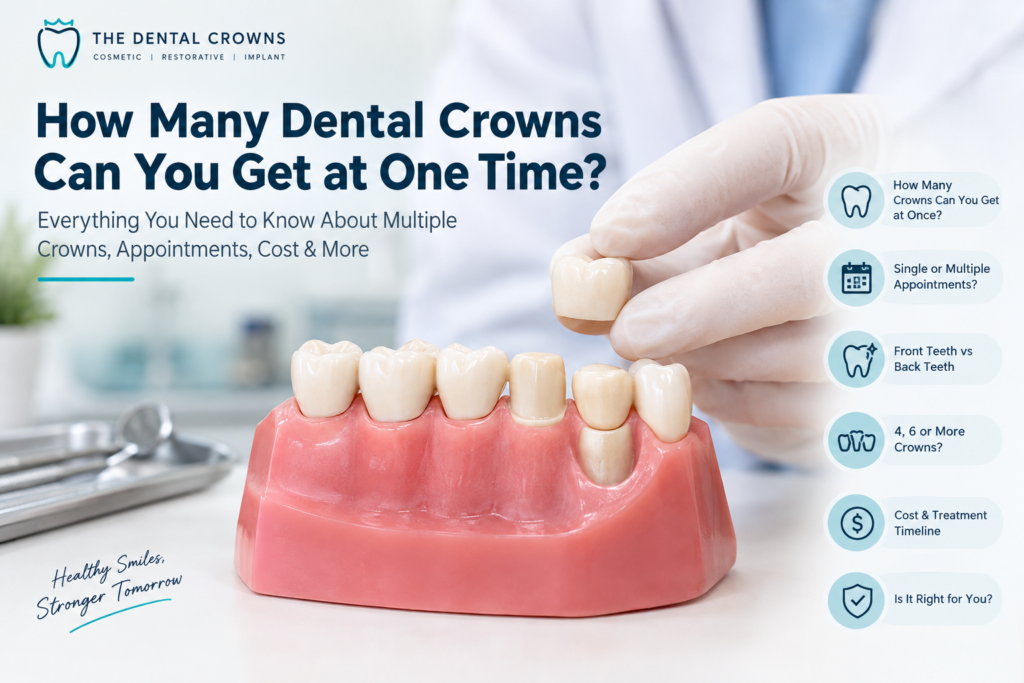
A dental crown is a custom-made restoration that covers the visible portion of a tooth.
It is sometimes called a dental cap because it fits over the tooth and helps restore its shape and function.
Dental crowns may be used to:
- Protect a weakened tooth
- Restore a broken tooth
- Strengthen a tooth with extensive damage
- Restore a heavily decayed tooth
- Protect a tooth after root canal treatment
- Restore certain worn-down teeth
- Improve the appearance of some damaged or discoloured teeth
- Cover a dental implant
The NHS also describes a crown as a cap that completely covers a natural tooth and notes that crowns can be used when a tooth has broken, decayed or become damaged.
What Causes a Damaged Tooth in Sector 77 Noida?
A damaged tooth can have several causes. Some common reasons include:
1. Tooth Decay
Untreated cavities can progressively weaken the tooth. When a large amount of tooth structure has been lost, a regular filling may not provide sufficient protection.
In such situations, your dentist may consider a crown depending on the remaining tooth structure.
2. Cracked or Fractured Tooth
A tooth can crack because of trauma, grinding, biting hard foods or other stresses.
The appropriate treatment depends on the location and severity of the crack. Some cracks may require a crown, while deeper damage may require root canal treatment or, in severe cases, extraction.
3. Broken Tooth
If a significant portion of a tooth has broken, a dental crown may help restore its shape and protect the remaining tooth structure.
4. Large or Old Fillings
A tooth with a large filling may become structurally weaker over time. If there is not enough natural tooth remaining to support another filling, a crown may be considered.
The American Dental Association specifically notes that crowns can strengthen teeth with large fillings when insufficient tooth structure remains to hold the filling.
5. Tooth Damage After Root Canal Treatment
A tooth that has undergone root canal treatment may need additional protection.
Depending on the tooth and remaining structure, a crown may be recommended to restore and protect it.
If you are also researching root canal treatment in Noida, discuss both the condition of the tooth and its planned restoration with your dentist.
Does Every Damaged Tooth Need a Dental Crown?
No.
This is one of the most important things to understand before choosing dental crown treatment.
A small chip or minor area of damage may sometimes be treated with bonding, contouring or another conservative restoration.
For example, Cleveland Clinic explains that smaller chips may be treated with procedures such as bonding, while more significant damage may require a crown or other restorative treatment.
A dentist may consider several factors, including:
- Amount of tooth structure remaining
- Size and location of the damage
- Presence of tooth decay
- Whether the tooth is cracked
- Condition of the dental pulp
- Gum health
- Bite and chewing forces
- Previous dental treatment
- Overall oral health
That is why a dental examination is important before deciding on a crown.
When Could a Dental Crown Be Recommended?
A crown may be considered when a tooth is sufficiently damaged or weakened that it needs full-coverage protection.
Common situations include:
- A large portion of the tooth has broken
- Extensive tooth decay has weakened the tooth
- A large filling has compromised the tooth structure
- A cracked tooth requires additional protection
- A tooth has been treated with root canal therapy
- A tooth has significant wear
- A tooth needs structural restoration rather than only cosmetic improvement
The goal is generally to restore the tooth’s strength, function and shape, while also maintaining an appropriate appearance.
Dental Crown vs Dental Filling: Which One Is Used for a Damaged Tooth?
The answer depends on the extent of the damage.
A dental filling is generally suitable for restoring smaller areas of tooth decay or damage.
A dental crown covers the tooth and provides more extensive structural coverage.
If the damage is somewhere between what can be treated with a filling and what requires a full crown, an inlay or onlay may sometimes be considered.
Cleveland Clinic notes that inlays and onlays can be options when a tooth is too damaged for a filling but does not necessarily require a crown.
Therefore, instead of choosing a treatment based only on the name of the procedure, ask your dentist:
“How much healthy tooth structure do I still have, and which restoration is appropriate for it?”
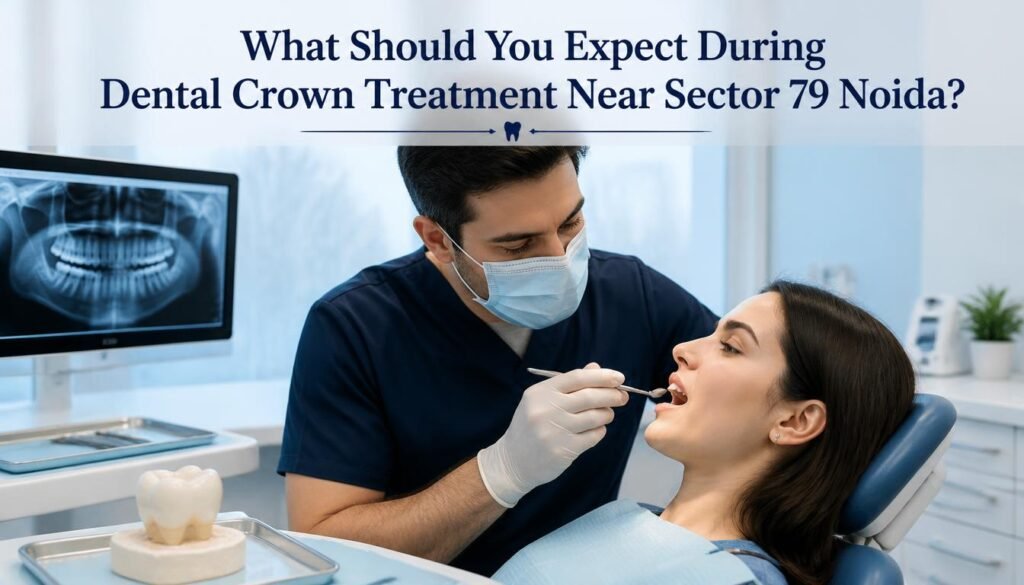
What Happens During Dental Crown Treatment?
The exact process varies according to the condition of your tooth and the type of crown selected.
A conventional crown treatment may involve several stages.
Step 1: Dental Examination
The dentist examines the damaged tooth and evaluates the surrounding teeth and gums.
If necessary, diagnostic imaging may also be used.
Step 2: Treatment Planning
The dentist determines whether the tooth can be restored with a crown and whether additional treatment, such as root canal therapy, is required.
Step 3: Tooth Preparation
The tooth is carefully prepared so that the crown can fit correctly.
Some natural tooth structure may need to be removed to create adequate space for the restoration.
Step 4: Crown Fabrication
Depending on the treatment workflow and crown type, impressions or digital scans may be used to create the restoration.
Step 5: Temporary Crown
In conventional treatment, a temporary crown may be placed while the permanent crown is being prepared.
Step 6: Permanent Crown Placement
When the permanent crown is ready, the dentist checks its:
- Fit
- Shape
- Colour
- Bite
- Overall appearance
The crown is then permanently cemented or bonded according to the treatment plan.
Cleveland Clinic describes a similar process involving tooth preparation, temporary restoration and placement of the permanent crown after its fit and appearance have been checked.
How Long Does a Dental Crown Last?
A dental crown is not necessarily a lifetime restoration.
Its lifespan depends on several factors, including:
- Crown material
- Oral hygiene
- Bite forces
- Tooth condition
- Grinding or clenching
- Eating habits
- Regular dental care
- Crown fit
Cleveland Clinic states that dental crowns generally last around 5 to 15 years with proper care, although individual results can vary.
You can also read our detailed guide:
Dental Crown Treatment Near Noida Sector 77: How Long Do Crowns Last?
This can help patients understand the factors that influence crown longevity.
How Should You Care for a Dental Crown?
A crown still requires regular oral hygiene.
After receiving a dental crown:
- Brush twice a day with fluoride toothpaste
- Clean between your teeth regularly
- Attend routine dental check-ups
- Avoid repeatedly chewing extremely hard objects
- Avoid using your teeth to open packages
- Tell your dentist if you grind or clench your teeth
- Contact your dentist if the crown becomes loose, chipped or uncomfortable
Cleveland Clinic recommends regular brushing, daily flossing, avoiding extremely hard or sticky foods and addressing grinding or clenching when caring for crowns.
Can a Dental Crown Improve the Appearance of a Damaged Tooth?
Yes, depending on the situation.
A crown can restore the shape and colour of a damaged tooth while also providing structural protection.
However, the primary purpose of a crown is generally restorative rather than purely cosmetic.
If the main concern is cosmetic, your dentist may discuss other options depending on the condition of your teeth.
For example, veneers generally cover the front surface of a tooth, while crowns provide full-coverage restoration.
What If the Damaged Tooth Is Painful?
Pain should not be ignored, especially when it is accompanied by:
- Swelling
- Severe sensitivity
- Pain while biting
- Persistent toothache
- A visible crack
- Gum swelling
- Bad taste or pus
- Fever
- Facial swelling
A damaged tooth may sometimes have underlying pulp involvement or infection.
If a crack reaches the pulp, root canal treatment may be required, followed by appropriate restoration such as a crown in suitable cases.
If you experience a dental emergency, the American Dental Association recommends seeking dental care promptly.
Can a Severely Damaged Tooth Still Be Saved?
Sometimes, yes.
The possibility of saving a damaged tooth depends on factors such as:
- Location of the damage
- Depth of the crack
- Amount of remaining tooth structure
- Condition of the root
- Presence of infection
- Gum and bone support
- Overall restorability of the tooth
A dentist may recommend restorative treatment when the tooth can be predictably repaired.
However, if a tooth is too severely damaged to restore, extraction and tooth replacement may need to be considered.
This is why delaying an evaluation after significant tooth damage may not be advisable.
Dental Crown Treatment in Sector 77 Noida
If you live in Sector 77 Noida and have a broken, cracked, decayed or weakened tooth, getting a professional examination can help you understand your treatment options.
The Dental Crowns is located at Civitech Stadia, Sector 79, Noida, making it accessible for patients from Sector 77 and surrounding Noida sectors.
The clinic’s website also provides information about dental crown treatments and related restorative procedures.
You can explore:
- Dental Crown in Sector 77 Noida – Best Solution to Restore Damaged Teeth
- Dental Crown Treatment Near Noida Sector 77 – How Long Do Crowns Last?
- Dental Crown Treatment Near Noida Sector 78 – Cost and Treatment Options
- How Long Does It Take to Get a Dental Crown in Noida?
- Porcelain Dental Crowns at The Dental Crown, Noida
These internal links help visitors move from this article to more detailed information about dental crowns, treatment timelines, crown materials and Sector 77/78-specific questions.
Why You Shouldn’t Delay Treatment for a Damaged Tooth
A damaged tooth may initially cause only mild sensitivity or a small visible chip.
However, the underlying problem may be more significant.
For example, a crack can progress, decay can become deeper, and an untreated infection can lead to more extensive dental problems.
This does not mean every damaged tooth will become worse immediately, but it does mean that professional evaluation is important when there is significant damage or persistent symptoms.
If you have recently damaged a tooth in Sector 77 Noida, consider arranging a dental examination rather than trying to determine the appropriate treatment based solely on symptoms.
Frequently Asked Questions About Damaged Teeth and Dental Crowns
1. Can a dental crown fix a damaged tooth?
A dental crown can restore certain damaged, broken, weakened or heavily decayed teeth when sufficient tooth structure remains. The dentist must determine whether the tooth is suitable for a crown.
2. Does every cracked tooth require a crown?
No. Treatment depends on the location and severity of the crack. Some minor cracks may need different treatment, while more significant cracks may require a crown or root canal treatment.
3. Can a crown be placed after a root canal?
Yes. Crowns are commonly used to restore and protect teeth that have undergone root canal treatment when appropriate.
4. How long does a dental crown last?
Dental crowns commonly last around 5 to 15 years with proper care, although individual longevity varies.
5. Is a crown better than a filling for a damaged tooth?
Neither is automatically better. A filling may be appropriate for a smaller restoration, while a crown may be considered when a tooth requires greater structural protection.
6. Can a damaged tooth be saved without extraction?
In many cases, a damaged tooth can be restored, but this depends on the severity and location of the damage and whether enough healthy structure remains.
7. Can a dental crown look natural?
Yes. Modern crown materials can be designed to closely match the appearance of surrounding teeth. The final result depends on the material, shade selection, laboratory work and clinical placement.
8. Is dental crown treatment painful?
The procedure is performed using appropriate local anaesthesia when required. Some sensitivity or gum tenderness may occur after treatment, but persistent or severe pain should be discussed with your dentist.
9. What should I do if my tooth breaks suddenly?
Avoid chewing on the affected side and arrange a dental examination promptly. If there is significant trauma, bleeding, swelling or severe pain, seek urgent dental care.
10. Can a crown protect a weak tooth?
Yes. One of the purposes of a dental crown is to provide coverage and protection for an appropriately selected weak or damaged tooth.
Final Takeaway
If you have a damaged tooth in Sector 77 Noida, a dental crown may be an option—but it should not be assumed that every damaged tooth needs one.
The right treatment depends on the extent of damage, remaining tooth structure, presence of decay or infection, gum health and overall condition of the tooth.
A dental crown can help restore the strength, shape, function and appearance of a suitably damaged tooth. If the tooth also has an infection or deep decay, additional treatment such as root canal therapy may be required before the final restoration.
If you are experiencing tooth pain, a visible crack, significant breakage or sensitivity, consider getting the tooth examined by a qualified dental professional.
Resources
For additional information about dental crowns and damaged teeth:
- American Dental Association – Crowns
- Cleveland Clinic – Dental Crowns
- NHS – Dental Treatments
- Cleveland Clinic – Cracked Tooth
- ADA – Dental Emergencies
Disclaimer: This article is for general educational purposes and does not replace an examination or diagnosis by a dental professional.