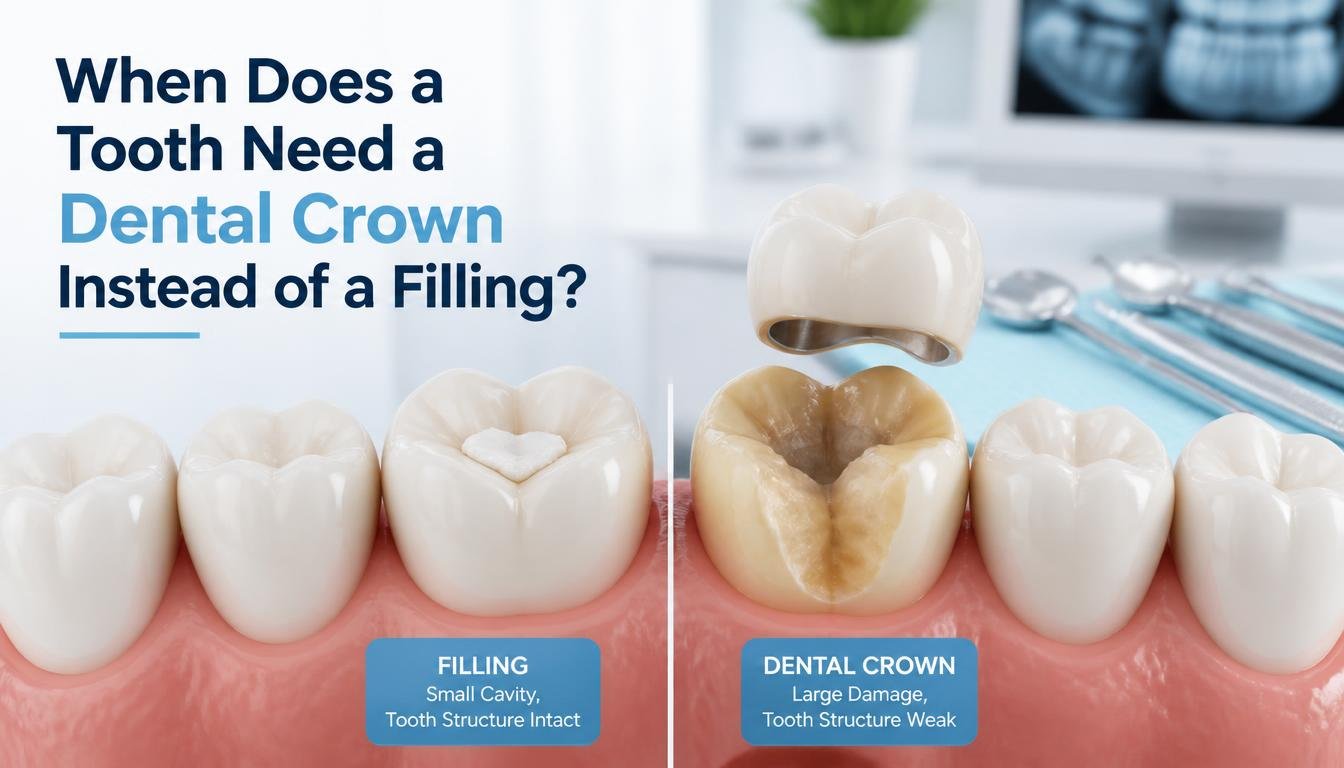
When a tooth develops decay, cracks, chips, or other damage, one of the first questions patients often ask is: “Do I need a dental filling or a dental crown?”
The answer depends largely on how much healthy tooth structure remains and how well the tooth can withstand normal biting and chewing forces.
A dental filling can be an excellent option when the damaged area is relatively small and enough strong tooth structure remains. However, when a tooth has lost a substantial amount of structure, has a large existing filling, is badly cracked or weakened, or requires additional protection after certain root canal treatments, a dental crown may be more appropriate.
The American Dental Association explains that crowns can strengthen teeth with large fillings when there is not enough natural tooth remaining to support the filling, protect weak or broken teeth, and restore damaged teeth.
If you are searching for dental crown treatment in Noida, understanding the difference between these two restorations can help you have a more informed conversation with your dentist.
What Is the Difference Between a Dental Filling and a Dental Crown?
A dental filling restores a specific area of a tooth after decay or minor damage has been removed. It is generally more conservative because it preserves more of the natural tooth when appropriate.
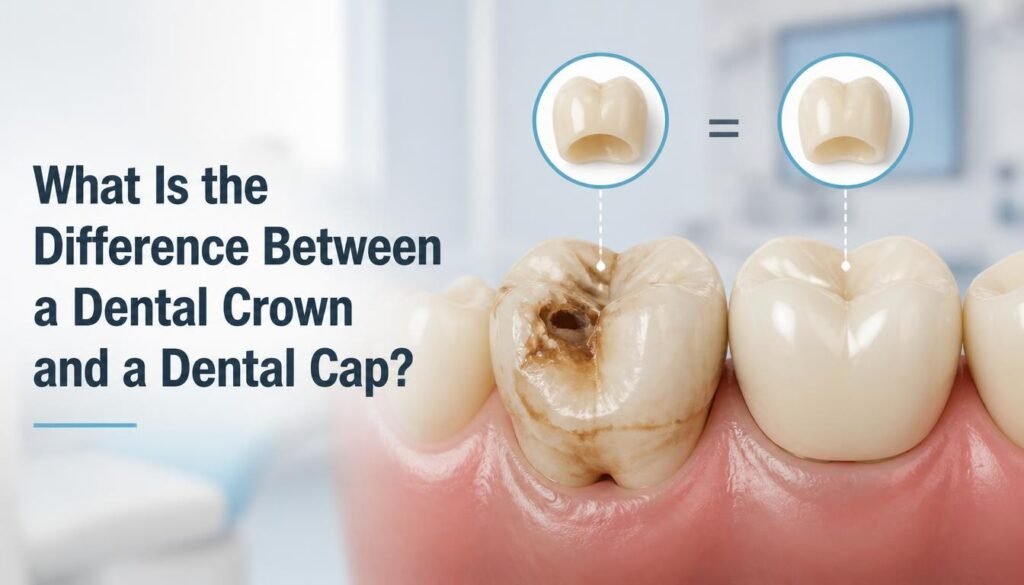
A dental crown, sometimes called a dental cap, covers a much larger portion of the visible tooth. It is designed to restore the tooth’s shape and function while providing protection when the remaining tooth structure is weakened.
In simple terms:
A filling repairs a damaged part of the tooth. A crown protects and restores a significantly weakened tooth.
The American Dental Association notes that restorative materials and treatment choices depend on factors such as the type and extent of the dental problem and the clinical situation.
When Is a Dental Filling Usually Enough?
A filling may be suitable when the tooth still has enough healthy structure to support the restoration.
Your dentist may consider a filling when:
- The cavity is small or moderate.
- Most of the tooth structure is healthy.
- The tooth is not significantly cracked.
- The remaining tooth walls are strong.
- The damage does not require full-coverage protection.
- The tooth can be restored predictably with a direct restoration.
Tooth-coloured restorations can also provide an aesthetic option for appropriate cavities and damaged areas. The Dental Crowns offers tooth-coloured restorations designed to restore damaged areas while maintaining a natural-looking appearance.
However, a filling is not automatically the best choice simply because it is smaller or less extensive than a crown.
The important question is:
Will the remaining tooth structure be strong enough after the damaged portion is removed?
If the answer is no, your dentist may recommend a crown or another type of restoration.
When Does a Tooth Need a Dental Crown Instead of a Filling?
There are several situations in which a dentist may recommend a crown rather than a conventional filling.
1. The Tooth Has a Very Large Cavity
One of the most common reasons for considering a crown is extensive tooth decay.
When decay destroys a large portion of the tooth, there may not be enough strong natural tooth structure left to support a conventional filling.
In such cases, simply replacing the missing area with filling material may not provide the level of protection the weakened tooth requires.
The Mayo Clinic notes that people with extensive decay or weakened teeth may need a crown to protect the remaining tooth structure and reduce the risk of fracture.
This is why treating a cavity early can be important.
A relatively small cavity may sometimes be restored with a filling. If decay progresses and more tooth structure is lost, treatment may become more extensive.
2. You Already Have a Very Large Filling
A tooth that has previously received a large filling may eventually become structurally weakened.
Why?
A large filling means a significant amount of natural tooth structure has already been lost. Over time, the remaining walls or cusps may be placed under considerable chewing forces.
The American Dental Association specifically notes that crowns can strengthen teeth with large fillings when insufficient natural tooth remains to hold the filling.
If you have an old, large filling and notice:
- Cracks around the filling
- Pain while biting
- A filling that repeatedly breaks
- Pieces of the tooth breaking away
- Sensitivity around the restoration
it is worth having the tooth examined.
A crown may be recommended if the tooth needs greater structural protection.
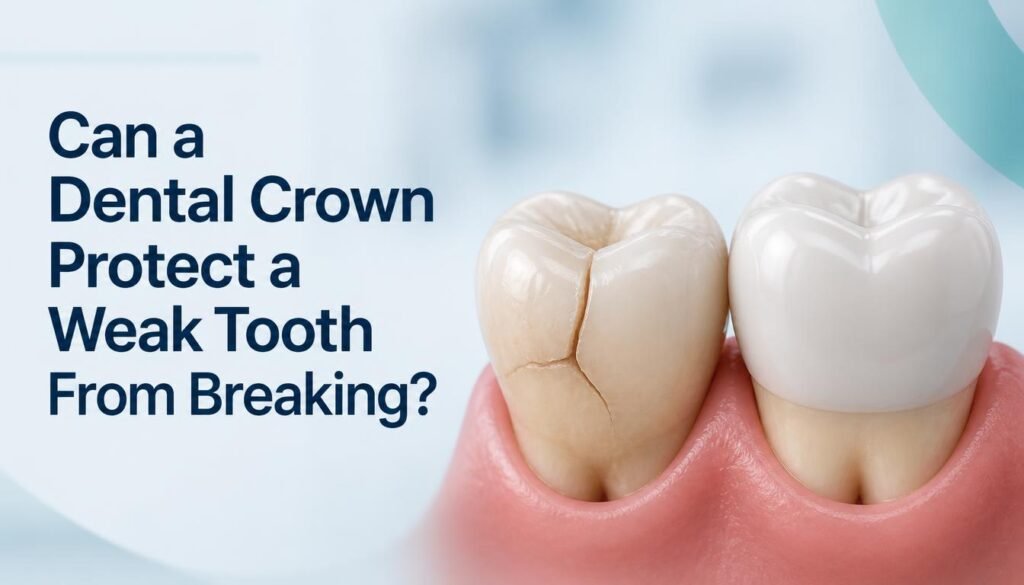
3. The Tooth Is Cracked or Fractured
A cracked tooth can require a different treatment approach from a simple cavity.
Some cracks may be managed with a filling or another conservative restoration. However, a more significant crack may require a crown to help protect the remaining tooth structure.
The American Association of Endodontists explains that treatment of cracked teeth depends on the location and severity of the crack. If a crack extends into the pulp, root canal treatment followed by a crown may be necessary in appropriate cases.
Do not assume that occasional pain means a crack is harmless.
Symptoms can include:
- Pain when biting
- Pain when releasing your bite
- Sensitivity to cold
- Intermittent discomfort
- A visible crack
- A chipped portion of the tooth
A dentist needs to assess the crack before deciding whether a filling, crown, root canal treatment, or another treatment is appropriate.
4. A Large Portion of the Tooth Has Broken Off
If a tooth has lost a significant portion because of trauma, decay, an old restoration, or biting on something hard, a filling may not provide enough structural support.
A crown can sometimes be used to rebuild and protect the remaining tooth.
However, not every broken tooth can be crowned.
Your dentist needs to determine:
- How much tooth structure remains
- Whether the tooth root is healthy
- Whether the pulp is affected
- Whether the crack extends below the gum line
- Whether the tooth can be predictably restored
If the tooth cannot be restored, other treatment options may need to be considered.
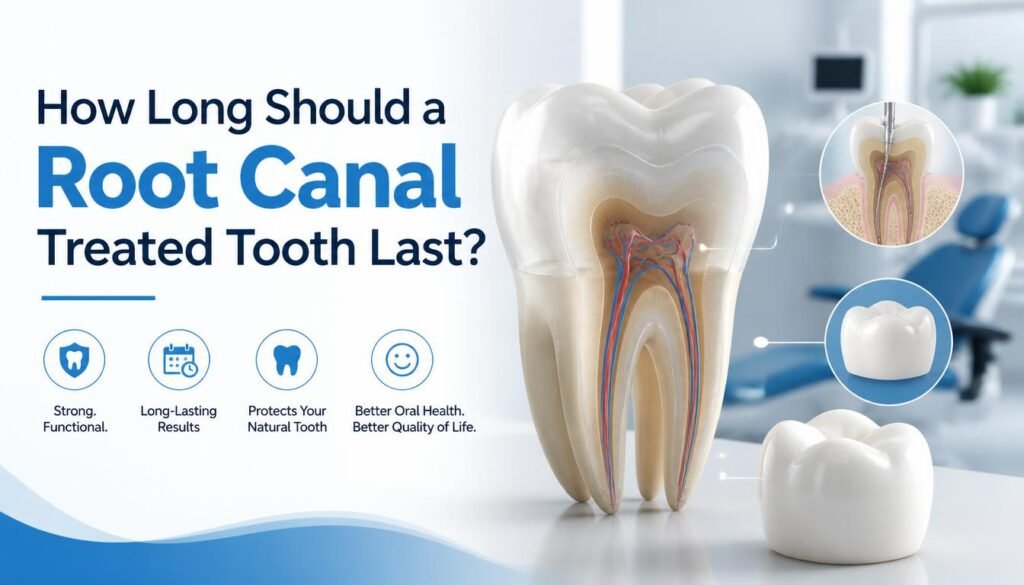
5. The Tooth Has Been Weakened After Root Canal Treatment
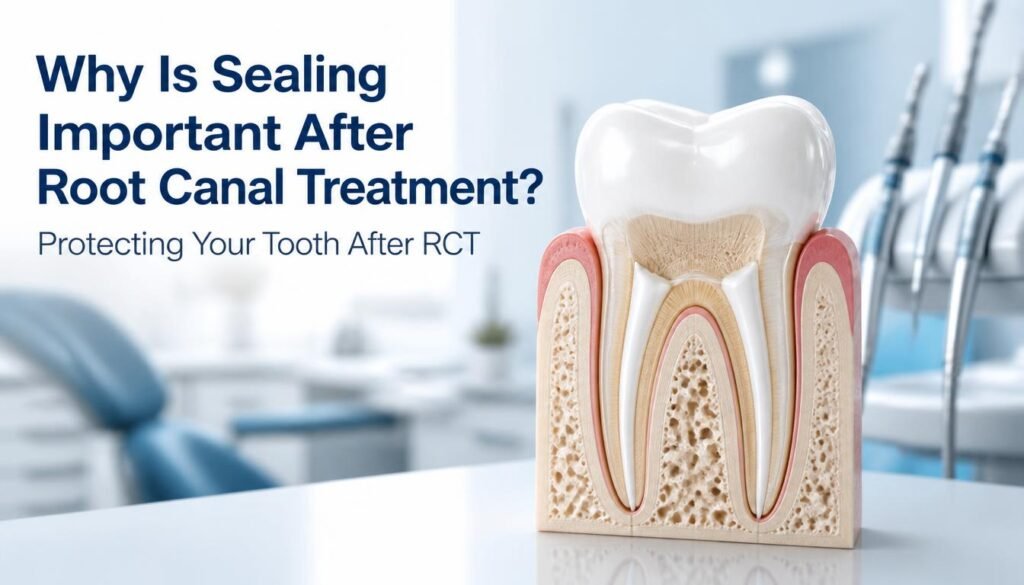
A tooth that has undergone root canal treatment may require a protective restoration depending on the amount of remaining tooth structure, the tooth’s location, and its functional demands.
The goal is to restore the tooth and protect the remaining structure from further damage.
If your tooth requires root canal treatment, you can learn more about painless root canal treatment in Noida offered by The Dental Crowns.
It is important to understand that not every root-canal-treated tooth automatically requires the exact same restoration. Your dentist should evaluate the individual tooth before recommending a crown.
6. The Tooth Is Severely Worn Down
Teeth can become worn because of factors such as long-term grinding, clenching, acid erosion, or other causes.
When significant tooth structure has been lost, a simple filling may not be enough to restore the tooth’s shape and function.
Depending on the underlying cause and the amount of remaining structure, your dentist may discuss a crown or another restorative option.
If you grind your teeth at night, tell your dentist because excessive biting forces can affect restorative treatment planning.
7. A Previous Filling Keeps Breaking
Repeatedly damaged fillings can be a sign that the tooth requires a different type of restoration.
For example, if a large filling repeatedly fractures because the remaining tooth is unable to withstand normal chewing forces, replacing the filling again may not address the underlying structural problem.
Your dentist may evaluate whether a crown, inlay, onlay, or another restoration would provide a more suitable solution.
Dental Crown vs Filling: Quick Comparison
| Feature | Dental Filling | Dental Crown |
|---|---|---|
| Main purpose | Repair a localized area | Restore and protect a weakened tooth |
| Coverage | Limited portion of tooth | Covers most of the visible tooth |
| Best suited for | Small to moderate damage | Extensive damage or weakened structure |
| Natural tooth structure | Usually more remains | Significant structure may be missing |
| Cracked tooth | Selected cases | Often considered for significant cracks |
| Large existing filling | May not be sufficient | May provide additional protection |
| Root canal-treated tooth | Depends on case | May be recommended |
| Treatment decision | Based on extent of damage | Based on structural condition and function |
The key point is that neither treatment is universally better.
The correct treatment depends on the condition of your individual tooth.
Why Doesn’t a Dentist Simply Put a Filling in Every Cavity?
This is a common question.
If a filling is less extensive, why not use it for every damaged tooth?
Because a filling needs enough healthy tooth structure around it to provide support.
Imagine a wall with a small hole. Repairing the hole may be straightforward.
Now imagine that most of the wall has already been removed. Filling the empty space does not necessarily recreate the original structural strength.
The same general concept applies to a heavily damaged tooth.
When too much natural tooth structure has been lost, a full-coverage restoration such as a crown may offer the protection needed.
That is why dentists evaluate the remaining tooth structure, not simply the size of the cavity.
Can a Filling Replace a Dental Crown?
Sometimes, but not always.
If a tooth has enough healthy structure and can be predictably restored with a filling, your dentist may recommend the more conservative option.
But if the tooth is severely weakened, extensively damaged, significantly cracked, or has insufficient structure to support a filling, a crown may be recommended.
It is generally not advisable to choose a filling simply because it appears to be the cheaper or faster option.
The goal should be to select the restoration that is appropriate for the condition of the tooth.
What Does a Dentist Check Before Recommending a Crown?
Before recommending a dental crown, a dentist may assess several factors.
1. Remaining Tooth Structure
How much healthy tooth remains after decay or damaged material is removed?
2. Location of the Tooth
Molars and premolars experience significant chewing forces, so their functional demands are different from those of many front teeth.
3. Cracks or Fractures
The dentist needs to determine whether cracks are present and how extensive they are.
4. Pulp and Nerve Health
If decay has reached the pulp, root canal treatment may be necessary before definitive restoration.
5. Bite Forces
Grinding, clenching, and heavy biting forces can influence restorative planning.
6. Gum Health
Healthy gums and supporting tissues are important for successful restorative treatment.
7. Aesthetic Requirements
For visible teeth, colour, shape, translucency, and overall appearance can influence the choice of crown material.
The Dental Crowns also provides porcelain dental crowns in Noida for appropriate cases where aesthetics and restoration are important considerations.
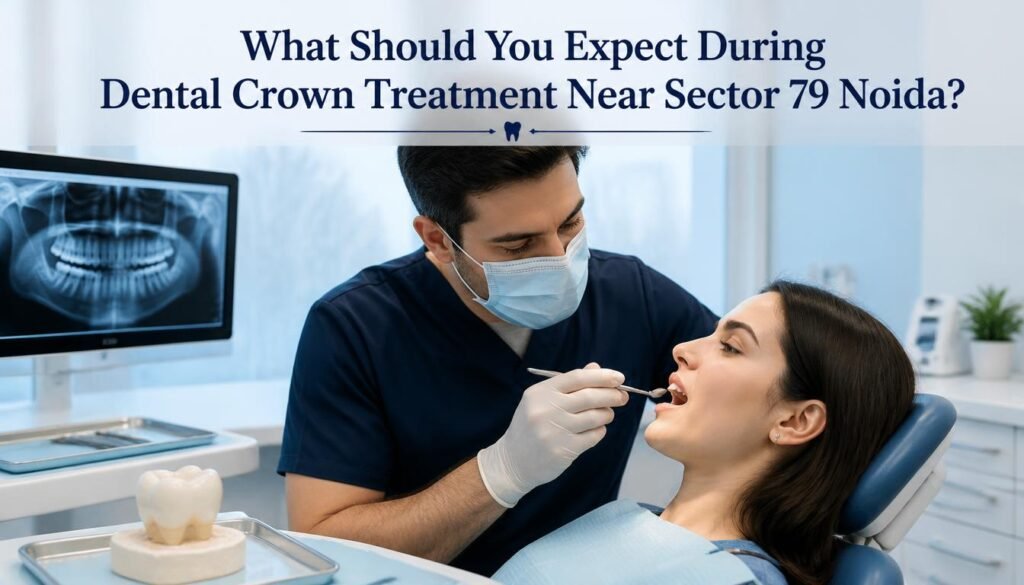
What Happens During Dental Crown Treatment?
The exact process varies depending on the condition of the tooth.
A typical treatment pathway may involve:
Step 1: Dental Examination
Your dentist examines the tooth and surrounding tissues. X-rays or other diagnostic procedures may be recommended when necessary.
Step 2: Treatment Planning
The dentist determines whether a filling, crown, inlay, onlay, root canal treatment, or another option is appropriate.
Step 3: Tooth Preparation
If a crown is selected, the tooth is prepared so the restoration can fit properly.
Step 4: Crown Fabrication
The crown is made according to the required size, shape, colour, and functional requirements.
Step 5: Crown Placement
The dentist checks the restoration’s fit, appearance, contact with neighbouring teeth, and bite before completing the placement.
Step 6: Follow-Up and Care
You will receive instructions on caring for the crown and maintaining good oral hygiene.
Is a Dental Crown Better Than a Filling?
Not necessarily.
A crown is not automatically better than a filling.
If a tooth can be successfully restored with a filling while preserving healthy tooth structure, a filling may be the appropriate choice.
A crown becomes more relevant when the tooth needs additional structural support or protection.
The American Dental Association’s guidance on restorative materials also emphasizes that different restorative materials have different indications and limitations.
Therefore, the question should not be:
“Which treatment is better?”
Instead, ask:
“Which treatment is appropriate for the condition of my tooth?”
How Can You Tell If You May Need a Crown?
Symptoms alone cannot confirm that you need a dental crown.
However, you should consider scheduling a dental examination if you notice:
- A large cavity
- A broken tooth
- A cracked tooth
- Pain while biting
- A repeatedly broken filling
- A very large old filling
- Significant tooth wear
- A tooth that has undergone root canal treatment
- A missing portion of the tooth
- Persistent sensitivity associated with damaged tooth structure
Importantly, tooth sensitivity by itself does not mean you need a crown.
Sensitivity can have several possible causes, so a dental examination is necessary to identify the underlying problem.
Dental Crown Treatment in Noida
If you are searching for dental crown treatment in Noida, choosing a clinic that can evaluate the tooth and discuss different treatment options is important.
The Dental Crowns is located at Civitech Stadia, Sector 79, Noida, Uttar Pradesh 201301 and provides a range of general, cosmetic, and surgical dental services, including dental crowns, tooth-coloured restorations, root canal treatment, dental implants, veneers, braces, and laser dentistry.
You can explore the clinic’s complete dental services in Noida to understand the available treatment options.
If you are unsure whether your damaged tooth needs a filling or crown, a professional examination can help determine the most suitable approach.
Frequently Asked Questions
1. When does a tooth need a dental crown instead of a filling?
A tooth may need a crown instead of a filling when it has lost substantial structure, has a large cavity or filling, is significantly cracked or broken, is severely worn, or requires additional protection after certain root canal treatments. The final decision should be made after a dental examination.
2. Is a crown necessary for a large cavity?
Not necessarily, but a large cavity can leave insufficient healthy tooth structure to support a conventional filling. In such cases, your dentist may recommend a crown or another appropriate restoration.
3. Is a crown stronger than a filling?
Crowns and fillings serve different purposes, so they should not simply be compared as “stronger” or “weaker.” A crown provides broader coverage and may be more appropriate for a structurally weakened tooth.
4. Can I get a filling instead of a crown?
Sometimes. If enough healthy tooth structure remains and the tooth can be predictably restored with a filling, a crown may not be necessary.
5. Does every root canal need a crown?
No. The need for a crown after root canal treatment depends on factors such as the remaining tooth structure, tooth location, functional demands, and overall condition of the tooth.
6. Can a cracked tooth be treated with a crown?
Some cracked teeth can be restored with a crown, but treatment depends on the location and severity of the crack. A dentist needs to evaluate the tooth before determining whether a crown, root canal treatment, bonding, extraction, or another approach is appropriate.
7. How do I know if my old filling needs to be replaced with a crown?
A dentist may consider a crown if an old filling is very large and the surrounding tooth structure has become weakened, cracked, or repeatedly fractured. An examination is necessary to determine whether replacement with a crown is appropriate.
8. Is dental crown treatment painful?
Dental crown treatment is generally performed using local anaesthesia. Some patients may experience temporary sensitivity or gum tenderness after treatment. Persistent or severe pain should be discussed with your dentist.
9. How long does a dental crown last?
The lifespan of a crown varies according to its material, oral hygiene, bite forces, tooth condition, and other individual factors. Good oral hygiene and regular dental check-ups can help maintain both the crown and the tooth underneath it.
10. Which is cheaper: a filling or a crown?
In general, fillings are less extensive restorations and may cost less than crowns, but the price varies by material, tooth, complexity, and clinic. Treatment should be selected based on what the tooth needs rather than cost alone.
11. Can a crown prevent a cracked tooth from getting worse?
A crown can provide protection for certain weakened or cracked teeth, but it cannot repair every type of crack. The earlier a significant crack is diagnosed, the more treatment options may be available.
12. Can a crown be placed over a badly decayed tooth?
Sometimes, if enough healthy tooth structure remains and the tooth is otherwise restorable. If decay has affected the pulp, root canal treatment may be necessary before the definitive restoration.
Final Takeaway: Crown or Filling?
The decision between a dental crown and a filling comes down to the condition and strength of the remaining tooth.
A filling may be appropriate when the damage is limited and enough healthy tooth remains.
A crown may be recommended when the tooth is:
- Heavily decayed
- Structurally weak
- Significantly cracked
- Broken
- Severely worn
- Supporting a very large existing filling
- In need of additional protection after certain root canal treatments
The earlier a damaged tooth is assessed, the better your dentist can determine whether a conservative filling is enough or whether the tooth needs more comprehensive protection.
If you are experiencing tooth pain, a broken filling, a cracked tooth, or significant decay and are unsure whether you need a filling or dental crown, schedule a professional dental evaluation rather than trying to diagnose the tooth yourself.
For patients looking for dental crown treatment in Noida, The Dental Crowns provides restorative and general dental services from its clinic in Sector 79, Noida.