A misaligned tooth can affect more than just the appearance of your smile. It may also make chewing uncomfortable, create difficulties while brushing, and affect the way your upper and lower teeth come together. If you have noticed that one of your teeth is slightly tilted, rotated, or positioned differently from the surrounding teeth, you may be wondering whether a dental crown can correct the problem.
So, can a dental crown be used to correct a tooth that is out of position? Yes, in selected cases, a dental crown can improve the visible appearance of a mildly misaligned, misshapen, or irregularly positioned tooth. However, it is important to understand that a dental crown does not physically move a tooth into a new position. It changes the visible shape and contour of the tooth.
The right treatment depends on the degree of misalignment, the condition of the natural tooth, your bite, and your overall dental health. Let’s understand when dental crown treatment may help and when other treatments, such as braces or clear aligners, may be more suitable.
What Is a Dental Crown?
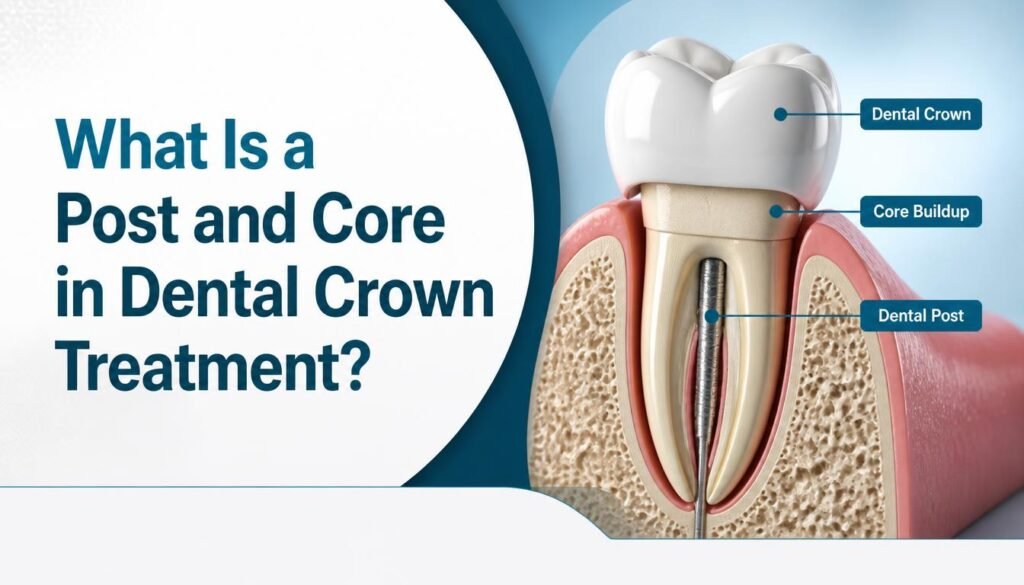
A dental crown is a custom-made cap that covers the visible portion of a damaged or weakened tooth. It is designed to restore the tooth’s shape, strength, size, and appearance while protecting the remaining natural structure.
Dentists may recommend dental crowns for several reasons, including:
- Teeth that are cracked, broken, or severely damaged.
- Teeth with extensive decay.
- Teeth with large fillings and weakened structures.
- Certain discoloured or misshapen teeth.
- Teeth that need additional protection after selected root canal treatments.
- Dental implants that require a visible tooth restoration.
Modern dental crowns are available in different materials, including porcelain, ceramic, zirconia, and porcelain-fused-to-metal.
Can a Dental Crown Correct a Tooth That Is Out of Position?
A dental crown can sometimes improve the appearance of a tooth that looks slightly out of position. For example, if a tooth is mildly rotated, unevenly shaped, or positioned in a way that creates a visible cosmetic concern, a dentist may consider a carefully designed crown.
However, a crown does not move the natural tooth or correct the underlying alignment of the jaw. Instead, it changes the external appearance of the tooth.
This distinction is important because not every misaligned tooth should be treated with a crown.
For example, a mildly tilted tooth that is also structurally damaged may benefit from a crown if the restoration can be designed without compromising the bite. On the other hand, severely crowded or significantly rotated teeth may require orthodontic treatment to achieve proper alignment.
When Can a Dental Crown Help Improve Tooth Position?
A dental crown may be considered when the alignment concern is relatively minor and the tooth also has a restorative or cosmetic problem.
1. A Slightly Tilted Tooth
If a tooth is slightly tilted but has enough healthy supporting structure, a dentist may sometimes use a customised crown to improve its visible shape and appearance.
However, the dentist must consider the amount of tooth preparation required and whether the final restoration will create a healthy bite.
2. A Misshapen Tooth
Some teeth naturally develop with unusual shapes or uneven contours. A dental crown may help create a more balanced appearance by restoring the tooth’s shape and proportions.
3. A Damaged Tooth That Looks Misaligned
A tooth that has been chipped, fractured, or worn down may appear uneven compared with neighbouring teeth. A crown may restore its original shape while improving the overall appearance of the smile.
4. An Uneven Tooth After Previous Dental Treatment
In selected cases, an existing restoration may need to be replaced or redesigned to improve the appearance and function of a tooth.
Your dentist will need to examine the existing restoration, surrounding teeth, gum health, and bite before recommending another crown.
When Is a Dental Crown Not the Right Solution?
Although dental crowns can improve the appearance of certain teeth, they are not a universal solution for orthodontic problems.
A crown may not be appropriate if:
- Several teeth are crowded or overlapping.
- A tooth is significantly rotated.
- The upper and lower jaws do not meet correctly.
- There is a serious bite problem.
- The tooth is positioned too far forward or backward.
- Achieving the desired appearance would require excessive removal of healthy tooth structure.
In these situations, orthodontic treatment may provide a more appropriate solution.
It is important not to choose a crown simply because it offers a quicker cosmetic change. Preserving natural tooth structure should remain an important consideration when planning dental treatment.
Dental Crown vs Braces: Which Is Better for a Misaligned Tooth?
Dental crowns and braces serve different purposes. A crown restores the visible structure of a tooth, while braces apply controlled pressure to gradually move teeth into better positions.
Here is a simple comparison:
| Feature | Dental Crown | Braces |
|---|---|---|
| Main purpose | Restores tooth shape and strength | Moves teeth into better alignment |
| Corrects tooth position | Improves visible appearance in selected cases | Physically moves teeth |
| Treatment duration | Usually involves one or more appointments | Usually takes months or longer |
| Tooth preparation | Requires removal of some tooth structure | Does not require full-tooth preparation |
| Best suited for | Damaged, weakened or misshapen teeth | Crowding, rotation and bite problems |
If your main concern is crooked teeth rather than tooth damage, braces or orthodontic treatment may be a more conservative option.
You can also explore clear aligners and invisible braces at The Dental Crowns to understand another approach to improving tooth alignment.
Can Clear Aligners Correct a Tooth That Is Out of Position?
Yes. Clear aligners can help correct selected cases of mild to moderate tooth misalignment.
These transparent, removable trays are designed to apply controlled pressure to teeth over time. As you progress through a planned series of aligners, your teeth gradually move towards their intended positions.
Clear aligners may be considered for:
- Mildly crowded teeth.
- Small gaps between teeth.
- Selected rotated teeth.
- Minor alignment concerns.
- Certain bite-related problems.
However, not every orthodontic problem can be treated with clear aligners. More complicated cases may require fixed braces or a different treatment approach.
An orthodontic assessment is necessary to determine whether clear aligners are suitable for your particular condition.
What Are the Benefits of Using a Dental Crown for a Misaligned-Looking Tooth?
When a crown is clinically appropriate, it may offer several benefits:
Improved smile appearance: A customised crown can improve the visible shape, size, and proportions of a tooth.
Restoration of damaged teeth: It can cover and protect a tooth that has lost significant natural structure.
Better tooth symmetry: A carefully designed restoration may help a tooth look more balanced alongside neighbouring teeth.
Functional restoration: A properly planned crown can restore chewing function when the original tooth has been damaged.
Natural-looking results: Porcelain and ceramic crowns can be designed to complement the colour and appearance of surrounding teeth.
It is important to remember that these benefits depend on proper diagnosis, crown design, and individual dental conditions.
What Is the Dental Crown Treatment Procedure?
If your dentist determines that a crown is suitable, the treatment generally involves the following steps.
Step 1: Dental Examination
The dentist examines the affected tooth, surrounding teeth, gums, and bite. X-rays or digital scans may be recommended depending on the clinical situation.
Step 2: Treatment Planning
Your dentist determines whether a crown is the right option or whether braces, aligners, veneers, or another restoration would be more suitable.
Step 3: Tooth Preparation
If a crown is recommended, the tooth is carefully prepared to create sufficient space for the restoration.
Step 4: Impression or Digital Scan
An impression or digital scan is taken to help create a customised crown that fits the prepared tooth.
Step 5: Crown Placement
Once the permanent crown is ready, the dentist checks its fit, shape, colour, and bite before securing it in place.
Step 6: Follow-Up and Maintenance
Your dentist may schedule a follow-up to check your comfort and ensure that the crown is functioning properly.
For more information, read our guide to dental crown treatment near Noida Sector 76.
How to Choose the Right Dental Crown Material?
If a crown is recommended, choosing the right material is another important consideration.
Common options include:
Porcelain Crowns: These offer a natural-looking appearance and may be considered for visible teeth.
Zirconia Crowns: Zirconia is known for its strength and may be suitable for teeth that experience considerable chewing forces.
Porcelain-Fused-to-Metal Crowns: These combine a metal base with a porcelain exterior.
The best material depends on the location of the tooth, bite pressure, aesthetic requirements, available tooth structure, and your dentist’s recommendation.
You can explore porcelain dental crowns at The Dental Crowns to learn more about this restoration option.
Why Is a Professional Dental Examination Important?
Before deciding between a crown and orthodontic treatment, your dentist needs to identify the actual cause of the alignment concern.
A detailed examination helps determine:
- Whether the tooth is genuinely misaligned or simply misshapen.
- Whether the surrounding gums and supporting structures are healthy.
- Whether the bite is affected.
- How much healthy tooth structure remains.
- Whether orthodontic treatment would be more suitable.
- Whether a crown can provide a safe and functional result.
Choosing treatment without understanding these factors may result in unnecessary removal of healthy tooth structure or an unsuitable bite.
If you are experiencing tooth alignment concerns, consult a qualified dental professional before choosing a cosmetic or restorative procedure.
Dental Crown Treatment in Noida at The Dental Crowns
If you are looking for dental crown treatment in Noida, The Dental Crowns provides a range of dental services, including porcelain crowns, braces, clear aligners, dental implants, and root canal treatment.
Located at Civitech Stadia, Sector 79, Noida, the clinic serves patients from nearby areas who want to understand their dental treatment options.
Whether you are concerned about a slightly tilted tooth, a damaged front tooth, or an uneven smile, a dental consultation can help determine whether a dental crown or orthodontic treatment is more appropriate.
The goal should always be to achieve a healthy, functional, and natural-looking smile while preserving as much healthy tooth structure as possible.
Book a dental consultation with The Dental Crowns:
- Address: Shop No. 16, 1st Floor, Civitech Stadia, Sector 79, Noida, Uttar Pradesh 201301.
- Phone: +91 89202 71787.
- Website: https://thedentalcrowns.in/
Frequently Asked Questions (FAQs)
1. Can a dental crown fix a crooked tooth?
A dental crown can improve the visible appearance of a mildly crooked or misshapen tooth in selected cases. However, it does not physically move the tooth into a new position. Braces or clear aligners may be more appropriate for actual alignment problems.
2. Can a dental crown make a tilted tooth look straight?
Yes, a customised crown may improve the appearance of a slightly tilted tooth. The dentist must first evaluate the tooth structure, surrounding gums, and bite to determine whether this approach is suitable.
3. Are dental crowns better than braces for crooked teeth?
Not necessarily. Crowns restore tooth structure and appearance, whereas braces physically move teeth. For genuine orthodontic problems, braces or aligners are generally more suitable.
4. Can a dental crown correct a rotated tooth?
A crown may improve the appearance of a mildly rotated tooth in carefully selected cases. Significant rotation generally requires orthodontic treatment.
5. Can clear aligners correct a misaligned front tooth?
Clear aligners can correct certain mild to moderate alignment problems, including selected front-tooth concerns. An orthodontic assessment is required to determine suitability.
6. Does getting a dental crown hurt?
Local anaesthesia is commonly used during tooth preparation to minimise discomfort. Some temporary sensitivity or gum tenderness may occur after treatment.
7. How long does a dental crown last?
The lifespan of a dental crown varies depending on its material, oral hygiene, bite forces, and maintenance. Regular dental check-ups and good oral hygiene help support its longevity.
8. Can a dental crown change my smile?
Yes. A properly designed crown can improve the shape, colour, size, and appearance of a damaged or misshapen tooth. However, it cannot correct every underlying alignment problem.
9. Can I get a dental crown without braces?
Yes, if your dentist determines that the tooth can be restored safely with a crown and orthodontic treatment is not necessary. The decision depends on your individual dental condition.
10. Where can I get dental crown treatment in Noida?
You can consult The Dental Crowns at Civitech Stadia, Sector 79, Noida, to discuss dental crown treatment and other suitable dental care options.
Final Thoughts
A dental crown can sometimes improve the appearance of a tooth that looks slightly out of position, but it is not a replacement for orthodontic treatment. The most suitable option depends on whether the problem involves the tooth’s shape, its actual position, or a combination of both.
Before choosing a dental crown, braces, or clear aligners, get your tooth examined by a qualified dentist. A personalised treatment plan can help you achieve a balanced smile while protecting your long-term oral health.
The Dental Crowns, Sector 79, Noida, is available to help you understand your dental treatment options and take the next step towards a healthier smile.