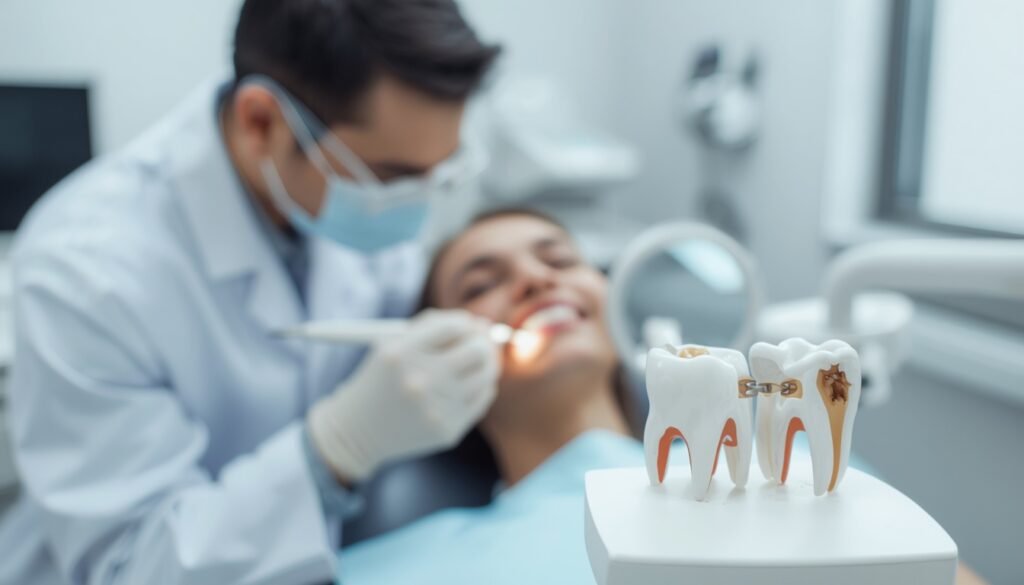
If you are searching for a dental crown consultation near Sector 75 Noida, you may already have a damaged, cracked, decayed, discolored, or weakened tooth. You may also have been advised to get a crown after root canal treatment or be wondering whether a dental crown is actually necessary.
The first consultation is an important part of dental crown treatment because your dentist needs to examine your tooth, understand your oral health, identify the cause of the problem, and determine whether a crown is the right restoration for you.
For patients in Sector 75 and nearby areas such as Sector 74, Sector 76, Sector 77, Sector 78, and Sector 79 Noida, understanding what happens during the first visit can make the process easier and less stressful.
At The Dental Crowns, located at Civitech Stadia, Sector 79, Noida, patients can discuss their dental concerns and treatment options with a dental professional.
Quick Answer: What Happens During a Dental Crown Consultation?
During a first dental crown consultation, your dentist may:
- Ask about your dental problem and symptoms.
- Review your dental and medical history.
- Examine the affected tooth and surrounding gums.
- Check the amount of healthy tooth structure remaining.
- Evaluate your bite and neighboring teeth.
- Take dental X-rays or other diagnostic images when clinically appropriate.
- Check whether decay, cracks, infection, or previous dental treatment is present.
- Determine whether root canal treatment may be necessary.
- Discuss suitable dental crown materials.
- Explain treatment stages, estimated appointments, costs, and aftercare.
The exact process varies according to the condition of your tooth and your individual treatment needs.
What Is a Dental Crown?
A dental crown, sometimes called a dental cap, is a custom-made restoration that covers a tooth to restore its shape, strength, function, and appearance.
Crowns can be used for teeth that are significantly damaged, weakened, broken, heavily restored, or treated with root canal therapy. They can also be used as restorations supported by dental implants.
The American Dental Association defines a crown as an artificial replacement that surrounds remaining tooth structure or can be placed on a dental implant.
The appropriate restoration depends on factors such as the amount of remaining tooth structure, oral health, bite, location of the tooth, aesthetic requirements, and the dentist’s clinical assessment.
Why Should You Have a Dental Crown Consultation First?
A dental crown should not be selected simply because a tooth looks damaged.
Your dentist first needs to determine why the tooth is damaged and how much healthy structure remains.
For example, a tooth may require:
- A dental filling
- An inlay or onlay
- A dental crown
- Root canal treatment followed by a crown
- Another restorative procedure
- In some severe cases, extraction followed by tooth replacement
Cleveland Clinic notes that crowns may be used to restore broken, weak, worn, or decayed teeth and can also cover root-canal-treated teeth and dental implants.
This is why a proper consultation is an important first step.
Dental Crown Consultation Near Sector 75 Noida: Step-by-Step
1. Discussing Your Dental Problem
Your first visit usually starts with a conversation about your concern.
Your dentist may ask:
- When did you first notice the problem?
- Do you have tooth pain?
- Is the tooth sensitive to hot or cold?
- Does it hurt when you bite?
- Has the tooth broken or cracked?
- Have you previously had a filling?
- Has the tooth undergone root canal treatment?
- Are you experiencing swelling or gum problems?
Try to describe your symptoms as accurately as possible.
Even seemingly small details can help your dentist understand what may be happening.
2. Reviewing Your Dental History
Your dentist may ask about previous dental treatment, existing restorations, medications, allergies, and other relevant medical information.
If you have previously had X-rays or dental reports, taking them to the appointment can be useful.
The American Dental Association’s guidance for first dental visits also emphasizes reviewing available radiographs before deciding whether new radiographs are needed.
3. Examining the Tooth
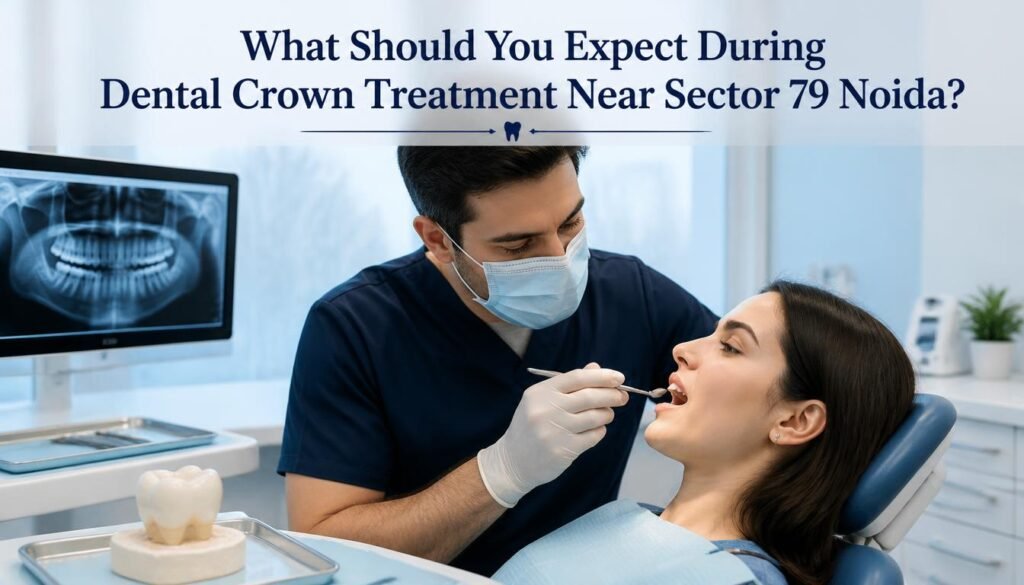
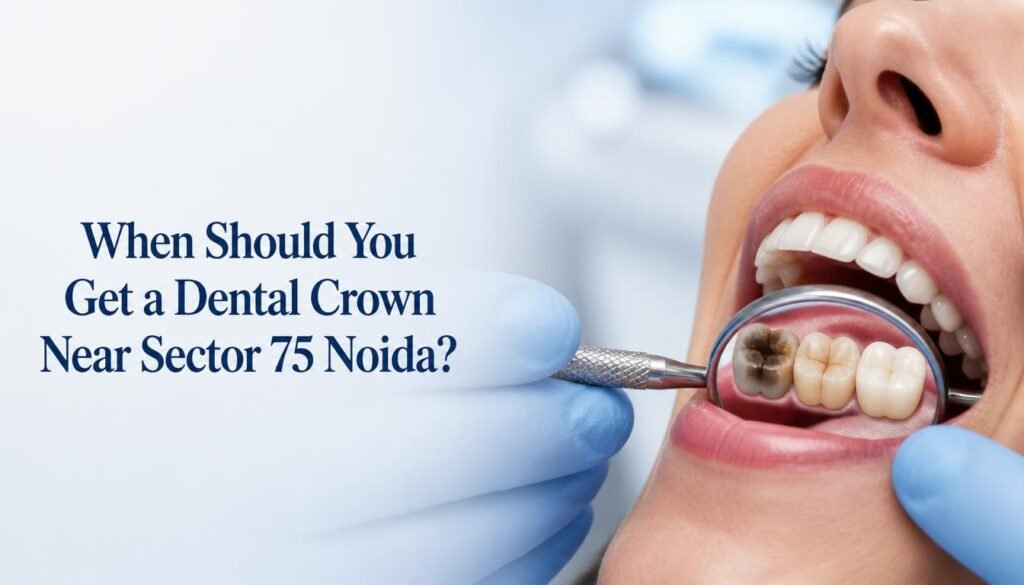
The dentist will visually and clinically examine the affected tooth.
The examination may include checking:
- Tooth decay
- Cracks or fractures
- Existing fillings
- Tooth structure
- Tooth discoloration
- Gum condition
- Signs of infection
- Tooth mobility
- Bite and contact with neighboring teeth
The purpose is to understand whether the tooth can be predictably restored and what type of restoration may be appropriate.
4. Checking How Much Tooth Structure Remains
One of the important considerations before a dental crown is the amount and condition of the remaining tooth structure.
If a tooth has lost substantial structure because of decay, fracture, previous restorations, or other damage, a full-coverage crown may be considered.
However, the dentist needs to evaluate the individual tooth before recommending treatment.
A crown is not automatically required simply because a tooth has a cavity or small fracture.
In some situations, an inlay, onlay, or filling may be considered instead.
5. Dental X-Ray May Be Recommended
Depending on your symptoms and the condition of the tooth, your dentist may recommend an X-ray.
An X-ray can provide information that may not be visible during a normal visual examination.
It may help the dentist assess:
- The extent of decay
- The tooth roots
- Bone surrounding the tooth
- Previous root canal treatment
- Possible infection
- The condition of the tooth underneath an existing restoration
Not every patient requires the same type or number of dental X-rays. The dentist determines whether diagnostic imaging is appropriate based on the clinical situation.
The American Dental Association’s resources emphasize appropriate selection of dental radiographs rather than automatically taking new images for every patient.
6. Checking Whether Root Canal Treatment Is Needed
Sometimes a damaged tooth cannot immediately proceed to crown treatment.
If the tooth’s pulp is infected or significantly inflamed, your dentist may recommend root canal treatment before placing a permanent crown.
Root canal treatment involves removing infected or inflamed tissue from inside the tooth, cleaning and disinfecting the canals, filling them, and sealing the tooth.
A permanent crown may subsequently be used to protect and restore the treated tooth.
This is why a dental crown consultation is more than simply choosing a crown material.
The dentist first needs to determine the condition of the tooth.
7. Discussing Dental Crown Options
If a crown is appropriate, your dentist can explain the available options.
Depending on the individual case, options may include:
Porcelain Crowns
Porcelain restorations can provide a natural-looking appearance and may be considered when aesthetics are important.
Zirconia Crowns
Zirconia is a ceramic material used in dental restorations and may offer a combination of strength and aesthetics.
Porcelain-Fused-to-Metal Crowns
These restorations combine a metal substructure with a porcelain exterior.
Metal Crowns
Metal crowns can provide high durability and may be considered for certain posterior teeth.
The appropriate crown material depends on factors such as tooth location, biting forces, remaining tooth structure, aesthetics, oral health, and your dentist’s recommendation.
You can also explore the Porcelain Dental Crowns treatment at The Dental Crowns to learn more about one available crown option.
8. Discussing the Treatment Plan
Once the dentist has evaluated your tooth, they can explain the proposed treatment.
Your treatment plan may include:
- Initial examination
- X-ray or diagnostic imaging if required
- Decay removal
- Root canal treatment if necessary
- Tooth preparation
- Dental impressions or digital scanning
- Temporary crown placement when appropriate
- Laboratory fabrication
- Permanent crown placement
- Bite adjustment
- Follow-up care
Traditional crown treatment often involves more than one appointment, although treatment time varies according to the clinical situation and technology available.
Cleveland Clinic describes a common crown process involving tooth preparation, impressions, a temporary crown, and a later appointment for fitting the permanent crown.
9. Understanding Dental Crown Cost
One of the most common questions patients ask during a dental crown consultation near Sector 75 Noida is:
“How much will my dental crown cost?”
There is no single price that applies to every patient.
The total cost can depend on:
- Crown material
- Tooth location
- Extent of tooth damage
- Need for root canal treatment
- Need for a core buildup
- Diagnostic procedures
- Laboratory charges
- Temporary restoration
- Number of appointments
- Complexity of the case
Therefore, it is useful to ask for the complete estimated treatment cost, rather than comparing only the crown material price.
You can also read our guide on what to check before choosing dental crown treatment in Noida.
10. Your Dentist Will Explain What Happens Next
At the end of your consultation, you should have a clearer understanding of:
- What is wrong with your tooth
- Whether you need a crown
- Whether root canal treatment is required
- Which crown options may be suitable
- How many appointments may be required
- What preparation is necessary
- Expected treatment costs
- How to care for the restoration
You should also have an opportunity to ask questions before deciding whether to proceed.
What Should You Bring to Your Dental Crown Consultation?
If you are visiting a dentist near Sector 75 Noida for a crown consultation, consider bringing:
Previous Dental Reports
If you have previous X-rays, treatment records, or prescriptions, bring them if available.
List of Medications
Tell your dentist about medications you currently take.
Previous Dental Information
Mention previous root canals, fillings, crowns, implants, extractions, or other major dental procedures.
Your Questions
Write down your questions before the appointment so you don’t forget them.
7 Questions to Ask During Your Dental Crown Consultation
Before beginning treatment, consider asking:
1. Do I definitely need a dental crown?
Ask why a crown has been recommended and whether another restoration could be suitable.
2. Does my tooth need a root canal?
If the tooth has pain, infection, or significant internal damage, ask whether additional treatment is required.
3. Which crown material is suitable for me?
Ask why a particular material has been recommended for your tooth.
4. How many appointments will I need?
Treatment duration varies depending on the condition of the tooth and the restoration process.
5. Will I need a temporary crown?
A temporary restoration may be used while a laboratory-made crown is being prepared.
6. What is included in the total cost?
Ask whether examinations, X-rays, temporary restorations, laboratory work, and follow-up adjustments are included.
7. What should I do after the crown is placed?
Ask about brushing, flossing, diet, sensitivity, and follow-up appointments.
Is a Dental Crown Consultation Painful?
The consultation itself is generally an examination and discussion rather than the complete crown procedure.
Your dentist may examine the tooth, gums, bite, and surrounding structures. Diagnostic imaging may also be recommended.
If treatment such as tooth preparation is required later, local anesthesia can be used when appropriate.
If you are nervous about dental treatment, tell your dentist before the procedure. Discussing your concerns beforehand can help your dental team plan your care appropriately.
How Long Does a Dental Crown Appointment Take?
The exact duration depends on what needs to be done.
A consultation may be relatively straightforward if you only require an examination and diagnosis. However, if X-rays, additional diagnostic procedures, or treatment planning are necessary, the appointment may take longer.
The complete crown process can require multiple visits.
For a detailed explanation, read:
How Long Does It Take to Get a Dental Crown in Noida?
Dental Crown Consultation Near Sector 75 vs Sector 79 Noida
If you live in Sector 75, you may also search for:
- Dental crown near Sector 75 Noida
- Dental crown treatment near Sector 75 Noida
- Dentist near Sector 75 Noida
- Dental crown consultation near Sector 75
- Dental clinic near Sector 75
- Dental crown specialist near Sector 75
- Dental cap near Sector 75 Noida
The Dental Crowns is located at Civitech Stadia, Sector 79, Noida, which serves patients from nearby Noida sectors.
The clinic’s website provides information about its dental crown services and treatment options.
Explore Dental Crown Services at The Dental Crowns
Dental Crown Consultation for Patients From Nearby Noida Sectors
Patients searching for dental crown treatment around Sector 75 may also come from nearby sectors such as:
- Sector 74 Noida
- Sector 75 Noida
- Sector 76 Noida
- Sector 77 Noida
- Sector 78 Noida
- Sector 79 Noida
Because dental crown treatment can require follow-up appointments, choosing a clinic that is reasonably accessible for future visits can be useful.
For example, you can also read our related guide:
Dental Crown Treatment Near Noida Sector 76: What to Expect
Why Proper Diagnosis Matters Before a Dental Crown
A dental crown is a long-term restoration, so diagnosis should come before treatment.
A crown may be appropriate when a tooth is significantly damaged, weakened, broken, worn, or otherwise requires full coverage. But if the tooth has a different underlying problem, treating that problem first may be necessary.
For example:
Deep decay → possible pulp involvement → root canal may be required → crown may be considered afterward
The sequence depends on the individual tooth.
Cleveland Clinic explains that crowns can restore damaged teeth and may be used following root canal treatment, while the NHS also describes crowns as caps used for teeth that have broken, decayed, or been damaged.
What Happens After the Consultation?
If a dental crown is recommended, the next stage may involve preparing the tooth.
Depending on your case, this can include:
- Local anesthesia
- Removal of decay or damaged structure
- Tooth preparation
- Impression or digital scan
- Shade selection where appropriate
- Temporary crown placement
- Laboratory fabrication
- Permanent crown fitting
- Bite assessment and adjustment
- Follow-up
The exact sequence varies depending on the tooth, crown type, laboratory process, and dental technology being used.
Dental Crown Aftercare
Once your permanent crown has been fitted, maintaining good oral hygiene remains important.
General care includes:
- Brush twice daily with fluoride toothpaste.
- Clean between your teeth every day.
- Avoid using your teeth to open packages.
- Be cautious with extremely hard foods.
- Attend recommended dental check-ups.
- Contact your dentist if the crown becomes loose, chipped, cracked, or uncomfortable.
Cleveland Clinic recommends regular brushing, daily flossing, dental cleanings, and avoiding extremely hard or sticky foods to help maintain crowns.
Frequently Asked Questions About Dental Crown Consultation Near Sector 75 Noida
1. Do I need a consultation before getting a dental crown?
Yes. A dentist should evaluate the tooth before deciding whether a crown is appropriate and whether other treatment is needed first.
2. Can I get a dental crown if my tooth is badly damaged?
Possibly. The answer depends on how much healthy tooth structure remains and whether the tooth can be predictably restored.
3. Can a root canal and dental crown be done together?
Root canal treatment and crown placement are separate stages, although they may be part of the same overall treatment plan. A permanent crown may be placed after root canal treatment when appropriate.
4. What is checked during a crown consultation?
The dentist may examine the tooth, gums, surrounding teeth, bite, existing restorations, and remaining tooth structure. X-rays may be recommended when clinically appropriate.
5. How many appointments are required for a dental crown?
It depends on the case. Traditional crown treatment commonly involves preparation and a later appointment for permanent crown placement, although some digital workflows can reduce the number of visits.
6. Is a dental crown the same as a dental cap?
Yes. “Dental cap” is a common term used to describe a dental crown.
7. Can a crown fix a cracked tooth?
A crown may be recommended for certain damaged or cracked teeth, but the dentist must first determine the location and severity of the crack and whether the tooth can be restored.
8. Can a dental crown improve the appearance of a tooth?
Yes. Certain crowns can improve the shape, color, and overall appearance of a damaged or discolored tooth while also providing restorative function.
9. Can I get a crown after root canal treatment?
Yes. Crowns are commonly used to restore and protect teeth that have undergone root canal treatment when a full-coverage restoration is appropriate.
10. Where can I get a dental crown consultation near Sector 75 Noida?
Patients in Sector 75 and surrounding Noida sectors can consider consulting a dental professional at The Dental Crowns, Civitech Stadia, Sector 79, Noida, depending on their treatment requirements.
Book a Dental Crown Consultation Near Sector 75 Noida
If you have a broken, cracked, weakened, heavily decayed, discolored, or previously root-canal-treated tooth, the first step is a proper dental examination.
A consultation can help determine:
- Whether you actually need a crown
- Whether root canal treatment is required
- Which restoration may be suitable
- Which crown material may be appropriate
- How many appointments may be needed
- What the expected treatment process involves
If you are located in Sector 75 Noida or nearby areas, you can explore dental crown treatment options at The Dental Crowns, Civitech Stadia, Sector 79, Noida.
View Dental Crown Services and contact the clinic to discuss your dental concern and schedule a consultation.
Final Takeaway
A dental crown consultation near Sector 75 Noida is not simply about choosing a crown. It is about understanding the condition of your tooth and developing an appropriate treatment plan.
During your first visit, your dentist may examine the tooth, review your dental history, evaluate your gums and bite, recommend diagnostic imaging when necessary, check whether root canal treatment is required, and explain suitable crown options.
Getting the diagnosis right before starting treatment can help ensure that the restoration is planned according to your individual dental needs.
If you are experiencing tooth pain, a broken tooth, sensitivity, swelling, or another dental problem, arrange a professional dental examination rather than relying on online information alone.