Missing multiple teeth can affect more than just your smile. It may become difficult to chew food properly, speak comfortably, or feel confident in social situations. Over time, gaps left by missing teeth may also affect the alignment of neighbouring teeth and the overall balance of your bite.
If you are searching for options for replacing multiple missing teeth in Sector 75 Noida, the good news is that modern dentistry offers several treatment solutions. These include dental implants, implant-supported bridges, traditional dental bridges, partial dentures, and full-mouth dental implant treatments.
The right treatment depends on the number of missing teeth, the condition of your gums, available jawbone, existing natural teeth, and your budget.
At The Dental Crowns, Noida, patients can explore personalised tooth replacement options designed to restore dental function, comfort, and smile aesthetics.
Why Is It Important to Replace Multiple Missing Teeth?
Losing multiple teeth can gradually affect your oral health and everyday quality of life. Even if the gaps are not visible when you smile, missing teeth can create functional problems that should not be ignored.
Some common concerns include:
- Difficulty chewing certain foods
- Changes in speech or pronunciation
- Shifting of neighbouring teeth
- Uneven distribution of biting pressure
- Reduced confidence while smiling
- Changes in facial appearance in cases of extensive tooth loss
- Potential jawbone changes following tooth loss
Replacing missing teeth can help restore chewing efficiency, maintain a more balanced bite, and improve the appearance of your smile.
If you are experiencing these problems, consulting a dentist near Sector 75 Noida can help you understand which restorative treatment is suitable for your condition.
What Are the Best Options for Replacing Multiple Missing Teeth?
There is no single treatment that works best for everyone. Below are some of the most commonly recommended options for replacing multiple missing teeth.
1. Dental Implants for Multiple Missing Teeth
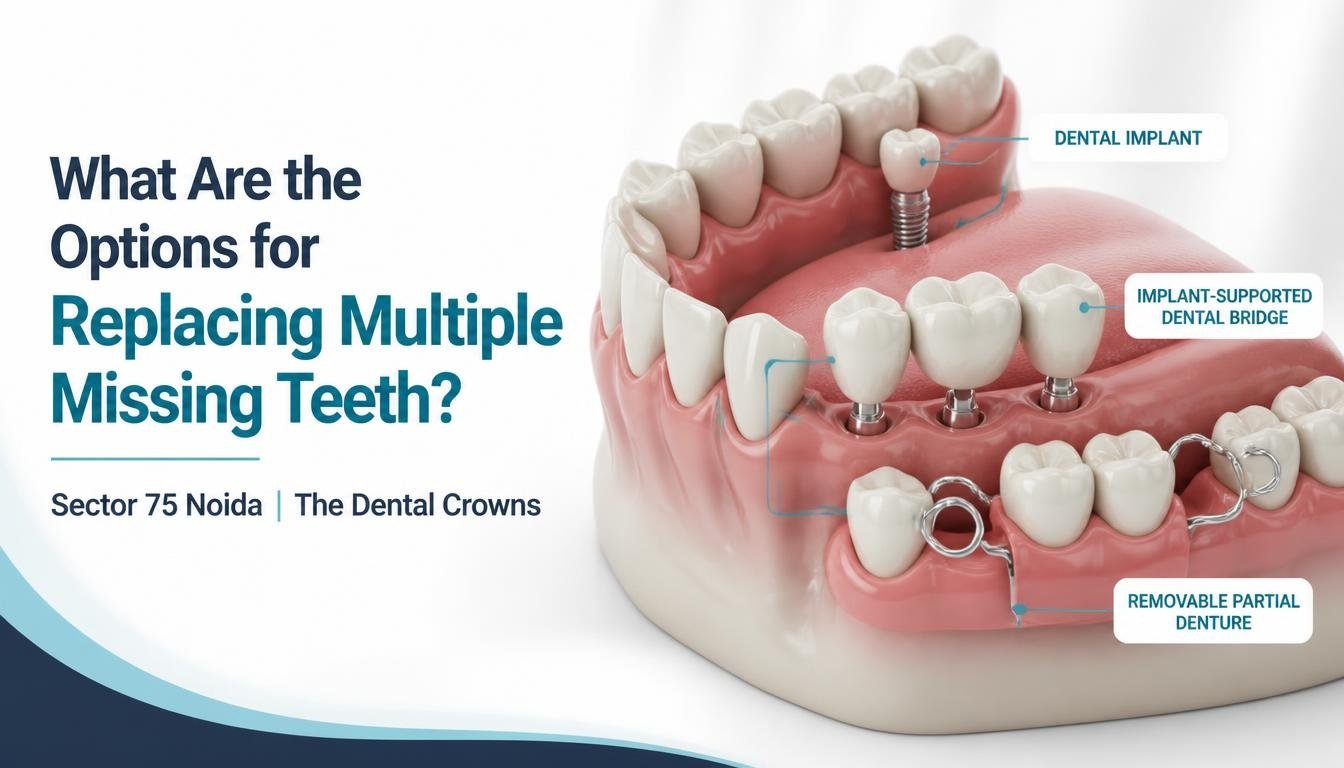
Dental implants are one of the popular options for replacing missing teeth because they are designed to function as artificial tooth roots.
A dental implant consists of a biocompatible post placed into the jawbone. After healing, it can support a dental crown or bridge to replace the missing teeth.
How do dental implants work?
The implant is placed in the jawbone to support a replacement tooth. After the healing process, a customised dental crown or bridge is attached to restore the appearance and function of the missing teeth.
Benefits of dental implants
- Provide a fixed tooth replacement solution
- Help restore chewing function
- Offer a natural-looking appearance
- Do not usually require adjacent healthy teeth to support individual implants
- Can help maintain jawbone structure in the implant area
- Provide a long-term tooth replacement option with proper care
Dental implants may be suitable for patients who have lost several teeth and have adequate bone support or can undergo additional procedures if needed.
Learn more about Dental Implants in Noida Sector 75 to understand the treatment process, benefits, and considerations.
2. Implant-Supported Dental Bridges
If you have lost several adjacent teeth, an implant-supported dental bridge may be an appropriate option.
Instead of placing an individual implant for every missing tooth, your dentist may strategically place implants to support a bridge consisting of multiple artificial teeth.
How does an implant-supported bridge work?
Dental implants are placed in selected positions in the jawbone. Once healing is complete, a customised bridge is attached to these implants to replace multiple missing teeth in the same area.
Advantages of implant-supported bridges
- Replace several adjacent missing teeth
- Provide a fixed restoration
- Restore chewing function and appearance
- May require fewer implants than individual implant-supported crowns
- Avoid relying on natural neighbouring teeth for support
The number and placement of implants depend on your bone condition, bite, and the design of the restoration.
This option is often discussed with patients who want a fixed solution for multiple missing teeth.
3. Traditional Dental Bridges
A traditional dental bridge is another option for replacing one or more missing teeth.
In this treatment, artificial teeth are supported by crowns placed on neighbouring natural teeth. These supporting teeth are called abutment teeth.
Who may benefit from dental bridges?
A dental bridge may be considered when:
- One or more teeth are missing in a specific area
- The neighbouring teeth are healthy enough to support the bridge
- The patient prefers a fixed restoration
- Dental implants are unsuitable or not preferred
Benefits of dental bridges
- Provide a fixed tooth replacement
- Restore chewing and speaking function
- Can improve the appearance of your smile
- May involve a shorter treatment timeline than implant treatment in selected cases
- Do not require implant surgery
However, traditional bridges may require reshaping the neighbouring teeth. Your dentist should evaluate whether this is appropriate for your particular case.
Read more about Dental Implants vs Dental Bridges: Which Is Better? before making a decision with your dentist.
4. Removable Partial Dentures
Removable partial dentures are designed to replace several missing teeth while using the remaining natural teeth and oral structures for support.
They can be removed for cleaning and are generally considered a non-surgical option.
Benefits of partial dentures
- Replace multiple missing teeth
- Usually more economical than implant treatment
- Do not generally require surgical placement
- Can be designed to replace teeth in different areas of the mouth
- Offer a practical solution when several natural teeth remain
Partial dentures may be suitable for patients who are looking for an affordable tooth replacement option or who are not currently candidates for dental implant surgery.
However, they may require adjustments over time to maintain comfort and fit.
5. Implant-Supported Dentures
Implant-supported dentures combine dental implants with a removable denture to provide additional stability.
Unlike conventional removable dentures, which rely primarily on the gums and underlying tissues for support, implant-supported dentures attach to dental implants placed in the jawbone.
Advantages of implant-supported dentures
- Improved stability compared with conventional dentures in suitable cases
- Better retention during eating and speaking
- A solution for patients with extensive tooth loss
- Reduced movement of the denture during everyday activities
- Can improve comfort for selected patients
These dentures are generally removed by the patient for cleaning, according to the dentist’s instructions.
They may be suitable for individuals who have lost many teeth and want improved denture stability without choosing a permanently fixed full-arch restoration.
6. Full-Mouth Dental Implants
For patients who have lost most or all teeth in one or both jaws, full-mouth dental implant treatment may be considered.
Depending on the clinical situation, dental implants can support a full-arch fixed bridge or an implant-retained removable denture.
What are the benefits of full-mouth dental implants?
- Replace an entire arch of missing teeth
- Restore chewing function
- Provide a more stable alternative to conventional complete dentures in suitable cases
- Improve smile aesthetics
- Support a personalised full-mouth rehabilitation plan
The number of implants required and the type of restoration depend on the patient’s jawbone, remaining teeth, bite, and oral health.
Not every patient requires the same implant technique. A thorough dental examination is essential before deciding on full-mouth dental implant treatment.
For more information, explore Dental Implants Near Noida Sector 79.
Dental Implants vs Bridges vs Dentures: Which Is Better?
Understanding the differences between tooth replacement treatments can help you make a more informed decision.
| Treatment | Main advantages | Important considerations |
|---|---|---|
| Dental implants | Fixed, natural-looking, help maintain bone | Surgery and healing required |
| Implant-supported bridge | Replaces several adjacent teeth with a fixed restoration | Requires adequate bone and carefully planned implant placement |
| Traditional dental bridge | Fixed restoration, often a shorter treatment process | May require preparation of neighbouring teeth |
| Partial dentures | Economical, non-surgical, replace multiple teeth | Removable and may require adjustments |
| Implant-supported dentures | Greater stability than conventional dentures | Requires implants and ongoing maintenance |
| Full-mouth implants | Comprehensive tooth replacement for extensive tooth loss | Requires detailed assessment and personalised treatment |
Important: The best tooth replacement option is not determined by cost or convenience alone. Your dentist should consider oral health, long-term maintenance, functionality, and treatment expectations.
How Do Dentists Decide Which Treatment Is Suitable?
Before recommending a treatment for multiple missing teeth, your dentist may evaluate several factors.
1. Number of Missing Teeth
Replacing two adjacent teeth is different from replacing several teeth spread across the mouth. The number and location of missing teeth influence the design of your treatment.
2. Jawbone Condition
Dental implants require sufficient bone support. If bone loss has occurred, additional procedures such as bone grafting may sometimes be considered.
3. Gum Health
Healthy gums are essential for successful tooth replacement and long-term maintenance. Gum disease may need to be treated before restorative procedures.
4. Condition of Remaining Teeth
If your remaining teeth are healthy, preserving them is an important consideration when selecting a replacement option.
5. Budget and Treatment Timeline
Different treatments have different costs, healing requirements, and maintenance needs. Your dentist can explain the estimated treatment timeline and available options.
6. Overall Health
Medical history, medications, smoking habits, and other health-related factors may influence treatment planning, especially for surgical procedures.
What Is the Cost of Replacing Multiple Missing Teeth in Sector 75 Noida?
The cost of replacing multiple missing teeth in Noida varies depending on the treatment selected and the patient’s individual dental condition.
Some of the major factors affecting the treatment cost include:
- Number of missing teeth
- Number of dental implants required
- Type and brand of implant system
- Material used for dental crowns or bridges
- Type of denture
- Bone grafting or additional procedures
- Diagnostic scans and consultations
- Complexity of the treatment
- Follow-up and maintenance requirements
Dental implants generally involve a higher initial investment than conventional dentures. However, the total cost should be evaluated alongside the expected function, durability, maintenance, and suitability of each option.
For an individual estimate, consult your dentist and request a personalised treatment plan.
You can also read Dental Implant Cost in Noida Sector 74 to learn more about the factors affecting implant treatment expenses.
Where Can You Get Treatment for Multiple Missing Teeth Near Sector 75 Noida?
If you are looking for a dental clinic near Sector 75 Noida for missing teeth treatment, The Dental Crowns offers dental services for patients seeking restorative and implant dentistry.
The clinic is located at:
The Dental Crowns
Shop No. 16, 1st Floor, Civitech Stadia, Sector 79, Noida
Patients from Sector 75, Sector 76, Sector 77, Sector 78, and surrounding Noida areas can explore dental consultation and treatment options based on their oral health requirements.
The dental team can assess your condition and explain suitable tooth replacement options, including dental implants, bridges, dentures, and other restorative treatments.
Explore the complete Dental Services in Noida page to learn more about available treatments.
How to Maintain Your Replacement Teeth
Whether you choose dental implants, bridges, or dentures, maintaining good oral hygiene is important.
Follow these general recommendations:
- Brush twice daily using a soft-bristled toothbrush
- Clean between your teeth regularly
- Use specialised cleaning tools for bridges and implants if recommended
- Remove and clean removable dentures as instructed
- Schedule regular dental check-ups
- Avoid biting excessively hard objects
- Follow all post-treatment instructions provided by your dentist
Proper maintenance can help protect your remaining natural teeth and support the long-term health of your restorations.
Frequently Asked Questions (FAQs)
1. What is the best option for replacing multiple missing teeth?
Dental implants, implant-supported bridges, traditional bridges, and removable dentures are all possible options. The best treatment depends on the number of missing teeth, jawbone condition, gum health, budget, and personal preferences.
2. Can dental implants replace multiple missing teeth?
Yes. Dental implants can support individual crowns, implant-supported bridges, or full-arch restorations, depending on the patient’s clinical condition.
3. Is an implant-supported bridge better than a traditional bridge?
An implant-supported bridge does not usually depend on neighbouring natural teeth for support. However, a traditional bridge may be suitable for certain patients. Your dentist can compare both options based on your oral health.
4. Are dentures a good option for multiple missing teeth?
Yes. Partial or complete dentures can be practical and economical options for replacing multiple missing teeth. Implant-supported dentures may offer additional stability in suitable cases.
5. How long does it take to replace multiple missing teeth?
The timeline varies depending on the treatment. Dentures and traditional bridges may require a relatively shorter process, while implant treatment can take several months because of healing and integration with the jawbone.
6. Can I get dental implants if I have bone loss?
Possibly. Some patients with bone loss may be considered for additional procedures, such as bone grafting. Your dentist must assess the available bone before recommending implant treatment.
7. Are dental implants painful?
Implant placement is performed using appropriate anaesthesia. Some swelling, soreness, or discomfort may occur during recovery. Your dentist will explain post-operative care and pain management.
8. Where can I consult a dentist for missing teeth treatment near Sector 75 Noida?
You can consult The Dental Crowns at Civitech Stadia, Sector 79, Noida, to discuss treatment options for multiple missing teeth.
Conclusion
Replacing multiple missing teeth can help restore chewing comfort, improve speech, and bring back confidence in your smile.
Whether you need dental implants, an implant-supported bridge, traditional bridges, partial dentures, or full-mouth dental implant treatment, modern dentistry offers several solutions for different needs.
If you are exploring options for replacing multiple missing teeth in Sector 75 Noida, the first step is to consult an experienced dental professional who can evaluate your oral health and recommend a personalised treatment plan.
Book a dental consultation at The Dental Crowns to understand your tooth replacement options and take the next step towards a healthier, more confident smile.
References and Further Reading