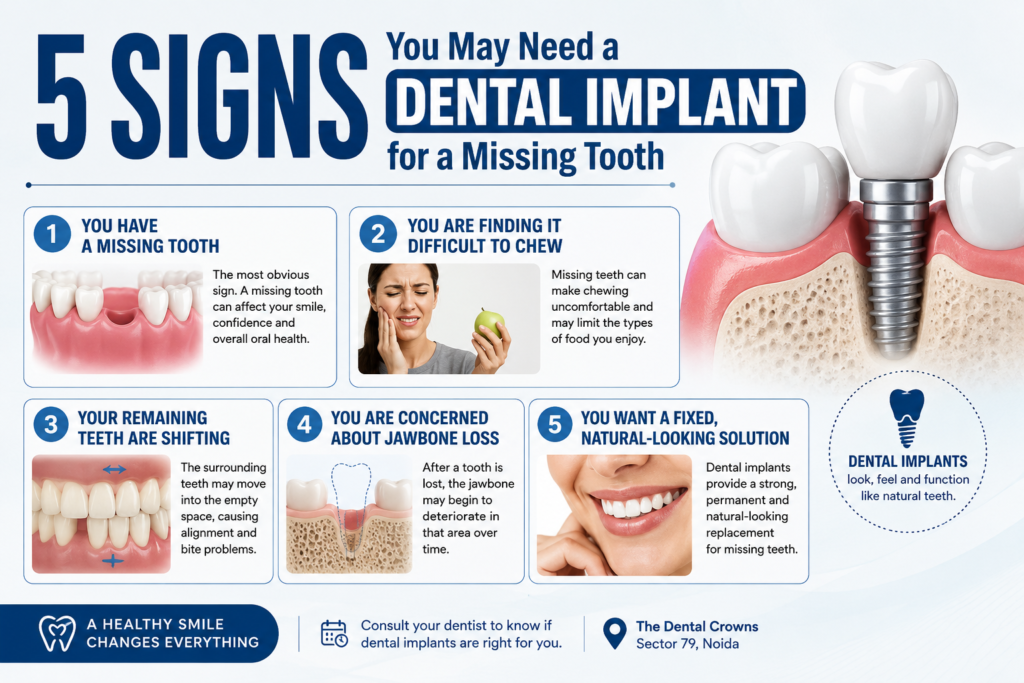

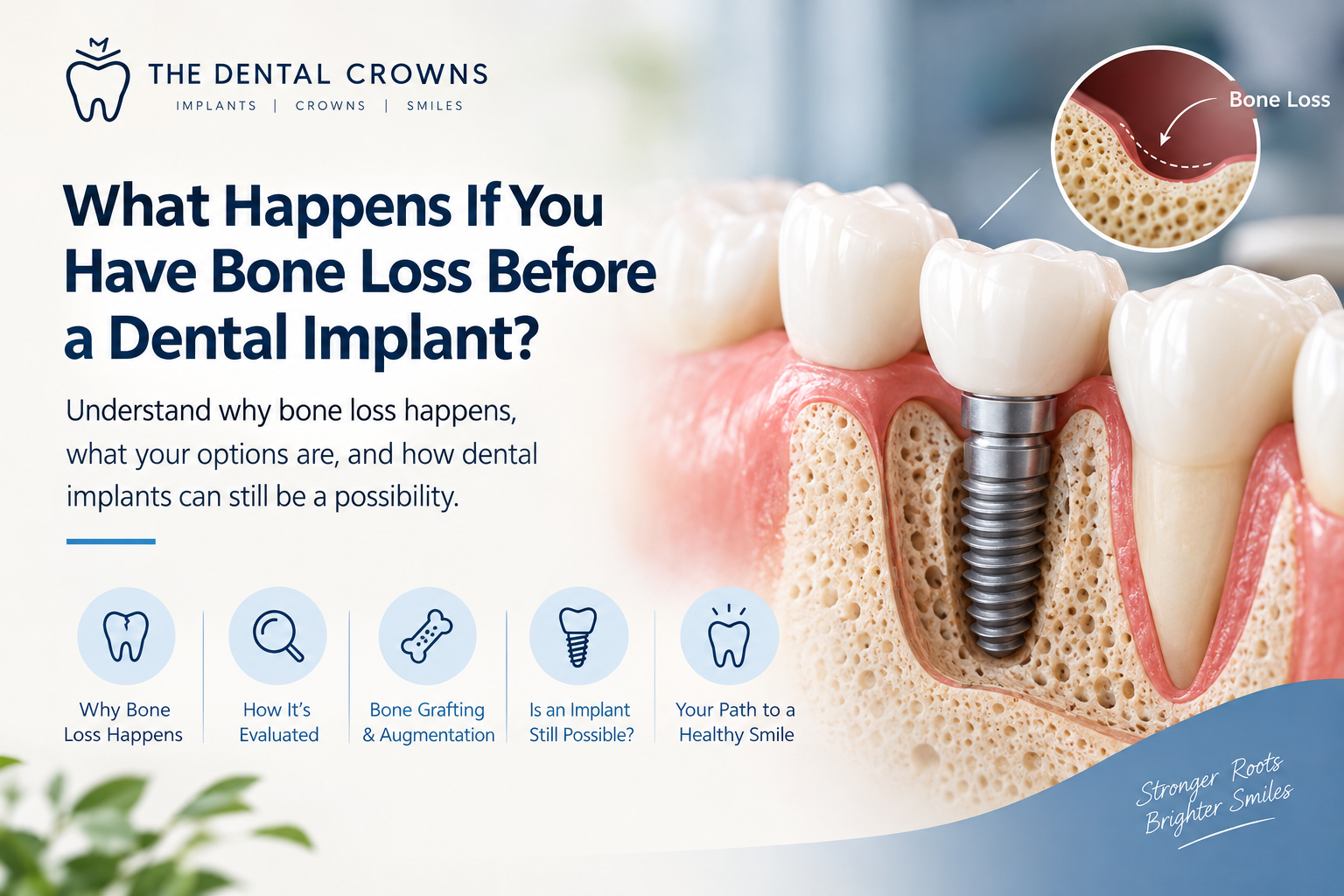
If you have been told that you have bone loss before a dental implant, you may be wondering whether you can still get an implant. The good news is that bone loss does not automatically mean you cannot have a dental implant.
Dental implants need adequate jawbone support to remain stable. When a tooth has been missing for a long time, the bone that previously supported that tooth can gradually shrink. Gum disease, trauma, infection and certain other dental conditions can also contribute to bone loss.
Depending on the amount and location of bone available, your dentist may recommend bone grafting, bone augmentation or another preparatory procedure before dental implant placement.
At The Dental Crowns in Noida, implant treatment is planned after evaluating your oral health, available bone, gums and individual treatment requirements.
Quick Answer: Can You Get a Dental Implant With Bone Loss?
In many cases, yes.
Bone loss may make dental implant treatment more complicated, but it does not necessarily rule out an implant. Your dentist first needs to determine whether there is enough healthy bone to provide stability.
If there is not enough bone in the planned implant site, a bone graft or other bone augmentation procedure may be recommended. After the area heals and develops sufficient support, the dental implant may be placed.
The American Association of Oral and Maxillofacial Surgeons notes that people with bone loss may still be candidates for dental implants and that bone grafting can be used to create a suitable foundation for implant placement.
Why Does Bone Loss Happen Before a Dental Implant?
Jawbone is not static. It responds to stimulation from natural teeth. When a tooth is lost, the bone that supported its root may gradually be resorbed.
Some common reasons for bone loss include:
1. Long-Term Tooth Loss
After a tooth is removed or lost, the surrounding bone may gradually shrink because the tooth root is no longer stimulating the area.
The longer a missing tooth remains untreated, the more the shape and volume of the surrounding bone may change.
2. Gum Disease
Advanced periodontal disease can damage the tissues and bone supporting teeth. If a tooth is eventually lost because of gum disease, the remaining bone may not provide the ideal foundation for an immediate implant.
3. Tooth Infection
A severe dental infection can affect the bone surrounding a tooth. Depending on the condition of the area, your dentist may need to treat the infection and allow the tissues to heal before considering implant placement.
4. Trauma
An accident or injury involving the jaw or teeth can cause loss or damage to bone.
5. Previous Tooth Extraction
Some bone shrinkage naturally occurs following tooth extraction. Bone preservation procedures may sometimes be considered at the time of extraction to help maintain the site for future treatment.
According to the AAOMS, loss or extraction of a tooth can result in resorption of the supporting jawbone, potentially affecting future dental treatment such as implants.
Why Is Bone Important for Dental Implants?
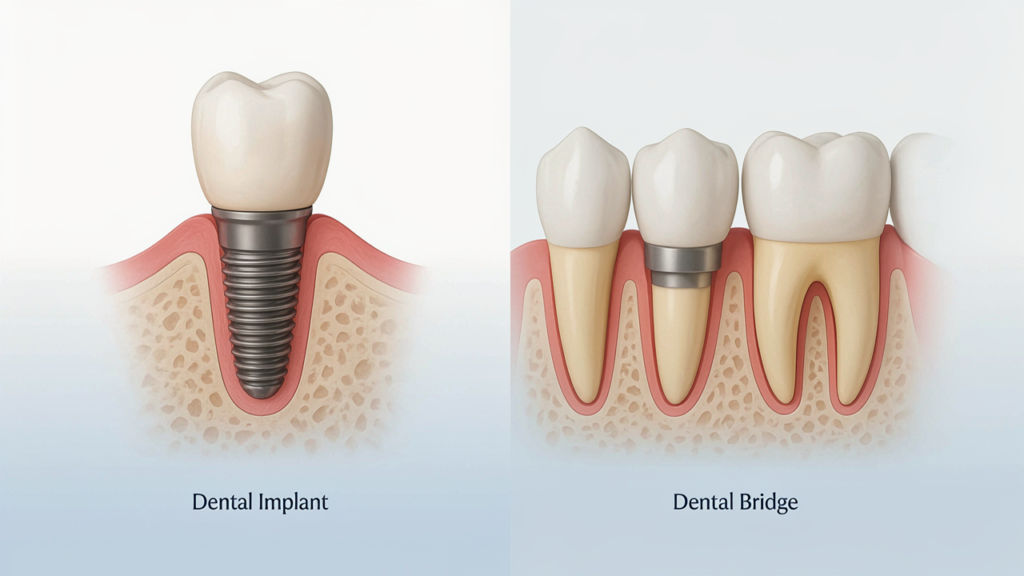
A dental implant is placed into the jawbone and acts as an artificial tooth root. The implant needs sufficient bone support so that it can achieve stability and integrate with the surrounding bone.
This process is known as osseointegration.
Once integration occurs, the implant can support an abutment and replacement dental crown.
You can learn more about the complete treatment option on our Dental Implants in Noida service page.
The American Academy of Periodontology states that adequate bone and healthy gum tissues are important considerations when determining whether someone is a candidate for dental implants.
What Happens If You Don’t Have Enough Bone for a Dental Implant?
If your dentist determines that there is insufficient bone, the implant may not be placed immediately.
Instead, your dentist may recommend a procedure to improve the foundation of the implant.
Depending on your individual condition, this can include:
- Bone grafting
- Ridge augmentation
- Socket preservation
- Sinus augmentation in selected upper-jaw cases
- Other site-development procedures
The exact procedure depends on where the bone loss has occurred, how much bone is available and the planned implant position.
A bone graft can provide additional material or a framework that allows new bone to develop in the area. AAOMS describes bone grafting as a procedure that can be used to improve the quantity and quality of bone for dental implant treatment.
What Is Bone Grafting Before a Dental Implant?
Bone grafting is a procedure used to improve the amount or shape of bone in an area where additional support may be required.
A graft may be obtained from different sources, including the patient’s own bone, donor material or manufactured/synthetic materials, depending on the clinical situation and treatment plan.
The objective is to create a more suitable foundation for future treatment.
Not every patient with bone loss requires a bone graft. Some people may have enough bone for implant placement despite having some degree of bone resorption.
That is why an individual examination is important.
How Does a Dentist Check Bone Loss Before an Implant?
Your dentist will generally evaluate the missing-tooth area before deciding whether an implant can be placed.
The assessment may include:
Clinical Examination
The dentist examines your gums, teeth, bite and the area where the tooth is missing.
Dental X-Rays
X-rays can provide information about the teeth and surrounding structures.
CBCT Scan
In more complex implant cases, three-dimensional imaging such as cone beam computed tomography (CBCT) may be considered to assess bone anatomy and treatment requirements.
The American Academy of Oral and Maxillofacial Radiology recommends considering CBCT when clinical circumstances indicate a need for augmentation or site-development procedures before implant placement.
Your dentist uses this information to determine whether the existing bone is sufficient or whether additional treatment should be considered.
Can a Dental Implant Be Placed Immediately If You Have Bone Loss?
It depends.
There is no single answer for every patient.
If enough healthy bone remains to provide adequate initial stability, an implant may sometimes be placed without extensive grafting.
If the bone deficiency is significant, your dentist may recommend treating the bone first.
The decision can depend on:
- Amount of available bone
- Bone width
- Bone height
- Location of the missing tooth
- Condition of the gums
- Presence of infection
- Number of missing teeth
- Implant position
- Overall oral health
- Your treatment goals
Therefore, bone loss should be evaluated rather than assumed to make implants impossible.
How Long Does Bone Grafting Take Before a Dental Implant?
The timeline varies from patient to patient.
Some cases may require a healing period before implant placement, while other situations may allow different treatment approaches.
The healing period depends on factors such as:
- Type of graft
- Size of the bone deficiency
- Location of the graft
- Individual healing
- Oral health
- Whether the implant is placed at the same time or later
Your dentist should provide a personalized timeline after evaluating your scans and clinical condition.
It is important not to compare your treatment timeline with another patient’s because bone requirements can be very different.
What If You Have Severe Bone Loss?
Severe bone loss can make conventional implant placement more challenging.
However, treatment possibilities may still exist.
Depending on the location and severity of bone deficiency, a dental professional may consider different approaches, including bone augmentation or other implant-related techniques.
In some situations, alternative tooth-replacement options may also be discussed.
The appropriate solution should be determined after a detailed examination rather than based only on symptoms or an online article.
Does Bone Loss Mean Dental Implants Will Fail?
Not necessarily.
Bone loss is a factor that needs to be assessed and managed appropriately.
The purpose of bone augmentation, when recommended, is to improve the foundation available for implant treatment.
Dental implant success also depends on factors such as implant positioning, healing, oral hygiene, gum health, smoking, systemic health and long-term maintenance.
AAOMS notes that problems with bone healing can contribute to early implant failure, while conditions such as peri-implantitis can affect implants after they have integrated.
This is why proper diagnosis and regular follow-up are important before and after implant treatment.
What Happens After the Bone Has Healed?
Once your dentist determines that the bone has developed sufficiently for implant treatment, the next stage can be planned.
The general process may involve:
Step 1: Examination and imaging
Your dentist evaluates the bone, gums, bite and overall oral condition.
Step 2: Bone treatment if required
A graft or other preparatory procedure may be performed if additional bone support is needed.
Step 3: Healing
The treated area is allowed to heal according to your dentist’s instructions.
Step 4: Implant placement
The dental implant is surgically placed into the prepared jawbone.
Step 5: Osseointegration
The implant gradually integrates with the surrounding bone.
Step 6: Abutment and crown
Once the implant is ready for restoration, an abutment and dental crown can be used to complete the tooth replacement.
You can also explore our Dental Crown Treatment options if a crown is part of your restorative treatment plan.
Can Bone Loss Be Prevented After Tooth Extraction?
In some cases, steps can be taken to help preserve the bone after extraction.
One such approach is socket preservation, where the extraction site is treated to help maintain the shape and volume of the bone.
This can be particularly relevant when a patient expects to consider an implant in the future.
However, not every extraction site requires the same treatment. Your dentist can assess the individual tooth and explain whether bone preservation is appropriate.
AAOMS explains that preserving the bone after tooth extraction can help maintain the site for future dental treatment and improve the foundation available for implants.
Is Bone Grafting Painful?
Bone grafting is a dental surgical procedure, so some discomfort, swelling or tenderness can occur during the recovery period.
Your dental professional will provide instructions for managing the area after treatment.
The experience can vary depending on:
- The location of treatment
- The amount of grafting required
- The type of procedure
- Individual healing
- Whether other procedures are performed at the same time
Follow your dentist’s postoperative instructions carefully and contact the dental team if you experience unexpected or persistent symptoms.
What Can You Do If You Have Been Told You Have Bone Loss?
If you have been told that you do not have enough bone for an implant, don’t assume that treatment is impossible.
Instead, ask your dentist:
- How much bone is available?
- Where exactly is the bone deficiency?
- Do I need a bone graft?
- Can the graft and implant be performed together?
- How long will the healing process take?
- What imaging is required?
- Are there alternative treatment options?
- What will the complete treatment involve?
Getting answers to these questions can help you understand your treatment plan and make an informed decision.
Dental Implants With Bone Loss in Noida
If you are searching for dental implants in Noida and have been told that you have bone loss, professional evaluation is the next step.
At The Dental Crowns, implant treatment is planned according to your individual oral condition, available bone, gum health and restoration requirements.
The clinic is located at Civitech Stadia, Sector 79, Noida, making it accessible for patients from nearby Noida sectors.
You can explore our Dental Implants service in Noida to learn more about the treatment approach.
Patients from nearby areas can also explore our dental implant guides for:
- Dental Implants Near Noida Sector 76
- Dental Implants Near Noida Sector 77
- Dental Implants in Noida Sector 75
- Dental Implants in Noida Sector 79
Frequently Asked Questions About Bone Loss and Dental Implants
1. Can I get a dental implant if I have bone loss?
Yes, many people with bone loss can still receive dental implants. Depending on the amount of available bone, additional treatment such as bone grafting may be recommended before implant placement.
2. What happens if there is not enough bone for an implant?
Your dentist may recommend bone grafting, ridge augmentation or another procedure to improve the implant site. The appropriate option depends on the location and severity of bone loss.
3. How do I know if I have enough bone for a dental implant?
A dentist can evaluate the implant site using a clinical examination and appropriate dental imaging. CBCT may be considered when three-dimensional assessment is clinically indicated.
4. Is bone grafting always necessary before a dental implant?
No. Some patients have sufficient bone for implant placement despite having some bone loss. Bone grafting is recommended only when the clinical assessment indicates that additional support is needed.
5. Can a dental implant be placed after a bone graft?
Yes. In appropriate cases, an implant can be placed after the grafted area has healed and developed an adequate foundation.
6. How long should I wait after bone grafting?
The healing period varies according to the type and extent of grafting and the individual patient’s healing. Your dentist will determine when the site is ready for implant placement.
7. Can gum disease cause bone loss before dental implants?
Yes. Periodontal disease can damage the tissues and bone supporting teeth. Gum health should therefore be evaluated and managed as part of implant planning.
8. Does losing a tooth cause bone loss?
Tooth loss can lead to resorption of the bone that previously supported the tooth. The extent varies between individuals.
9. Can severe bone loss be treated?
In many cases, procedures designed to augment or reconstruct deficient bone may be considered. However, the appropriate treatment depends on the patient’s anatomy and overall dental condition.
10. What is the best treatment for bone loss before an implant?
There is no single best treatment for every patient. Your dentist should select the approach based on the location, amount and type of bone deficiency and the planned implant restoration.
Final Takeaway
Having bone loss before a dental implant does not automatically mean you cannot get an implant.
The key question is whether there is enough healthy bone to provide the stability required for successful implant treatment.
If additional bone is needed, procedures such as bone grafting or bone augmentation may help prepare the site. In other cases, an implant may be possible without extensive bone treatment.
The safest approach is to have your jawbone, gums and missing-tooth area professionally evaluated before making a decision.
If you are considering dental implants in Noida, contact The Dental Crowns for an evaluation and personalized treatment plan.
Book a Dental Implant Consultation
The Dental Crowns
Civitech Stadia, Sector 79, Noida, Uttar Pradesh 201301
Phone: +91 89202 71787
Email: thedentalcrowns@gmail.com
Important Medical Disclaimer
This article is intended for general educational purposes and should not replace a professional dental examination, diagnosis or treatment plan. Bone requirements and implant treatment can vary considerably between patients. A qualified dental professional should evaluate your individual condition before treatment.