Losing a tooth can affect much more than your smile. A missing tooth can make chewing difficult and may also affect the surrounding teeth and jawbone over time. Dental implants are one treatment option used to replace the root of a missing tooth and support a replacement tooth such as a crown.
But how exactly is a dental implant placed into the jawbone?
The procedure involves careful planning, preparation of the jawbone, placement of the implant, a healing period, and finally the attachment of the artificial tooth. The exact process varies from patient to patient depending on the condition of the bone, gums, remaining teeth and overall treatment plan.
In this guide, we explain how a dental implant is placed into the jawbone, what happens during implant surgery, how the implant bonds with the bone, and when the final crown is fitted.
For professional implant treatment, you can also learn more about Dental Implants at The Dental Crowns, Noida.
What Is a Dental Implant?
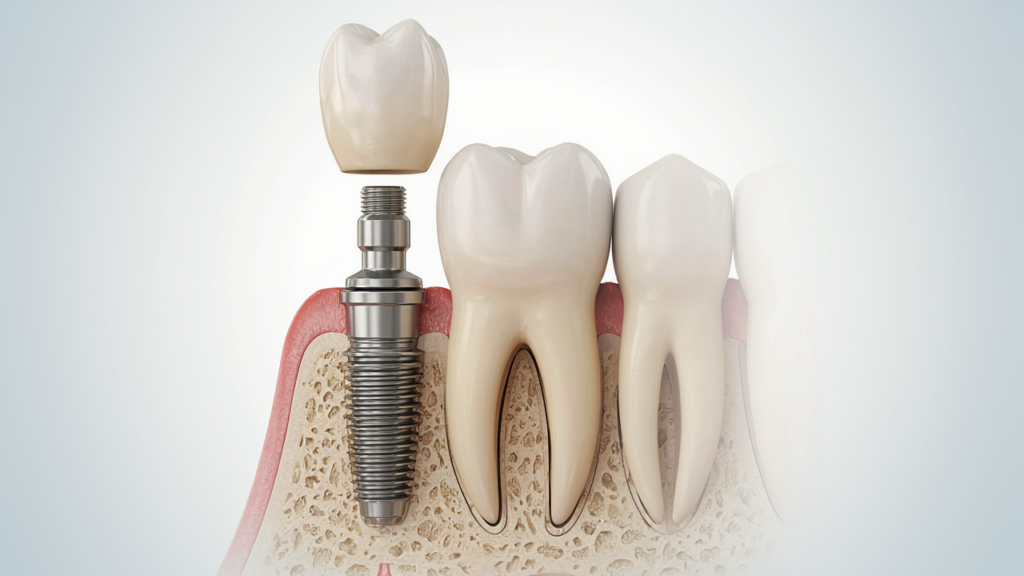
A dental implant is a small artificial tooth root that is surgically placed into the jawbone. The implant generally acts as the foundation for a replacement tooth.
A typical dental implant restoration consists of three main parts:
- Implant: The portion placed inside the jawbone.
- Abutment: The connector between the implant and replacement tooth.
- Dental crown: The visible artificial tooth attached to the implant.
Unlike a traditional bridge, an implant can replace the missing tooth root without requiring the adjacent teeth to be prepared as bridge supports.
The implant needs sufficient healthy bone for stability. If the jawbone does not have enough volume or density, your dentist may recommend bone grafting or another procedure before or during implant placement.
How Is a Dental Implant Placed Into the Jawbone?
Dental implant placement usually takes place in several stages. Your dentist first evaluates your mouth and jawbone, then plans the implant position before performing the surgical procedure.
Here is the typical process.
1. Dental Examination and Implant Planning
The first step is a detailed dental examination.
Your dentist evaluates:
- The missing tooth or teeth
- The condition of your gums
- The amount of available jawbone
- The position of nearby teeth
- Your bite
- Your overall dental health
- Any existing infections or gum problems
X-rays and, when appropriate, 3D imaging can be used to assess the jawbone and plan the implant position.
This planning stage is important because the implant must be positioned carefully to provide appropriate support for the final restoration.
2. Checking Whether Bone Grafting Is Required
The dental implant needs a suitable foundation inside the jawbone.
If the jawbone is too thin or does not have enough volume to support the implant, bone grafting may be recommended.
Bone grafting adds bone or bone-substitute material to an area where additional support is required. The graft then needs time to heal and develop sufficient strength before implant placement in some cases.
Not every patient requires a bone graft.
Your dentist determines whether additional bone treatment is necessary after examining your jawbone.
For more information about dental implant preparation, see the Mayo Clinic’s dental implant surgery guide.
3. Local Anaesthesia Is Given
Before implant surgery begins, the treatment area is numbed with local anaesthesia.
This helps prevent pain during the procedure.
Depending on the patient’s circumstances and the complexity of treatment, additional sedation options may also be discussed with the dental team.
The type of anaesthesia or sedation used depends on the individual treatment plan.
4. The Gum Is Carefully Opened
Once the treatment area is numb, the dentist or oral surgeon accesses the jawbone through the gum tissue.
A small incision may be made in the gum to expose the bone underneath.
This allows the dental professional to access the precise area where the implant will be placed.
The procedure is planned carefully to protect the surrounding teeth, bone and important anatomical structures.
5. A Space Is Prepared in the Jawbone
After exposing the appropriate area of bone, the dentist prepares a small space in the jawbone for the implant.
Special dental instruments are used to create an opening that matches the planned implant position and dimensions.
This is one of the most important stages of dental implant placement because the implant must be positioned accurately inside the bone.
The exact technique varies according to the implant system, location of the missing tooth, bone condition and individual treatment plan.
6. The Dental Implant Is Inserted Into the Jawbone
The implant is then placed into the prepared area of the jawbone.
The implant acts as an artificial tooth root.
It is positioned inside the bone at the location where the missing tooth root previously existed.
According to Cambridge University Hospitals, implant surgery generally involves lifting the gum to expose the bone, preparing a hole in the bone and inserting the implant before closing the gum with stitches.
The implant may be covered by gum tissue during healing, or a healing component may be positioned so that part of the implant system is accessible above the gum.
7. The Gum Is Closed and the Healing Period Begins
After the implant has been placed, the gum is repositioned and may be closed with stitches.
The implant then needs time to heal.
This is an important part of the dental implant procedure because the implant is not immediately treated like a fully functioning natural tooth root.
Instead, the surrounding bone needs time to heal and establish a stable connection with the implant.
8. Osseointegration: How the Implant Bonds With the Jawbone
One of the most important terms to understand when learning how a dental implant is placed into the jawbone is osseointegration.
Osseointegration is the process in which bone forms a close connection with the implant surface.
As healing progresses, the jawbone becomes integrated with the implant, creating the foundation needed to support the replacement tooth.
The healing period can take several months, although the exact timeline differs between patients.
Mayo Clinic explains that osseointegration involves the jawbone growing into and joining with the implant surface, helping provide a stable base for the artificial tooth.
The amount of time required depends on factors such as bone quality, implant location, whether bone grafting was required and the individual’s healing process.
9. The Abutment Is Connected
Once the implant has integrated sufficiently with the jawbone, the next stage is connecting the abutment.
The abutment is the component that connects the implant to the final dental crown.
Depending on the implant system and treatment approach, the abutment may be connected during the initial procedure or placed during a later minor procedure.
If the implant was covered by gum tissue during healing, the dentist may need to expose the implant before attaching the abutment.
Your dental professional will determine which approach is appropriate for your case.
10. The Dental Crown Is Placed
After the implant and surrounding tissues have healed sufficiently, the final replacement tooth can be prepared.
Your dentist may take impressions or digital scans of your mouth and implant area. These records help create a crown designed to fit your bite and complement your surrounding teeth.
The final crown is then attached to the implant through the abutment.
The result is a replacement tooth supported by an implant that has integrated with the jawbone.
If you are considering implant treatment, you can explore The Dental Crowns’ dental implant service in Noida.
How Long Does Dental Implant Placement Take?
The implant placement appointment itself can be relatively short in straightforward cases, but the complete dental implant treatment takes considerably longer because the implant needs time to heal and integrate with the jawbone.
The overall timeline can depend on:
- Whether a tooth needs to be extracted
- The condition of the jawbone
- Whether bone grafting is necessary
- The number of implants
- The location of the implant
- The patient’s healing response
- The type of restoration being placed
Some patients may complete treatment in several months, while more complex cases can take longer.
For example, NHS patient information explains that implant treatment may involve several stages and can take several months, particularly when bone grafting is required.
Does Dental Implant Surgery Hurt?
Dental implant surgery is normally performed under local anaesthesia, which numbs the treatment area.
Patients may experience some soreness, swelling or bruising after the procedure as the tissues heal.
Post-operative discomfort varies between individuals and depends on the complexity of treatment.
Your dentist will provide specific instructions for managing recovery and maintaining oral hygiene after implant surgery.
If you experience severe or worsening pain, persistent bleeding, significant swelling or other concerning symptoms, contact your dental professional promptly.
What Happens If There Isn’t Enough Jawbone for an Implant?
Not having enough jawbone does not necessarily mean dental implants are impossible.
If the bone is insufficient, your dentist may recommend a bone graft or another procedure to increase the available bone.
Bone grafting can add additional treatment time because the graft may need to heal before the implant is placed.
In some cases, minor bone grafting can be performed alongside implant placement.
The appropriate approach depends on the amount and location of bone available and the patient’s individual treatment requirements.
How Long Does It Take for a Dental Implant to Fuse With the Jawbone?
The process of the implant becoming integrated with the surrounding bone is called osseointegration.
The exact healing time varies.
Some clinical guidance describes an integration period of approximately three to six months, while other cases can take longer depending on bone quality, grafting and other treatment factors.
This is why dental implant treatment should not be judged only by the time required for the surgical appointment. The biological healing period is an essential part of the treatment.
What Are the Benefits of Dental Implants?
Dental implants can provide several advantages when they are appropriate for a patient.
Potential benefits include:
- Replacing a missing tooth root
- Supporting an individual dental crown
- Supporting bridges or implant-retained dentures
- Providing a fixed tooth-replacement option
- Avoiding preparation of some adjacent healthy teeth in appropriate cases
- Helping restore chewing function
- Providing a natural-looking tooth replacement when properly planned and restored
However, dental implants are not automatically suitable for everyone. A dentist needs to assess your oral health, bone condition, gums, medical history and treatment goals before recommending an implant.
What Can Affect Dental Implant Healing?
Several factors can influence implant healing and long-term maintenance.
These may include:
Gum Health
Healthy gums provide an important foundation for implant treatment. Existing gum disease may need to be treated before implant placement.
Bone Quality
Adequate bone is needed to provide support around the implant.
Smoking
Smoking can negatively affect healing and is associated with increased implant complications. Your dentist may advise you to stop smoking before and after treatment.
Oral Hygiene
Good oral hygiene is important for maintaining both natural teeth and dental implants.
Regular Dental Checkups
Regular follow-up appointments allow your dentist to monitor the implant, crown, gums and surrounding teeth.
How Should You Care for a Dental Implant?
A dental implant still requires regular oral care.
After treatment, your dental professional may recommend:
- Brushing twice daily
- Cleaning between teeth
- Using an interdental brush or other recommended cleaning aid
- Attending regular dental checkups
- Following professional cleaning recommendations
- Avoiding habits that could damage the crown
- Following all post-operative instructions
Dental implants are not completely maintenance-free. Proper cleaning and professional monitoring are important for long-term oral health.
Frequently Asked Questions About Dental Implant Placement
Is a dental implant placed directly into the jawbone?
Yes. The implant component is surgically placed into the jawbone, where it acts as an artificial tooth root. The bone then heals around the implant during osseointegration.
Is dental implant surgery painful?
The treatment area is normally numbed with local anaesthesia during implant placement. Some soreness, swelling or bruising can occur during recovery.
How long does a dental implant take to heal?
Healing varies from person to person. The implant may require several months to integrate with the jawbone before the final restoration is completed.
Can I get an implant if I have low bone density?
It depends on the amount and quality of bone available. Some patients with insufficient bone may require bone grafting or another preparatory procedure.
When is the crown placed on a dental implant?
The crown is generally placed after the implant has healed sufficiently and the dental team confirms that it is ready to support the restoration.
Can a dental implant replace one missing tooth?
Yes. A single dental implant can be used to support a crown designed to replace one missing tooth when the patient is an appropriate candidate.
How many appointments are needed for a dental implant?
The number of appointments varies according to the patient’s condition and treatment plan. Assessment, imaging, surgery, healing checks and restoration may require multiple visits.
Can dental implants replace multiple missing teeth?
Yes. Depending on the situation, implants may support individual crowns, bridges or implant-retained dentures.
Final Takeaway: How Is a Dental Implant Placed Into the Jawbone?
The dental implant process is more than simply inserting a metal post into the jaw.
A typical treatment journey involves:
Consultation → Imaging & Planning → Bone Preparation if Required → Implant Placement → Healing & Osseointegration → Abutment → Dental Crown
The implant is carefully positioned inside the jawbone and then allowed to heal so that the surrounding bone can integrate with it. Once the implant is sufficiently stable, the abutment and final crown can be completed.
Because every patient’s bone, gums, missing-tooth area and overall oral health are different, the exact procedure and timeline should be determined by a qualified dental professional.
If you are considering replacing a missing tooth, you can learn more about dental implant treatment in Noida through The Dental Crowns’ Dental Implant service or schedule a consultation to discuss your individual treatment needs.