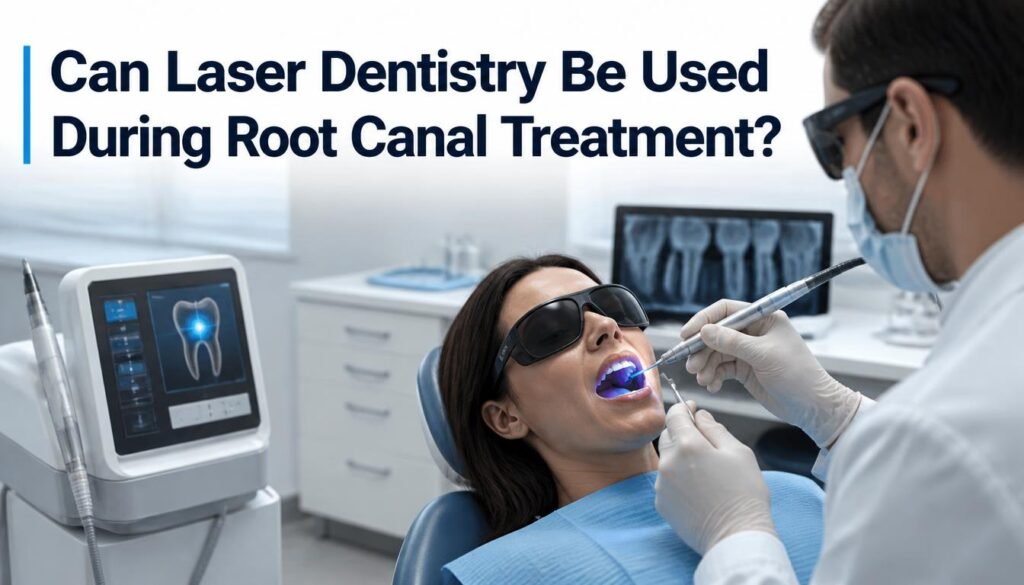

If you have been advised to undergo a root canal treatment, you may be wondering whether modern dental technology can make the procedure more comfortable or effective. One question patients increasingly ask is: Can laser dentistry be used during root canal treatment?
The short answer is yes, lasers can be used as an adjunct to certain root canal procedures. Depending on the patient’s condition, the type of laser, and the dentist’s treatment protocol, laser technology may be used to assist with disinfection, bacterial reduction, irrigation, or postoperative comfort.
However, laser dentistry does not necessarily replace every conventional step of root canal treatment. A dentist must first examine the tooth, assess the infection and root canal anatomy, and determine whether laser-assisted treatment is appropriate.
If you are looking for laser dentistry or painless root canal treatment in Sector 79, Noida, The Dental Crowns provides both treatment options at its clinic in Civitech Stadia, Sector 79.
What Is Root Canal Treatment?
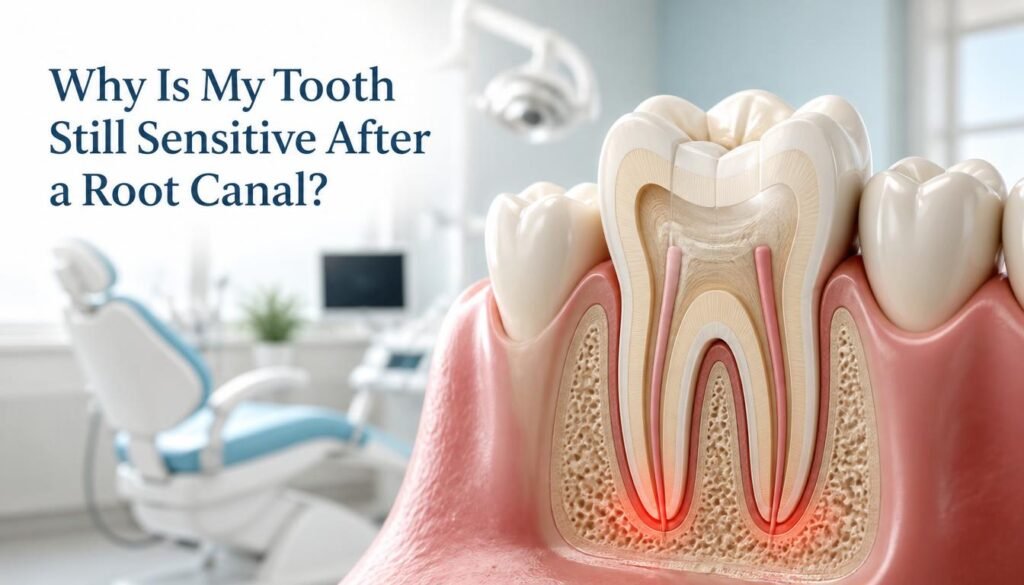
Root canal treatment, also known as endodontic treatment, is performed when the soft tissue or pulp inside a tooth becomes inflamed or infected.
This can happen because of:
- Deep tooth decay
- A cracked or damaged tooth
- Repeated dental procedures
- Dental trauma
- Untreated infection
- Deep cavities reaching the pulp
During root canal treatment, the dentist removes infected or inflamed pulp, cleans and shapes the root canal system, disinfects the canals and seals them.
The primary objective is to control infection and preserve the natural tooth whenever possible.
If you want to understand the treatment in more detail, you can also explore our Painless Root Canal Treatment service page and our guide on Root Canal Treatment Near Noida Sector 79
What Is Laser Dentistry?
Laser dentistry uses concentrated light energy for specific dental procedures. Different lasers can be used for different applications, so “laser dentistry” does not refer to one single treatment.
In endodontics, lasers have been investigated for applications including:
- Root canal disinfection
- Laser-activated irrigation
- Reduction of microorganisms
- Photobiomodulation for postoperative discomfort
- Supporting tissue healing
- Certain soft-tissue procedures
Research has explored several laser systems, including diode, Nd, Er and Er,Cr lasers.
Importantly, laser technology is generally considered an adjunct to appropriate endodontic treatment rather than a universal replacement for conventional cleaning, shaping and irrigation.
Can Laser Dentistry Be Used During Root Canal Treatment?
Yes, laser dentistry can be used during root canal treatment in selected cases.
A dentist may use laser technology as part of an overall endodontic treatment plan. The exact application depends on the tooth, infection, root canal anatomy, equipment available and the dentist’s clinical judgment.
One potential application is laser-assisted disinfection.
Root canals can contain microorganisms in areas that are difficult to access mechanically. Researchers have investigated whether laser energy, including laser-activated irrigation, can improve microbial reduction within the root canal system.
Recent evidence suggests that lasers may have potential benefits in endodontic disinfection and postoperative outcomes, but the evidence is still developing and protocols are not completely standardized.
Therefore, patients should not assume that laser treatment is automatically better than conventional root canal treatment. Instead, the dentist should determine whether it provides a useful benefit in the individual case.
How Is a Laser Used During Root Canal Treatment?
Laser-assisted root canal treatment may involve several stages.
1. Examination and Diagnosis
Before treatment begins, your dentist examines the tooth and may use dental X-rays or other diagnostic methods.
The dentist evaluates:
- The condition of the pulp
- The extent of infection
- Root canal anatomy
- The amount of remaining tooth structure
- Existing restorations
- Signs of infection around the root
This helps determine whether root canal treatment is required and whether laser assistance may be appropriate.
2. Local Anaesthesia
Local anaesthesia is normally used to make the procedure comfortable.
Laser technology does not mean that every patient will automatically require less or no anaesthesia. Your dentist will decide what is appropriate based on the procedure and your individual needs.
3. Accessing the Root Canal
The dentist creates an access opening in the tooth to reach the infected pulp and root canal system.
Conventional dental instruments remain important during this stage.
4. Cleaning and Shaping
The root canals are cleaned and shaped using appropriate endodontic instruments.
This step is essential because infected tissue and debris need to be removed from the canal system.
5. Laser-Assisted Disinfection
Depending on the treatment protocol, a laser may be used as an adjunct to conventional cleaning and irrigation.
Laser energy can be investigated for its ability to assist with bacterial reduction and improve the action of irrigation within parts of the root canal system.
However, the exact laser wavelength, settings and technique matter. Improper use can potentially damage tissues, which is why laser treatment should only be performed by appropriately trained dental professionals.
6. Filling and Sealing the Canal
After adequate cleaning and disinfection, the root canal is filled and sealed.
The objective is to prevent microorganisms from re-entering the treated canal system.
7. Restoring the Tooth
After root canal treatment, the tooth may require a restoration such as a filling or dental crown depending on how much tooth structure remains and which tooth has been treated.
You can learn more about restoration options through our Dental Crown Treatment service
What Are the Potential Benefits of Using Lasers During Root Canal Treatment?
Laser-assisted endodontic treatment has attracted interest because it may offer several potential benefits.
Better Microbial Reduction
One of the main areas of research is bacterial reduction.
The root canal system can be complex, with narrow spaces and anatomical variations. Researchers have investigated whether laser-assisted techniques can help reduce microorganisms in combination with conventional treatment.
Possible Reduction in Postoperative Discomfort
Some studies have reported reduced postoperative pain following certain forms of low-level laser therapy or photobiomodulation.
However, the quality and certainty of evidence vary between studies, so laser treatment should not be marketed as a guarantee of a completely pain-free experience.
Support for Treatment Comfort
Modern root canal treatment already uses local anaesthesia and advanced instruments to improve patient comfort.
Laser technology may be incorporated into selected treatment protocols, but the overall patient experience depends on many factors, including diagnosis, infection severity, treatment complexity and the clinician’s technique.
Potential Support for Healing
Laser therapy has also been studied in relation to healing around the tissues surrounding the tooth.
However, current evidence does not establish that adding a laser routinely produces better healing outcomes than conventional endodontic treatment in every patient.
Is Laser Root Canal Treatment Better Than Conventional Root Canal Treatment?
Not necessarily.
This is one of the most important things patients should understand.
Laser dentistry is an additional technology, not a guarantee of superior treatment.
A 2026 umbrella review of systematic reviews found that evidence regarding laser-activated irrigation in endodontics remains limited and heterogeneous. Some studies suggest potential benefits for microbial reduction and postoperative outcomes, but differences in laser systems, protocols and study designs make definitive conclusions difficult.
Similarly, research on low-level laser therapy has reported possible reductions in postoperative endodontic pain, but the certainty of evidence has been described as low or very low in some reviews.
This means that the success of root canal treatment still depends heavily on:
- Correct diagnosis
- Thorough cleaning
- Effective disinfection
- Proper canal shaping
- Adequate sealing
- Appropriate restoration
- Good oral hygiene
- Regular dental follow-up
For patients, the most important question is therefore not simply “Does the dentist use a laser?”
A better question is:
“Is laser technology appropriate for my specific root canal case, and how will it contribute to my treatment?”
Does Laser Dentistry Make Root Canal Treatment Completely Painless?
Laser technology should not be promoted as a guarantee that root canal treatment will be completely painless.
Modern root canal treatment can often be performed comfortably with local anaesthesia and appropriate pain-management techniques.
Some laser-based approaches have been studied for postoperative pain management, and certain studies have reported potential benefits. However, individual experiences vary.
The level of discomfort can depend on:
- The severity of infection
- Whether there is an abscess
- The location of the tooth
- Root canal complexity
- Existing inflammation
- Individual pain sensitivity
- The treatment technique used
If you are nervous about dental treatment, tell your dentist before the procedure. Your dentist can explain the available comfort measures and develop a treatment plan suited to your needs.
When Might a Dentist Consider Laser Assistance During Root Canal Treatment?
Laser assistance may be considered when the dentist believes it can provide a useful adjunct to conventional treatment.
Factors that may influence the decision include:
- The type and severity of infection
- Root canal anatomy
- Previous root canal treatment
- The need for additional disinfection
- The available laser technology
- The dentist’s training and experience
- The patient’s individual treatment requirements
Not every root canal requires laser assistance.
A proper clinical examination is therefore more important than choosing a treatment simply because it uses advanced technology.
Is Laser Dentistry Safe During Root Canal Treatment?
When appropriately selected and performed using suitable equipment and protocols, laser applications can be used in dentistry.
However, lasers must be used carefully.
Different wavelengths have different effects on dental tissues. Incorrect settings, excessive energy or improper positioning can potentially cause unwanted thermal effects or tissue damage.
For this reason, patients should ask:
- Which type of laser will be used?
- Why is the laser being recommended?
- Will it be used along with conventional root canal treatment?
- What benefit is expected in my case?
- Are there alternative treatment options?
- What should I expect after treatment?
A qualified dentist can answer these questions after examining your tooth.
Laser Dentistry in Sector 79, Noida
If you are searching for laser dentistry in Sector 79, Noida, The Dental Crowns offers laser dentistry along with a range of general, cosmetic and surgical dental services.
The clinic is located at:
Shop No. 16, 1st Floor, Civitech Stadia, Sector 79, Noida, Uttar Pradesh 201301
The Dental Crowns lists both Laser Dentistry and Painless Root Canal Treatment among its dental services.
Patients can discuss their symptoms, diagnosis and treatment options with the dental team before deciding whether laser assistance is appropriate.
You can explore all available treatments on the The Dental Crowns Services page
What Should You Ask Before Choosing Laser-Assisted Root Canal Treatment?
Before beginning treatment, consider asking your dentist:
“Do I actually need a root canal?”
Tooth pain does not always mean a root canal is required. A proper examination is necessary to determine the cause.
“Will a laser be useful in my case?”
Laser treatment should be recommended based on your clinical condition rather than simply because it is a newer technology.
“What type of laser will you use?”
Different lasers have different applications.
“Will the laser replace conventional root canal treatment?”
In many situations, laser technology is used as an adjunct rather than replacing the fundamental steps of endodontic treatment.
“Will I need a dental crown afterward?”
Depending on the tooth and remaining structure, a crown may be recommended to protect a root-canal-treated tooth.
Frequently Asked Questions
Can laser be used during a root canal?
Yes. Laser technology can be used as an adjunct during selected root canal procedures, particularly for applications such as disinfection or laser-activated irrigation. Its suitability depends on the individual case.
Does laser root canal treatment hurt less?
Some laser-based therapies have been studied for postoperative pain reduction, but results vary and the evidence is not strong enough to guarantee less pain for every patient.
Can laser completely replace conventional root canal treatment?
No. Laser technology does not automatically replace conventional endodontic procedures such as cleaning, shaping, irrigation and sealing.
Is laser dentistry suitable for every root canal?
No. The dentist must assess the tooth and determine whether laser assistance is appropriate.
Is laser-assisted root canal treatment safe?
When used appropriately by a trained dental professional with suitable equipment and protocols, laser applications can be incorporated into dental treatment. The exact risks and benefits depend on the laser and procedure.
Does every dentist offer laser root canal treatment?
No. Laser equipment and clinical protocols vary between dental clinics.
Can laser treatment remove all bacteria from a root canal?
No treatment should be presented as a guarantee of eliminating every microorganism. The goal of root canal treatment is thorough cleaning, disinfection and sealing of the canal system.
Can I get laser dentistry in Sector 79, Noida?
The Dental Crowns in Civitech Stadia, Sector 79, Noida, lists laser dentistry among its services. Patients can schedule a consultation to determine whether laser-assisted treatment is suitable for their condition.
Final Thoughts: Can Laser Dentistry Be Used During Root Canal Treatment?
Yes, laser dentistry can be used during root canal treatment in selected cases.
Laser technology may assist with areas such as microbial reduction, canal disinfection and postoperative comfort. However, it should generally be viewed as an adjunct to appropriate endodontic treatment, not a replacement for every conventional root canal procedure.
Current research is promising in some areas but still has limitations, including differences in laser systems, treatment protocols and study quality. Therefore, the right treatment should always be selected after a professional examination.
If you have persistent tooth pain, sensitivity, swelling or discomfort while chewing, do not delay a dental evaluation.
For patients looking for root canal treatment or laser dentistry in Sector 79, Noida, The Dental Crowns provides dental care at Civitech Stadia, Sector 79.References and Further Reading
References:
- PubMed — Systematic Review on the Role of Lasers in Endodontic Therapy Read the PubMed review
- PubMed — Low-Level Laser Therapy for Pain After Root Canal Treatment Read the systematic review
- PubMed — Updated Review of Low-Level Laser Therapy and Endodontic Pain Read the updated review
- PubMed — 2025 Umbrella Review of Low-Level Laser Therapy in Endodontics Read the 2025 review
- PubMed — 2026 Umbrella Review of Laser-Assisted Endodontic Treatment Read the 2026 review
Medical disclaimer: This article is for general educational purposes and does not replace a professional dental examination, diagnosis or personalized treatment plan.