How long should a root canal treated tooth last? A properly treated and restored tooth can potentially last for many years and, in some cases, even a lifetime with good oral hygiene, regular dental checkups, and proper protection. However, there is no fixed expiration date for a root canal treated tooth.
Research shows encouraging long-term survival. A systematic review found that the proportion of root canal-treated teeth surviving was approximately 86%–93% over 2–10 years. More recent research on root-filled posterior teeth reported pooled survival of about 87% at 8–20 years.
Another long-term observational study following root canal-treated teeth for up to 37 years reported survival rates of 97% at 10 years, 81% at 20 years, 76% at 30 years and 68% at 37 years.
So, rather than asking whether a root canal treated tooth lasts exactly 10, 15 or 20 years, it is more useful to understand what determines its long-term survival.
Quick Answer: How Long Does a Root Canal Treated Tooth Last?
A root canal treated tooth can last 10, 15, 20 years or much longer, and some teeth remain functional for a lifetime.
Its longevity depends on several factors, including:
- Quality of the root canal treatment
- Amount of healthy tooth structure remaining
- Quality of the final restoration
- Whether a dental crown is recommended and placed appropriately
- Oral hygiene
- Gum health
- Tooth location
- Bite forces
- Teeth grinding or clenching
- Cracks or fractures
- Regular dental examinations
- Timely treatment if problems return
The American Association of Endodontists notes that with proper care, a tooth that has undergone root canal treatment can last a lifetime, although some teeth may develop problems months or years later.
Why Can a Root Canal Treated Tooth Last for So Many Years?
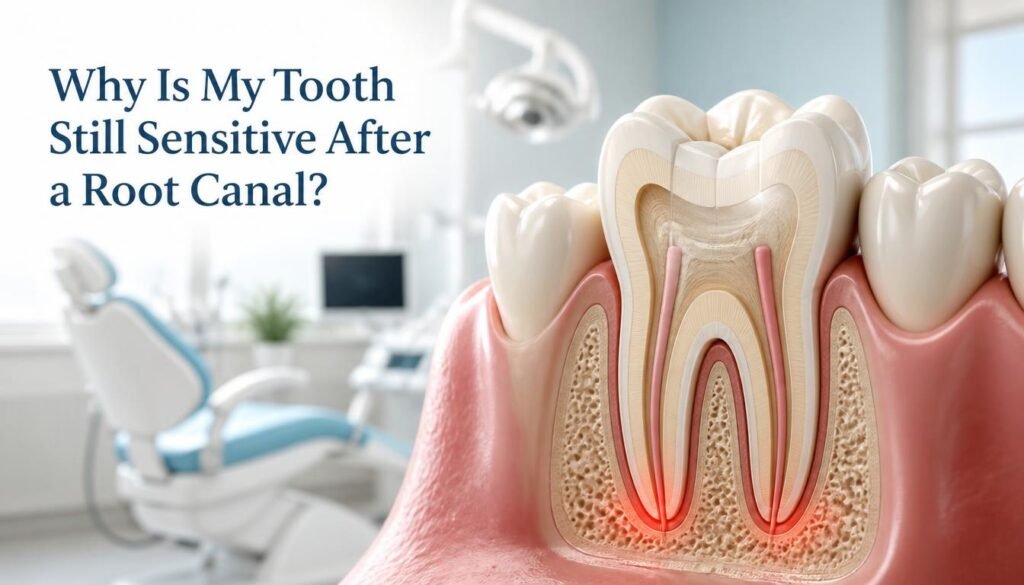
During root canal treatment, infected or inflamed pulp is removed from inside the tooth. The root canals are then cleaned, disinfected, filled and sealed.
The purpose of root canal treatment is to eliminate infection and preserve the natural tooth rather than removing it.
However, the treatment itself is only one part of saving the tooth.
After RCT, the remaining tooth needs an appropriate permanent restoration. Depending on the amount of tooth structure remaining and the tooth’s location, this may involve a filling, onlay or dental crown.
For patients considering treatment, you can learn more about Painless Root Canal Treatment in Noida at The Dental Crowns.
Does a Crown Make a Root Canal Treated Tooth Last Longer?
In many cases, yes.
A root canal treated tooth can be structurally vulnerable because the tooth may already have lost significant structure from decay, cracks, trauma or previous restorations.
A dental crown can cover and protect the remaining tooth structure when full-coverage restoration is clinically appropriate.
A systematic review found that placement of a crown after root canal treatment was associated with improved tooth survival. Another review reported a 10-year survival rate of about 81% for root-canal-treated teeth restored with crowns compared with 63% for those restored with direct restorations.
However, not every root canal treated tooth automatically requires a crown. The decision depends on the tooth type, remaining tooth structure, function and overall clinical condition.
Read more about whether you need a dental crown after root canal treatment.
How Long Does a Root Canal Treated Tooth Last Without a Crown?
There is no single number of years that applies to every tooth.
Some teeth may be successfully restored with a filling or another conservative restoration if sufficient healthy tooth structure remains.
However, heavily damaged back teeth may experience substantial chewing forces. If a dentist recommends a crown and the permanent restoration is delayed, the tooth may be more vulnerable to fracture or leakage.
The best restoration depends on:
- How much tooth structure remains
- Whether the tooth is a molar, premolar or front tooth
- Existing cracks
- Bite forces
- Presence of grinding or clenching
- Quality of the remaining enamel and dentin
- Overall oral health
Therefore, the question should not simply be “How long will my root canal tooth last without a crown?” Instead, ask your dentist whether the tooth has enough remaining structure to function safely with its proposed restoration.
What Factors Affect the Lifespan of a Root Canal Treated Tooth?
1. Quality of Root Canal Treatment
A properly cleaned, disinfected and sealed root canal reduces the risk of persistent infection.
Complex canal anatomy, untreated canals or inadequate sealing can contribute to treatment failure. The American Association of Endodontists identifies missed canals, complicated anatomy and problems with the final restoration among possible reasons a previously treated tooth may develop problems.
2. Amount of Remaining Tooth Structure
This is one of the most important considerations.
A tooth that has lost a large amount of structure through decay, fracture or previous dental work may be more susceptible to breaking.
The goal is not only to treat the infection but also to preserve and protect as much healthy tooth structure as possible.
3. Quality of the Final Restoration
After RCT, the tooth needs to be properly sealed and restored.
A restoration that fits well can help prevent bacteria from entering the tooth again and can provide appropriate protection against chewing forces.
Delaying the permanent restoration when one has been recommended can increase the risk of complications.
4. Oral Hygiene
Good oral hygiene does not directly make the root canal procedure “last longer,” but it helps protect the tooth, gums and surrounding tissues.
Brush twice a day with fluoride toothpaste, clean between your teeth daily and follow your dentist’s recommendations.
5. Teeth Grinding and Clenching
Bruxism can place excessive forces on teeth.
If you regularly grind or clench your teeth, your dentist may recommend protective measures such as a night guard, depending on your individual situation.
Long-term research has identified lack of occlusal protection as one factor associated with tooth extraction in some patients.
6. Gum Health
A root canal treated tooth still depends on healthy supporting tissues.
Periodontal disease, deep periodontal pockets and loss of supporting bone can negatively affect the long-term prognosis of a tooth.
7. Cracks and Fractures
A cracked tooth may have a different prognosis from an intact tooth.
If a tooth has a significant structural crack, your dentist must evaluate whether it can be predictably restored.
8. Regular Dental Checkups
Regular examinations can help identify:
- New decay
- Crown or filling problems
- Gum disease
- Cracks
- Bite problems
- Recurrent infection
Finding a problem early can sometimes allow the tooth to be treated before extraction becomes necessary.
Can a Root Canal Treated Tooth Last 20 Years?
Yes, it can.
A root canal treated tooth may remain functional for 20 years or longer when treatment, restoration and maintenance are favourable.
Long-term research demonstrates that some teeth can remain in function for several decades. In one 2023 study, cumulative survival was reported at 81% after 20 years and 68% after 37 years.
However, these figures represent groups of patients and should not be interpreted as a guarantee for an individual tooth.
Your personal prognosis depends on the condition of your tooth before treatment, the quality of treatment, the amount of remaining tooth structure and the restoration used afterward.
Can a Root Canal Treated Tooth Last a Lifetime?
Yes, a root canal treated tooth can potentially last a lifetime.
The American Association of Endodontists states that with proper care, teeth that have undergone root canal treatment can last a lifetime.
However, “can last a lifetime” does not mean every root canal treated tooth will do so.
A tooth can still be affected by:
- New decay
- Fracture
- Gum disease
- Failed restoration
- Persistent or recurrent infection
- Excessive bite forces
- Trauma
This is why long-term maintenance remains important even when the tooth feels completely normal.
What Are the Signs That a Root Canal Treated Tooth Is Failing?
A previously treated tooth should be evaluated if you notice new or persistent symptoms.
Watch for:
- Pain while biting
- Persistent toothache
- Swelling near the tooth
- A pimple or drainage on the gum
- Increased sensitivity or discomfort
- A loose or damaged crown
- A cracked tooth
- Bad taste or drainage
- Recurring symptoms in the same area
Importantly, a tooth can sometimes develop a problem without causing severe pain.
If you notice any unusual changes, a dentist or endodontist can examine the tooth and determine whether further treatment is necessary.
What Happens If a Root Canal Treated Tooth Gets Infected Again?
A root canal treated tooth does not necessarily have to be extracted if a problem develops.
Depending on the cause and the condition of the tooth, treatment options may include:
- Root canal retreatment
- Endodontic surgery
- Restoration replacement
- Extraction, when the tooth cannot be predictably saved
The American Association of Endodontists explains that retreatment can sometimes give a previously treated tooth another opportunity to heal.
You can also read What Happens During Root Canal Retreatment? to understand the process in more detail.
Root Canal Treatment vs Tooth Extraction
When a tooth can be predictably restored, preserving the natural tooth may be an important treatment goal.
Root canal treatment attempts to remove the infection while retaining the natural tooth.
Extraction removes the tooth entirely. If a tooth is extracted, replacement options may include:
- Dental implants
- Dental bridges
- Dentures
Dental implants can be an option for replacing missing teeth, but they are not automatically a better alternative to saving a restorable natural tooth.
The appropriate treatment depends on the condition of the tooth, supporting bone, gums, overall oral health and individual circumstances.
How to Make Your Root Canal Treated Tooth Last Longer
You can take several practical steps to protect your treated tooth.
Maintain Excellent Oral Hygiene
Brush twice daily and clean between your teeth every day.
Complete the Recommended Restoration
If your dentist recommends a crown or another permanent restoration, do not unnecessarily delay it.
Avoid Using Teeth as Tools
Do not use your teeth to open packages, bite hard objects or perform tasks that can cause fractures.
Manage Teeth Grinding
If you grind or clench your teeth, discuss this with your dentist.
Attend Regular Dental Checkups
Routine examinations allow your dentist to monitor the tooth and surrounding gums.
Treat New Dental Problems Early
Decay around a crown or restoration can eventually threaten the underlying tooth.
Follow Your Dentist’s Instructions
Your dentist knows the specific condition of your tooth and can recommend the appropriate restoration and follow-up schedule.
How Long Does a Root Canal Treated Tooth Last Compared With a Dental Implant?
This is not a simple “which lasts longer?” comparison.
A root canal treated tooth preserves your natural tooth, while a dental implant is used to replace a missing tooth.
Research demonstrates that appropriately treated natural teeth can have high long-term survival rates. For example, a systematic review reported pooled survival of root-filled posterior teeth of approximately 87% at 8–20 years.
If a natural tooth is restorable, your dentist may discuss saving it with root canal treatment. If the tooth is not restorable, extraction followed by tooth replacement may be considered.
For patients researching replacement options, see our guide to Dental Implants Near Noida Sector 78.
Root Canal Treated Tooth: Lifespan at a Glance
| Factor | Effect on Long-Term Survival |
|---|---|
| High-quality root canal treatment | Supports long-term tooth survival |
| Adequate remaining tooth structure | Helps resist fracture |
| Appropriate permanent restoration | Helps protect the tooth |
| Good oral hygiene | Reduces risk of new dental disease |
| Healthy gums | Supports the tooth |
| Regular checkups | Helps detect problems early |
| Severe grinding/clenching | Can increase mechanical stress |
| Cracks/fractures | Can reduce prognosis |
| Delayed final restoration | May increase vulnerability |
| Recurrent infection | May require retreatment or other treatment |
Frequently Asked Questions
1. How long should a root canal treated tooth last?
A root canal treated tooth can last 10, 15, 20 years or much longer. Some can remain functional for a lifetime with appropriate treatment, restoration and care.
2. Can a root canal treated tooth last 20 years?
Yes. Long-term studies show that many root canal treated teeth remain functional for two decades or longer, although individual outcomes vary.
3. Can a root canal treated tooth last a lifetime?
Yes, it can. The American Association of Endodontists states that properly cared-for root canal treated teeth can last a lifetime.
4. Does every root canal treated tooth need a crown?
No. The need for a crown depends on factors such as remaining tooth structure, tooth location, functional demands and the type of restoration appropriate for the tooth.
5. Why is a crown often recommended after root canal treatment?
A crown may help protect a structurally weakened tooth from damage and restore its function. Research has associated crown restoration after RCT with improved tooth survival.
6. Can a root canal tooth get infected again?
Yes. Although root canal treatment is designed to eliminate infection, a treated tooth can sometimes develop persistent or recurrent disease.
7. What happens if my root canal tooth hurts years later?
Pain years after treatment should be evaluated by a dentist or endodontist. Possible causes include recurrent infection, a crack, decay, restoration failure or another dental problem.
8. Is extraction always necessary if a root canal fails?
No. Depending on the cause and restorability of the tooth, retreatment or endodontic surgery may sometimes be possible.
9. Can a crowned root canal tooth still break?
Yes. A crown provides protection but does not make a tooth impossible to fracture. Bite forces, cracks, remaining tooth structure and other factors can still affect the tooth.
10. How can I protect my root canal treated tooth?
Maintain good oral hygiene, complete the recommended permanent restoration, avoid chewing extremely hard objects, manage grinding or clenching and attend regular dental checkups.
Final Takeaway
How long should a root canal treated tooth last? There is no universal number of years.
With high-quality root canal treatment, an appropriate permanent restoration and good long-term care, a treated tooth can survive for many years, 20 years or longer, and potentially a lifetime.
Research supports the long-term effectiveness of root canal treatment, but the prognosis of an individual tooth depends on factors such as remaining tooth structure, restoration quality, gum health, cracks, bite forces and the original condition of the tooth.
If you have pain, swelling, sensitivity, a damaged crown or other symptoms in a previously root canal treated tooth, arrange a professional dental examination rather than waiting for the symptoms to disappear.
For patients in Noida and nearby areas, you can learn more about Painless Root Canal Treatment offered by The Dental Crowns.
Related reading: