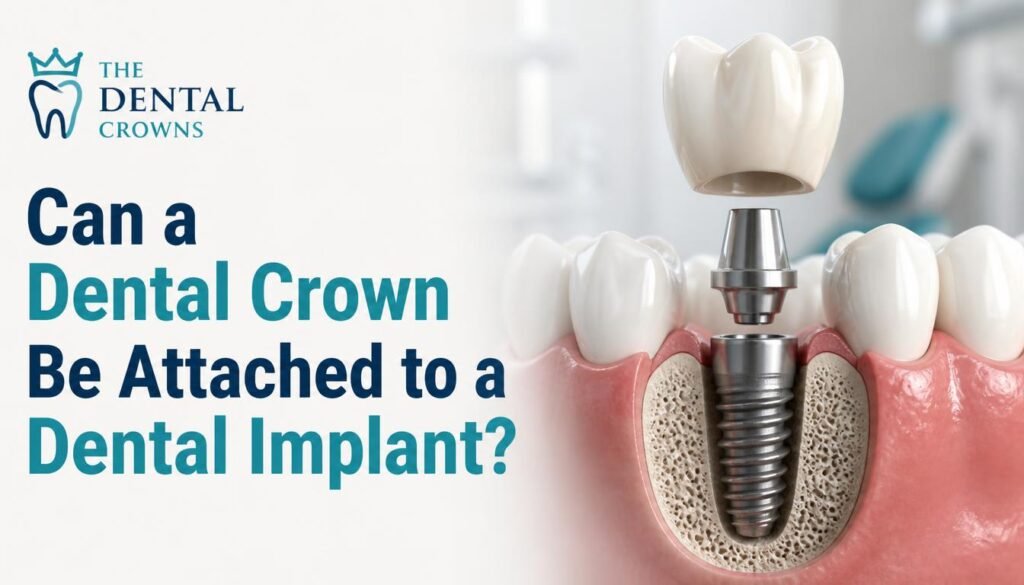
Yes, a dental implant can replace a missing front tooth. A single dental implant can act as an artificial tooth root and support a custom-made dental crown that replaces the visible portion of the missing tooth.
For someone who has lost a front tooth because of an accident, decay, infection, gum disease or another dental problem, an implant-supported crown can provide a stable replacement while also addressing the appearance of the smile.
However, replacing a front tooth with a dental implant requires careful planning because aesthetics are especially important in the front of the mouth. The dentist may need to evaluate the available bone, gums, bite, smile line, tooth colour and the position of neighbouring teeth before deciding whether an implant is appropriate.
According to the American Academy of Periodontology, a single dental implant and crown can replace one missing tooth while avoiding the need to prepare neighbouring healthy teeth as bridge supports.
If you are considering treatment for a missing front tooth, the most important question is not simply whether an implant can replace it, but whether an implant is the right option for your individual dental condition.
What Is a Front Tooth Implant?
A front tooth implant is a dental implant used to replace a missing tooth in the front portion of the mouth.
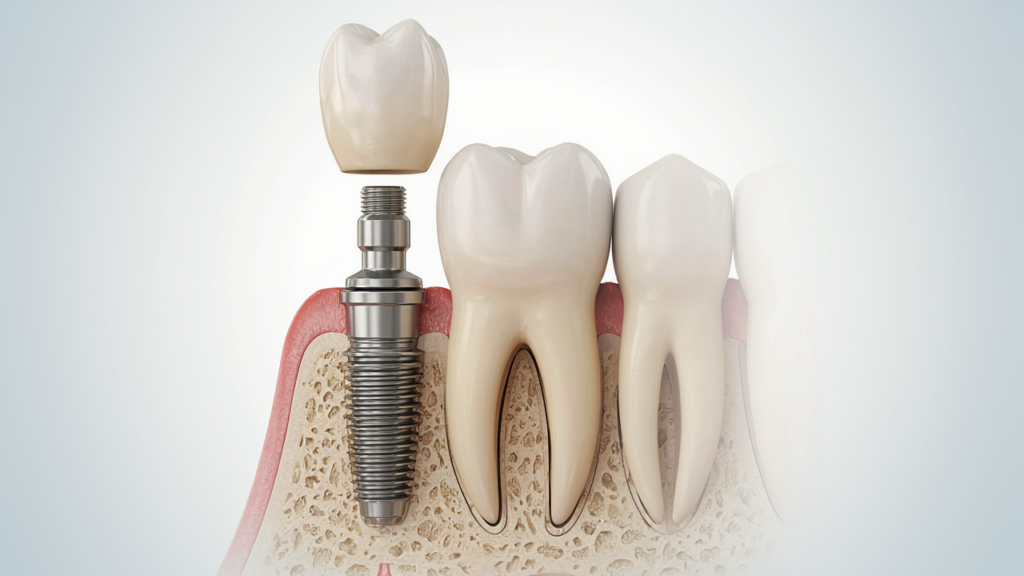
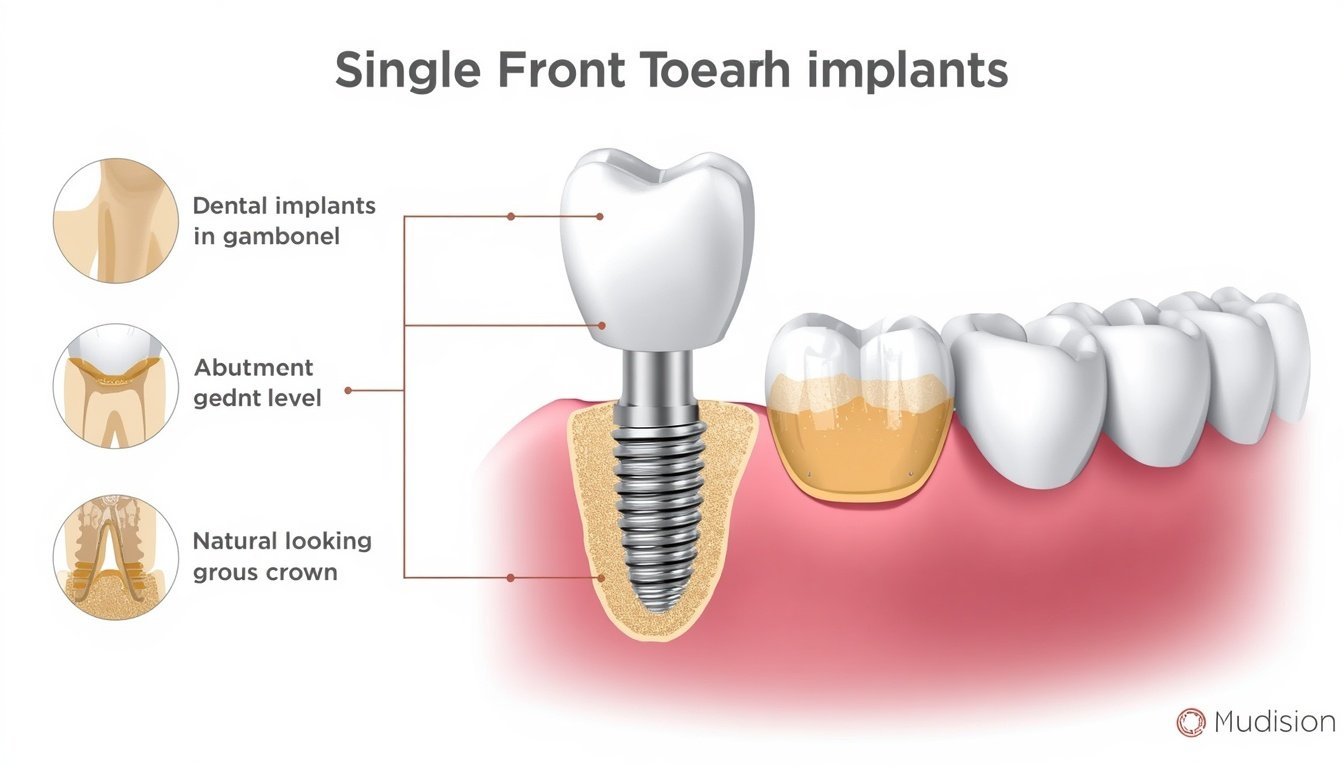
The treatment generally consists of three main components:
- Dental implant – the artificial tooth root placed into the jawbone.
- Abutment – the connector between the implant and crown.
- Dental crown – the visible artificial tooth designed to resemble your natural tooth.
Dental implants are placed into the jawbone and can support crowns, bridges or dentures.
For a single missing front tooth, the typical goal is to create a replacement that looks natural and functions comfortably while maintaining the health and appearance of the surrounding tissues.
Can One Dental Implant Replace One Front Tooth?
Yes.
If only one front tooth is missing, a single dental implant with a crown may be used.
This is different from a traditional dental bridge. A bridge normally relies on neighbouring teeth for support, whereas an implant-supported crown is anchored to an implant placed in the jawbone.
The American Academy of Periodontology notes that a single implant can replace one missing tooth without normally sacrificing the neighbouring teeth to support a bridge.
However, an implant is not automatically the best solution for everyone. Your dentist may consider:
- Bone volume
- Bone quality
- Gum health
- Remaining teeth
- Bite
- Oral hygiene
- Smoking or tobacco use
- Medical history
- Location of the missing tooth
- Aesthetic expectations
- Overall treatment goals
Why Is Replacing a Front Tooth Different?
A missing back tooth primarily creates a functional concern because molars and premolars play an important role in chewing.
A missing front tooth, however, can affect both function and appearance.
The dentist may need to pay particular attention to:
1. Tooth Colour
The replacement crown should blend with the surrounding teeth.
2. Tooth Shape
The crown needs to complement the shape and size of the neighbouring teeth.
3. Gum Appearance
The gum around a front implant contributes significantly to the appearance of the final smile.
4. Implant Position
The implant must be planned carefully because its position can affect the final crown and surrounding tissues.
5. Smile Line
People with a high smile line may show more gum tissue, making implant aesthetics particularly important.
6. Symmetry
The replacement front tooth should ideally look proportionate to the neighbouring teeth.
Because of these considerations, front tooth implant treatment requires detailed diagnosis and treatment planning.
How Does a Dental Implant Replace a Front Tooth?
A typical front tooth implant treatment may involve several stages.
Step 1: Dental Examination
The dentist first examines your mouth and the area where the tooth is missing.
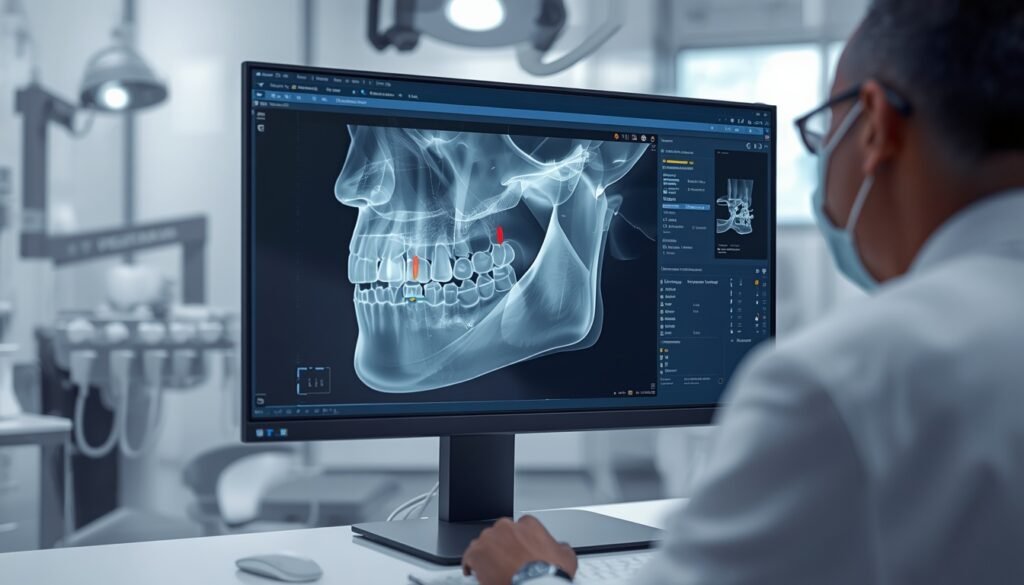
This may include dental X-rays or other imaging to assess the bone and surrounding structures.
The dentist will also evaluate the gums and neighbouring teeth.
Step 2: Treatment Planning
Once the examination is complete, the dentist determines whether there is enough suitable bone to support the implant.
If there is insufficient bone, bone grafting may sometimes be considered.
Not every patient requires bone grafting.
The NHS describes dental implant treatment as commonly involving assessment, possible bone grafting, implant placement and restoration with a crown or other prosthesis.
Step 3: Implant Placement
The dental implant is surgically positioned in the jawbone.
The implant serves as the artificial tooth root.
A healing period may be required so that the implant can integrate with the surrounding bone.
Step 4: Abutment Placement
Once the implant has adequately healed, an abutment may be connected.
The abutment provides the connection between the implant and the final crown.
Step 5: Custom Dental Crown
The final crown is designed to replace the visible portion of the missing tooth.
For a front tooth, the crown is carefully selected and shaped to complement your natural teeth.
This is why implant treatment and dental crown treatment work together when replacing a missing front tooth.
For information about crowns, you can explore Dental Crown Treatment at The Dental Crowns.
Can a Front Tooth Implant Look Natural?
Yes, a well-planned front tooth implant can be designed to look very natural.
However, the final appearance depends on several factors.
These may include:
- Position of the implant
- Amount and condition of available bone
- Gum health
- Crown design
- Crown material
- Tooth colour
- Shape of neighbouring teeth
- Bite
- Individual healing response
- Dentist and laboratory planning
The goal is not simply to place an implant. The goal is to create a replacement tooth that integrates appropriately with the surrounding smile.
This is particularly important for an upper front tooth because it is often visible when speaking and smiling.
What Happens If There Is Not Enough Bone for a Front Tooth Implant?
Bone loss can occur after tooth loss.
If the dentist determines that the available bone is insufficient for predictable implant placement, additional treatment may sometimes be recommended.
One possible approach is bone grafting.
Bone grafting is not required for every implant patient. Whether it is appropriate depends on the individual’s anatomy and treatment plan.
The dentist may assess the bone using appropriate diagnostic imaging before making this decision.
This is one reason an implant consultation is important before assuming that an implant can be placed immediately.
Can You Get an Immediate Implant for a Front Tooth?
In selected cases, an implant may be placed soon after a tooth is removed.
However, immediate implant placement is not suitable for every patient.
The condition of the tooth socket, surrounding bone, soft tissue and overall oral health can influence whether immediate placement is appropriate.
Research discussed by the American Dental Association has examined immediate versus delayed implant placement in the front region of the upper jaw, demonstrating why treatment timing needs to be planned according to the individual clinical situation.
Therefore, you should not assume that a damaged front tooth automatically qualifies for an immediate implant.
What Are the Benefits of a Front Tooth Dental Implant?
A single front tooth implant may offer several advantages when it is clinically appropriate.
1. Replaces the Missing Tooth Root
Unlike a conventional crown placed on a natural tooth, an implant is designed to replace the tooth root.
2. Supports a Fixed Crown
The implant can provide a stable foundation for a custom dental crown.
3. Does Not Normally Require Cutting Healthy Neighbouring Teeth
With a conventional bridge, adjacent teeth may need to be prepared as supports. A single implant can avoid this in appropriate cases.
4. Can Restore Smile Appearance
A custom crown can be designed to match the surrounding teeth.
5. Can Restore Function
Replacing a missing front tooth can help restore normal biting and contribute to comfortable speech.
6. Helps Maintain the Tooth-Replacement Space
A missing tooth can allow changes in the surrounding dentition. Replacing the missing tooth may help maintain the space, although it does not guarantee that tooth movement will never occur.
Dental Implant vs Dental Bridge for a Missing Front Tooth
If you have lost one front tooth, you may be comparing an implant with a dental bridge.
| Feature | Dental Implant | Dental Bridge |
|---|---|---|
| Replaces tooth root | Yes | No |
| Uses neighbouring teeth | Normally no | Usually yes |
| Fixed restoration | Yes | Yes |
| Requires surgery | Usually | No implant surgery |
| Can replace one tooth | Yes | Yes |
| Bone preservation considerations | Implant can help preserve bone around the implant | Does not replace the missing root |
| Treatment time | Often longer | Often shorter |
| Suitable for everyone | No | No |
The right choice depends on your dental condition, bone, neighbouring teeth, oral health, preferences and treatment goals.
The American Academy of Periodontology specifically notes that an implant can replace a single tooth without sacrificing neighbouring teeth for bridge support.
What If My Front Tooth Is Damaged but Still Present?
A dental implant is not automatically required just because a front tooth is damaged.
If the natural tooth can be saved, preserving it may be considered.
Depending on the problem, treatment could include:
- Filling
- Tooth-coloured restoration
- Root canal treatment
- Dental crown
- Other restorative treatment
For example, if a front tooth has become infected but can still be treated successfully, root canal treatment may be considered instead of extraction and implant placement.
You can learn more about Painless Root Canal Treatment at The Dental Crowns.
This distinction is important: a dental implant replaces a missing or non-restorable tooth; it is not simply an alternative to every dental crown or root canal treatment.
Can a Dental Crown Be Placed on a Front Tooth Implant?
Yes.
The crown is the visible part of the implant-supported replacement.
A simplified structure looks like this:
Jawbone → Dental Implant → Abutment → Dental Crown
The implant acts as the artificial root, while the crown provides the visible tooth.
This is why patients searching for a front tooth implant may also need information about dental crowns.
The Dental Crowns’ existing content explains that crowns can be used as restorations over dental implants.
How Long Does a Front Tooth Implant Take?
There is no single treatment timeline that applies to every patient.
The overall process may depend on:
- Whether the tooth needs to be extracted
- Whether immediate implant placement is possible
- Bone availability
- Need for bone grafting
- Healing
- Implant integration
- Gum condition
- Crown fabrication
- Individual healing response
Some patients may require additional procedures before the final crown can be fitted.
For this reason, your dentist should provide a personalized timeline after examining your teeth and bone.
Is a Front Tooth Implant Painful?
Implant placement is performed using local anaesthesia or another appropriate form of dental pain management.
You may experience some soreness, swelling or discomfort after the procedure, but the amount varies between patients and procedures.
Your dentist will provide specific aftercare instructions and explain what you should expect following treatment.
If you are concerned about dental treatment or have existing tooth pain, a proper examination is more useful than trying to diagnose the problem from symptoms alone.
How Much Does a Front Tooth Implant Cost in Noida?
The cost of a front tooth dental implant in Noida can vary significantly.
There is no responsible single price that applies to every patient because the total treatment cost can depend on:
- Implant system
- Type of crown
- Diagnostic imaging
- Bone grafting requirements
- Tooth extraction
- Abutment
- Surgical complexity
- Temporary restoration
- Number of appointments
- Additional procedures
- Dentist’s treatment plan
Instead of comparing only the advertised implant price, ask what is included in the complete treatment plan.
For example:
Does the quoted price include the implant, abutment, crown, imaging, consultation and follow-up care?
This provides a more meaningful comparison.
If you are considering treatment, you can explore Dental Implants at The Dental Crowns and arrange a professional assessment.
Who May Be a Candidate for a Front Tooth Implant?
A person may potentially be considered for an implant when they have:
- A missing tooth
- Adequate bone or the possibility of appropriate bone augmentation
- Healthy or treatable gums
- Suitable oral hygiene
- A stable treatment plan
- No major contraindication identified by the treating dental professional
However, candidacy cannot be determined from an online article.
A dentist needs to evaluate the individual patient.
When Might a Dental Implant Not Be the Best Option?
An implant may not be immediately appropriate in some situations.
For example, treatment may need to be delayed if there is:
- Active infection
- Significant bone deficiency
- Uncontrolled gum disease
- Poor oral hygiene
- Insufficient healing conditions
- Certain medical considerations
This does not necessarily mean an implant can never be used.
Sometimes the underlying problem is treated first before implant placement is reconsidered.
How Should You Care for a Front Tooth Implant?
Once your implant-supported crown has been placed, maintaining good oral hygiene remains important.
General care includes:
- Brush your teeth twice daily.
- Clean between your teeth every day.
- Follow your dentist’s implant-care instructions.
- Attend recommended dental check-ups.
- Avoid using your teeth to open packages.
- Report unusual pain, swelling, mobility or bleeding to your dentist.
An implant does not mean that you can stop caring for your gums.
Long-term maintenance is an important part of implant treatment.
Where Can You Get a Front Tooth Implant in Noida?
If you are searching for dental implants in Noida, The Dental Crowns is located at Civitech Stadia, Sector 79, Noida, and provides dental treatment for patients from nearby areas.
The clinic’s existing implant information also covers single-tooth implant treatment for patients in nearby Noida sectors.
Before treatment, the dentist can assess your individual situation and discuss whether an implant, bridge, crown, or another treatment is appropriate.
Frequently Asked Questions
1. Can a dental implant replace a front tooth?
Yes. A single dental implant can replace a missing front tooth and support a custom dental crown.
2. Is a front tooth implant noticeable?
A properly planned implant-supported crown can be designed to blend with the surrounding teeth. The final appearance depends on factors such as crown design, implant position, gums, bone and individual healing.
3. Can one implant replace one tooth?
Yes. A single dental implant can support an individual crown to replace one missing tooth.
4. Is an implant better than a bridge for a front tooth?
Neither is universally better. An implant may avoid preparing healthy neighbouring teeth, while a bridge may be appropriate in certain situations. Your dentist should compare the options for your specific condition.
5. Can a dental implant replace a front tooth after an accident?
Yes, an implant may be considered after traumatic tooth loss. However, the dentist needs to assess the bone, gums and surrounding teeth before deciding on treatment.
6. Can an implant be placed immediately after removing a front tooth?
Sometimes. Immediate placement is case-dependent and requires assessment of the extraction site, bone and soft tissues.
7. What if I don’t have enough bone for a front tooth implant?
Your dentist may discuss bone-grafting or other treatment options if there is insufficient bone for predictable implant placement.
8. Does a front tooth implant include a crown?
A complete implant restoration commonly involves an implant, abutment and crown, but you should confirm exactly what is included in your treatment plan.
9. Can a front tooth be saved instead of replaced with an implant?
Sometimes. If the natural tooth is restorable, treatments such as root canal treatment and a suitable restoration may be considered.
10. How much does a front tooth implant cost in Noida?
The cost varies depending on the implant system, crown, diagnostic procedures, bone requirements and other treatment factors. A personalized quotation requires a dental examination.
11. Can I get a front tooth implant if I have gum disease?
Active gum disease generally needs to be addressed before implant treatment is considered. Your dentist can evaluate your gum health and recommend appropriate treatment.
12. How long does a front tooth implant take?
The treatment timeline varies. Some cases require only implant placement and restoration, while others may require extraction, grafting and additional healing periods.
Final Takeaway
Can a dental implant replace a front tooth? Yes.
A single dental implant can replace the missing tooth root and support a custom dental crown that restores the visible tooth.
For front teeth, however, successful treatment involves more than simply placing an implant. The dentist must consider the bone, gums, implant position, neighbouring teeth, bite and aesthetics.
If you have lost a front tooth or are facing extraction, do not assume that an implant is your only option. A professional examination can help determine whether an implant, dental bridge, crown, root canal treatment or another restoration is appropriate for your situation.
For patients looking for dental implants in Noida, The Dental Crowns in Sector 79 can assess your condition and discuss suitable tooth-replacement options.