If you need to have a tooth removed and are considering a dental implant, you may wonder: Can you get a dental implant immediately after tooth extraction?
Yes, in some cases, a dental implant can be placed immediately after a tooth is extracted. This is known as immediate dental implant placement or immediate implant placement. Instead of waiting for the extraction socket to heal completely, the dentist places the implant into the socket during the same appointment, when the clinical conditions are suitable.
However, immediate implant placement is not appropriate for every patient or every extraction site. The dentist needs to evaluate the condition of the bone, gums, extraction socket, infection, bite, overall oral health and the amount of bone available to stabilize the implant.
Research and clinical guidance indicate that immediate implants can be a treatment option in appropriately selected cases, but careful treatment planning and case selection are essential.
If you are considering replacing a missing or severely damaged tooth, you can also explore dental implant treatment at The Dental Crowns in Noida.
What Is an Immediate Dental Implant?
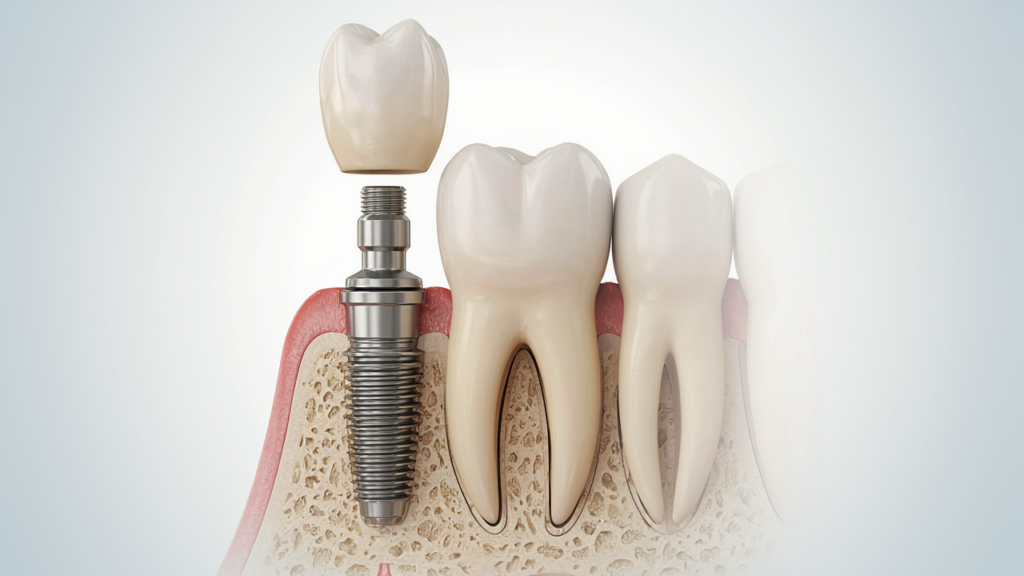
A dental implant is an artificial tooth root that is placed into the jawbone. Once the implant integrates with the surrounding bone, it can support a dental crown, bridge or denture.
With conventional implant treatment, the tooth is extracted first and the extraction site may be allowed to heal before the implant is placed.
With immediate implant placement, the process can look like this:
Damaged tooth → Tooth extraction → Implant placement in the same appointment → Healing and bone integration → Permanent dental crown
An immediate implant does not necessarily mean that the final permanent tooth is fitted on the same day. Implant placement and final crown placement are different stages of treatment.
The American Academy of Periodontology explains that after an implant is placed, the implant and jawbone generally need time to bond before the final replacement tooth is attached.
Can You Get a Dental Implant Immediately After Tooth Extraction?
Yes, but only when the extraction site is suitable.
According to NHS dental implant guidance, there are situations where a tooth can be extracted and an implant placed into the socket during the same visit if the conditions are appropriate. In other situations, the extraction site may be allowed to heal before implant placement.
Your dentist may consider immediate implant placement when:
- The tooth needs to be extracted but the surrounding bone is suitable.
- There is enough healthy bone to provide initial implant stability.
- The extraction can be performed carefully without unnecessarily damaging the surrounding tissues.
- The gums and supporting tissues are suitable for the planned treatment.
- Any infection or inflammation can be appropriately managed.
- The implant can be positioned correctly for the final crown.
- Your overall oral health and medical history support implant treatment.
A detailed examination and appropriate imaging are important before making the decision. Three-dimensional imaging such as CBCT may be used to assess bone volume and important anatomical structures when clinically indicated.
When Is Immediate Implant Placement Not Recommended?
Immediate placement is not automatically the best choice simply because you want a faster treatment.
Your dentist may recommend waiting if the extraction socket does not provide suitable conditions for predictable implant placement.
Potential concerns can include:
1. Insufficient Bone
An implant needs adequate bone support. If there is not enough bone around the extraction site, your dentist may recommend bone grafting or another treatment approach.
In some cases, grafting can be performed around the time of implant placement. In other situations, additional healing may be necessary before the implant can be placed.
2. Significant Bone Damage
A tooth extraction can sometimes leave a damaged or deficient socket. This does not necessarily make an implant impossible, but it can make treatment planning more complex.
A 2024 systematic review found that immediate implant placement in compromised extraction sockets may produce comparable short-term clinical outcomes in selected cases, but the authors emphasized that strict criteria and appropriate management are important.
3. Active Infection or Inflammation
Infection around a tooth can affect treatment planning. However, the presence of a previous infection does not automatically mean an immediate implant is impossible.
Evidence has investigated immediate implants in sockets with periapical pathology, with one 2024 systematic review reporting high implant survival in the included studies. However, individual cases still require clinical assessment and appropriate infection control.
4. Poor Gum Health
Healthy gums and supporting tissues are important for implant treatment. If there is significant periodontal disease or another gum problem, your dentist may recommend treating the underlying condition before implant placement.
5. Insufficient Initial Implant Stability
An implant needs adequate initial stability. If the available bone does not allow the implant to be securely positioned, delayed placement may be considered instead.
What Happens During Immediate Implant Placement?
The exact procedure varies depending on the tooth, bone condition and treatment plan, but it may involve the following steps.
Step 1: Dental Examination
Your dentist examines the tooth, gums and surrounding tissues. X-rays and, when indicated, 3D imaging may be used to assess the extraction site and available bone.
Step 2: Treatment Planning
The dentist determines whether the tooth should be extracted and whether immediate implant placement is appropriate.
Factors such as implant position, bone volume, gum condition and the planned final crown need to be considered before surgery.
Step 3: Tooth Extraction
The damaged tooth is carefully removed. An atraumatic extraction technique may be used to help preserve the surrounding tissues.
Step 4: Socket Assessment and Cleaning
The extraction socket is evaluated and cleaned as required. Any necessary treatment of the socket is planned based on its condition.
Step 5: Implant Placement
If the site meets the necessary criteria, the dental implant is positioned into the jawbone.
Step 6: Bone Grafting if Required
Some cases may require bone grafting or regenerative treatment to support the implant site.
Step 7: Temporary or Permanent Restoration
Depending on the case, a temporary tooth may be provided. The final crown is generally fitted after the implant has sufficiently integrated with the surrounding bone.
This distinction is important: “immediate implant” refers primarily to when the implant is placed, not necessarily when the final permanent crown is fitted.
How Long Does an Immediate Dental Implant Take to Heal?
Even when the implant is placed immediately after extraction, the implant still needs time to integrate with the jawbone.
The American Academy of Periodontology notes that implants commonly require a period of approximately two to six months for the implant and bone to bond before the final artificial tooth is completed, although treatment timelines vary between patients.
Another NHS source notes that patients usually need to wait at least around three months before an implant can support replacement teeth, although individual treatment plans vary.
Your actual timeline can depend on:
- Bone quality
- Implant stability
- Whether bone grafting is required
- Gum condition
- Location of the tooth
- Type of restoration
- Overall healing
- Your dentist’s treatment protocol
Therefore, immediate implant placement does not mean immediate completion of the entire treatment.
What Are the Benefits of Immediate Dental Implant Placement?
When a patient is an appropriate candidate, immediate placement may offer several potential advantages.
Potentially Shorter Overall Treatment Process
Because implant placement can occur during the extraction appointment, there may be fewer separate surgical stages compared with some delayed approaches.
Fewer Surgical Appointments
Extraction and implant placement may be combined into one procedure when clinically appropriate.
Preservation of the Extraction Site
Immediate implant treatment may help support the extraction site, although it does not completely eliminate normal post-extraction bone remodeling.
Faster Transition to Tooth Replacement
For suitable patients, immediate implant placement can reduce the time between extraction and implant surgery.
Potential Aesthetic Advantages
In carefully selected front-tooth cases, immediate implant treatment may be considered as part of an aesthetic treatment plan.
The evidence comparing immediate and delayed implant placement continues to be evaluated. A systematic review and meta-analysis published in 2024 assessed clinical outcomes of immediate, early and delayed implant placement in the aesthetic zone.
Are Immediate Dental Implants Safe?
Immediate dental implants can be a successful treatment option when the patient is appropriately selected and the procedure is carefully planned.
However, no dental implant procedure is completely risk-free.
Possible complications can include:
- Infection
- Implant failure
- Gum recession
- Bone loss
- Implant instability
- Aesthetic problems
- Peri-implant disease
- Need for additional bone grafting
- Need for additional treatment
Research on immediate implant placement shows that outcomes depend significantly on case selection, surgical technique, implant positioning, bone conditions and management of the surrounding tissues.
This is why a dental consultation should come before deciding whether an immediate implant is suitable.
Immediate vs Delayed Dental Implant: What’s the Difference?
| Feature | Immediate Implant | Delayed Implant |
|---|---|---|
| Tooth extraction | Yes | Yes |
| Implant placement | Same appointment in suitable cases | After healing |
| Healing before implant placement | Minimal/none at the implant-placement stage | Required |
| Bone grafting | May be performed when indicated | May be performed before or during implant placement |
| Number of treatment stages | May be reduced | May involve additional stages |
| Suitable for everyone? | No | No |
| Treatment planning | Highly important | Highly important |
There is no universal implant timing that is correct for every patient. A systematic review published in PubMed evaluated immediate, immediate-delayed and delayed approaches and highlighted the importance of considering individual clinical circumstances.
Does an Infection Prevent an Immediate Dental Implant?
This is one of the most common questions patients ask.
The answer is not always.
An infected tooth requires careful assessment and management. In selected cases, research suggests that immediate implant placement may still be possible after appropriate treatment of the extraction site.
For example, a 2024 systematic review and meta-analysis reported high implant survival in the studies it included for implants placed immediately into extraction sockets associated with periapical pathology. However, the evidence has limitations, and this should not be interpreted as meaning that every infected tooth is suitable for an immediate implant.
Your dentist should evaluate the severity and location of infection before recommending immediate implant placement.
Do You Need a Bone Graft With an Immediate Implant?
Not necessarily.
Some patients have enough healthy bone for immediate implant placement without additional grafting. Others may require bone grafting because of bone loss or defects around the extraction socket.
If there is insufficient bone, grafting may be considered to improve the foundation for the implant. NHS implant guidance also notes that some patients require bone grafting before or during implant treatment.
The decision depends on the amount and quality of available bone and the planned implant position.
Can You Get a Same-Day Dental Crown After Tooth Extraction?
This is where the terminology can become confusing.
An immediate implant means that the implant is placed at the time of tooth extraction.
A same-day crown means that a temporary or sometimes definitive restoration is attached during the same treatment period.
These are not necessarily the same thing.
In some carefully selected cases, an implant may be immediately placed and temporarily restored. In other cases, the implant may need to heal before the final crown is fitted.
The dentist will decide the appropriate restoration based on implant stability, location, bite forces, aesthetics and healing requirements.
How Much Does an Immediate Dental Implant Cost in Noida?
The cost of an immediate dental implant in Noida can vary considerably.
There is no single price that applies to every patient because the total cost may depend on:
- Implant brand and system
- Number of implants
- Tooth location
- Bone grafting requirements
- Extraction complexity
- Type of dental crown
- Diagnostic imaging
- Temporary restoration
- Complexity of the case
- Additional procedures
For this reason, patients should obtain a personalized treatment estimate after a dental examination rather than relying solely on an online price.
If you are comparing treatment options, you can also read our guide on dental implants near Noida Sector 78 and our guide to dental implants near Noida Sector 76.
Immediate Dental Implant After Extraction in Noida
If you live in Noida Sector 74, 75, 76, 77, 78 or 79 and are considering an implant after tooth extraction, a clinical evaluation is the first step.
The Dental Crowns is located at Civitech Stadia, Sector 79, Noida, and provides dental implant treatment and other restorative dental services.
You can also explore:
- Dental Implants in Noida Sector 75
- Dental Implants Near Noida Sector 77
- Dental Implants Near Noida Sector 78
- Dental Implants Near Noida Sector 76
- Dental Implant Consultation Near Sector 75 Noida
If the tooth can potentially be saved instead of extracted, your dentist may discuss alternatives such as root canal treatment and dental crown treatment.
You can learn more about painless root canal treatment in Noida before deciding on extraction.
Frequently Asked Questions
Can you get a dental implant immediately after tooth extraction?
Yes. An implant can sometimes be placed immediately after extraction if the bone, gums, socket and overall clinical conditions are suitable.
Is immediate implant placement better than delayed placement?
Neither approach is universally appropriate for every patient. The correct timing depends on the condition of the extraction site, bone, gums, infection status and treatment goals.
How soon after extraction can a dental implant be placed?
It may be placed immediately, after a period of early healing, or after the site has fully healed. Your dentist determines the timing based on your individual case.
Can an infected tooth receive an immediate implant?
Sometimes, but infection needs to be carefully assessed and managed. Immediate implantation should only be considered when the clinical conditions are appropriate.
Do immediate dental implants require bone grafting?
Not always. Bone grafting may be recommended when there is insufficient bone or a defect around the extraction site.
Does an immediate implant mean I get my permanent tooth the same day?
No. Immediate implant placement and same-day permanent crown placement are different concepts. The implant generally needs time to integrate with the jawbone.
How long does a dental implant take to heal?
Healing varies between patients. The implant may need several months to integrate with the surrounding bone before the final restoration is completed.
Is immediate implant placement painful?
The procedure is normally performed under local anaesthesia, so you should not feel the surgical procedure itself in the usual way. Some soreness, swelling or discomfort can occur afterward.
What happens if there is not enough bone for an immediate implant?
Your dentist may recommend bone grafting or another treatment approach before implant placement. The exact plan depends on the amount and location of bone deficiency.
Can a dental implant replace one tooth?
Yes. A single dental implant can replace the root portion of a missing tooth and support a replacement crown.
Final Takeaway: Can You Get a Dental Implant Immediately After Tooth Extraction?
Yes, a dental implant can sometimes be placed immediately after tooth extraction, but it is not suitable for every patient.
The decision depends on factors including:
- Bone availability
- Extraction socket condition
- Gum health
- Presence and management of infection
- Initial implant stability
- Tooth location
- Aesthetic requirements
- Overall oral and medical health
Immediate implant placement can reduce the interval between extraction and implant surgery in suitable cases, but proper diagnosis and treatment planning are more important than simply choosing the fastest option.
If you are planning a tooth extraction and want to know whether an immediate dental implant is possible, schedule a consultation with a qualified dental professional for an examination and appropriate imaging.
References:
- American Academy of Periodontology – Single Tooth Dental Implants
- American Dental Association – Immediate vs. Delayed Implant Placement
- PubMed – Clinical Outcomes of Immediate, Early and Delayed Implant Placement
- PubMed – Immediate Implant Placement in Damaged Extraction Sockets
- NHS – Dental Implants