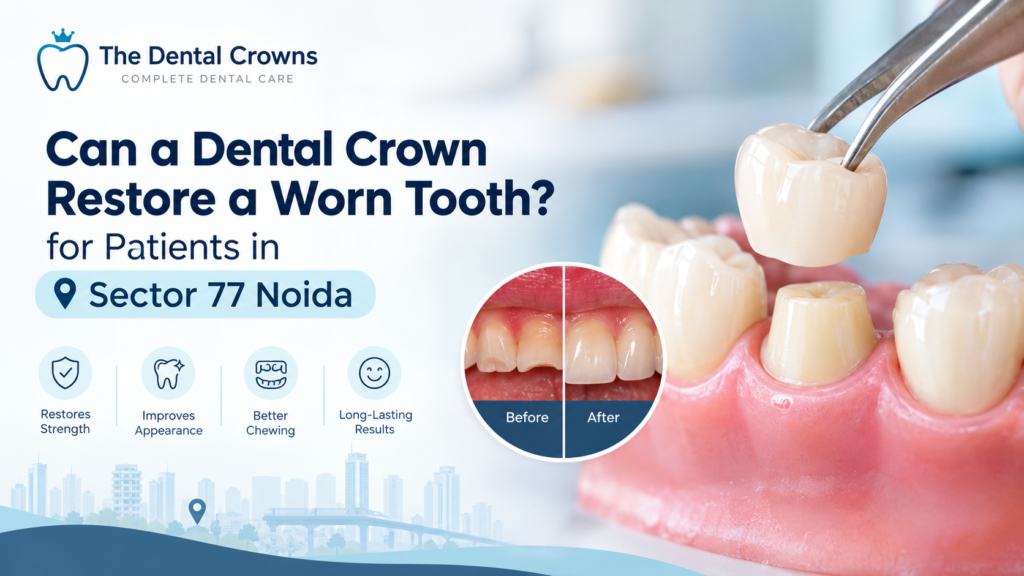


When a tooth develops decay, a cavity, a crack, or structural damage, one of the most common questions patients ask is: Should I get a dental filling or a dental crown?
Both treatments can restore damaged teeth, but they are designed for different situations.
A dental filling is generally used to repair a tooth when the damage is limited and enough healthy tooth structure remains. A dental crown, on the other hand, covers and protects a larger portion of a damaged or weakened tooth.
For patients searching for dental crowns vs dental fillings in Noida Sector 76, the right choice depends on the amount of tooth structure remaining, the location of the tooth, the extent of decay or damage, bite forces, previous treatment and your dentist’s clinical assessment.
The American Dental Association describes fillings as restorations used to replace lost tooth structure, while a crown surrounds the remaining coronal tooth structure or can be placed over a dental implant.
If you are looking for professional dental treatment near Sector 76, The Dental Crowns provides restorative, cosmetic and surgical dental services in Noida. The clinic is located in Sector 79 and serves patients from nearby sectors, including Sector 76.
What Is a Dental Filling?
A dental filling is a restorative treatment used to repair a tooth affected by decay or a relatively limited amount of damage.
During the procedure, the dentist removes the damaged or decayed portion of the tooth and restores the area with an appropriate filling material.
Common filling materials include:
- Composite resin
- Amalgam
- Glass ionomer materials
- Other restorative materials depending on the clinical situation
Tooth-coloured composite fillings are particularly popular when patients want a restoration that blends with their natural teeth.
According to the American Dental Association, direct restorative materials can be placed directly into a tooth cavity, and resin composites are commonly used as tooth-coloured restorative materials.
When Is a Dental Filling Usually Considered?
A filling may be appropriate when:
- The cavity is small or moderate.
- A sufficient amount of healthy tooth structure remains.
- The tooth does not have extensive cracks.
- The remaining tooth can adequately support the restoration.
- The damage does not require full-coverage protection.
Patients looking for tooth-coloured restoration in Noida can discuss composite restoration options with their dentist.
What Is a Dental Crown?
A dental crown is a custom-made restoration designed to cover and protect a damaged or weakened tooth.
Unlike a filling, which generally repairs a specific area of the tooth, a crown provides coverage around the remaining tooth structure.
A dentist may consider a crown when a tooth has:
- Extensive decay
- Significant structural damage
- A large existing filling
- Cracks or fractures
- Severe wear
- Major loss of tooth structure
- Been treated with root canal therapy
- Been restored over a dental implant
The American Dental Association defines a crown as an artificial replacement that restores missing tooth structure by surrounding the remaining coronal tooth structure, or a restoration placed on a dental implant.
Dental Crown Treatment services.
Dental Crowns vs Dental Fillings: Key Difference
The simplest way to understand the difference is:
A filling repairs a damaged area of the tooth, while a crown protects and restores a significantly weakened tooth by covering a larger portion of it.
However, the decision isn’t simply about choosing the stronger treatment.
Your dentist needs to determine whether the remaining tooth structure is strong enough to support a filling or whether greater coverage is required.
Quick Comparison
| Feature | Dental Filling | Dental Crown |
|---|---|---|
| Main purpose | Repair cavities and limited damage | Restore and protect weakened teeth |
| Coverage | Usually limited to damaged area | Covers most of the visible tooth |
| Tooth structure | More healthy structure generally remains | Greater structural damage may be present |
| Treatment approach | Direct restoration | Indirect/full-coverage restoration in many cases |
| Aesthetics | Tooth-coloured options available | Ceramic/porcelain/zirconia options available |
| Suitable for | Small to moderate cavities | Severely damaged or weakened teeth |
| Tooth preparation | Generally less extensive | Requires preparation of the tooth |
| Cost | Usually lower | Usually higher |
| Treatment complexity | Generally simpler | More involved |
| Protection | Restores damaged area | Provides broader structural protection |
The ADA notes that direct and indirect restorative materials have different physical and mechanical properties, processing methods and clinical indications, which is why material and restoration selection should be individualized.
Dental Filling or Crown: Which Is Better?
There is no single answer that applies to every patient.
The better treatment is the one that appropriately restores the tooth while preserving as much healthy tooth structure as possible.
For example, if you have a small cavity and plenty of healthy tooth structure remains, placing a crown may be unnecessary.
On the other hand, if a tooth has lost a significant amount of structure, simply placing a filling may not provide the level of protection needed.
This is why a dental examination is important before deciding between a filling and crown.
When Is a Dental Filling Better?
A filling may be preferable when the damage is relatively limited.
For example, a patient with an early or moderate cavity may be able to restore the tooth with a filling instead of requiring a crown.
Potential advantages of fillings include:
- Less extensive tooth preparation
- Generally quicker treatment
- Preservation of more natural tooth structure
- Tooth-coloured options
- Usually lower treatment cost than a crown
However, the suitability of a filling depends on the size and location of the restoration and the amount of remaining tooth structure.
The ADA’s evidence-based guideline on restorative treatments for caries lesions provides recommendations concerning direct restorative materials and caries removal approaches.
When Is a Dental Crown Better?
A crown may be considered when the tooth has suffered substantial structural damage.
Examples include:
1. Large Cavities
When decay has removed a large amount of tooth structure, a conventional filling may not provide adequate support.
2. Cracked or Fractured Teeth
A significantly cracked or weakened tooth may require greater coverage to restore its function.
3. Large Existing Fillings
A tooth containing a very large filling may have less remaining natural structure and may require a crown depending on its condition.
4. Root Canal Treated Teeth
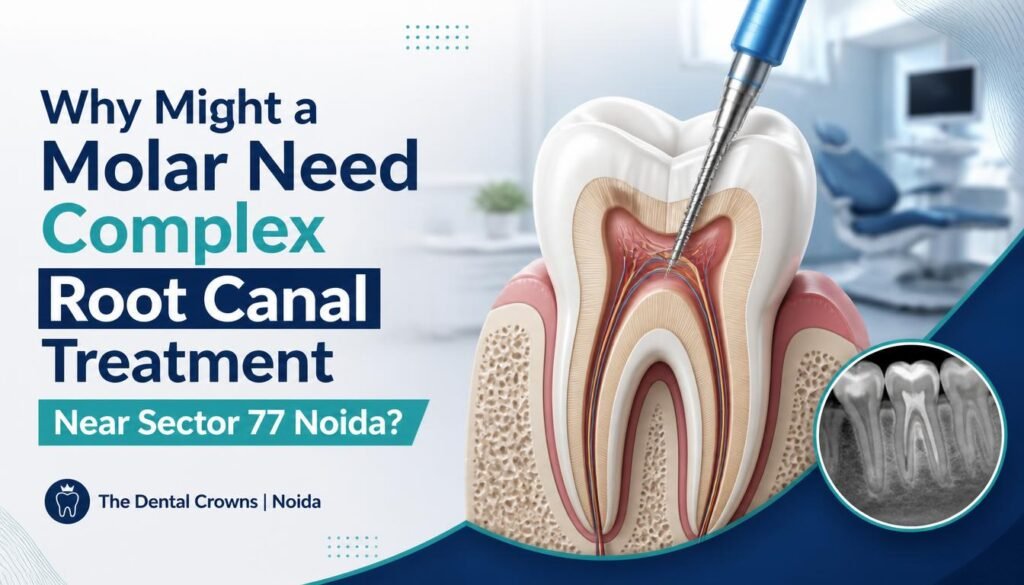
Teeth that have undergone root canal treatment may require a protective restoration depending on the amount of remaining tooth structure, tooth location and functional demands.
If you’re considering treatment, you can explore our Painless Root Canal Treatment options.
5. Severely Worn Teeth
Teeth affected by significant wear may sometimes require more extensive restorative treatment.
Can a Filling Replace a Dental Crown?
Sometimes, but not always.
If a tooth has sufficient remaining structure and the damage can be predictably restored with a filling, a crown may not be necessary.
However, when a tooth is significantly weakened, using a filling when a full-coverage restoration is clinically indicated may not provide adequate protection.
The decision should therefore be based on the actual condition of the tooth rather than simply choosing the cheaper option.
Is a Dental Crown Stronger Than a Filling?
A crown and filling are not directly comparable simply in terms of “strength.”
They are different types of restorations designed for different clinical situations.
A crown can provide broader coverage and may be appropriate when substantial tooth structure has been lost.
Composite fillings, meanwhile, can be effective for many cavity restorations. The ADA notes that resin composite materials have demonstrated increasingly long survival rates and reliability, although their indications and limitations vary by restoration size and clinical situation.
The dentist’s assessment of your tooth is therefore more important than choosing a treatment solely because one sounds stronger.
Dental Crowns vs Fillings for Back Teeth
Back teeth, particularly molars, experience significant chewing forces.
If a cavity is relatively small, a filling may be suitable.
But if a large portion of the molar has been damaged or weakened, your dentist may consider a crown or another appropriate indirect restoration.
The decision can depend on:
- Remaining tooth structure
- Size of the cavity
- Location of the tooth
- Bite forces
- Cracks
- Existing restorations
- Previous root canal treatment
- Oral hygiene
- Patient-specific factors
For patients in Noida Sector 76, an examination can help determine whether a filling or crown is appropriate instead of relying only on online comparisons.
Dental Crowns vs Fillings for Front Teeth
For front teeth, aesthetics can become especially important.
A relatively small cavity may often be restored with a tooth-coloured composite material.
For a severely damaged front tooth, however, a crown or another aesthetic restoration may be considered depending on the clinical condition.
Colour, shape, translucency and the appearance of neighbouring teeth all matter when planning an aesthetic restoration.
Patients interested in improving the appearance of their smile can also explore Porcelain Crowns and other cosmetic dental treatments.
What About Root Canal Treatment and a Crown?
One common situation where patients become confused is after root canal treatment.
A root canal treatment addresses problems involving the inside of the tooth. The tooth may then require an appropriate final restoration to restore function and protect the remaining tooth structure.
However, not every root canal-treated tooth automatically requires the exact same restoration.
The appropriate restoration depends on factors such as:
- Tooth location
- Amount of remaining tooth structure
- Existing cracks
- Functional forces
- Type of tooth
- Overall treatment plan
For patients experiencing tooth pain, sensitivity or other symptoms, delaying examination can allow a dental problem to become more complicated.
Painless Root Canal Treatment – The Dental Crowns
Dental Crown vs Filling Cost in Noida Sector 76
Cost is naturally an important consideration for many patients.
Generally, a filling costs less than a dental crown because the procedures and laboratory requirements can differ substantially.
However, there is no single price that applies to every patient.
The final treatment cost can depend on:
- Type of filling material
- Type of crown
- Tooth location
- Extent of tooth damage
- Need for root canal treatment
- Tooth preparation
- Laboratory charges
- Temporary restoration
- Additional procedures
Patients should be cautious about choosing treatment based solely on the lowest advertised price.
A clinically appropriate treatment can help avoid repeated repairs and unnecessary complications.
How Long Do Dental Fillings Last?
The lifespan of a filling varies.
It can depend on:
- Material used
- Size of the filling
- Tooth location
- Bite forces
- Oral hygiene
- Diet
- Tooth grinding or clenching
- Recurrent decay
- Regular dental check-ups
The ADA reports that composite restorations can have substantial longevity, but performance varies according to restoration size, location, material and clinical circumstances.
Therefore, patients should not expect every filling to last exactly the same number of years.
How Long Do Dental Crowns Last?
Dental crowns can also last for many years, but their longevity varies from patient to patient.
Factors that may affect a crown include:
- Oral hygiene
- Gum health
- Crown material
- Crown fit
- Bite forces
- Teeth grinding
- Diet and habits
- Tooth condition
- Regular dental examinations
Good oral hygiene and professional dental care are important for maintaining both crowns and natural teeth.
Are Tooth-Coloured Fillings Better for Noida Patients?
Tooth-coloured composite fillings can be an attractive option when appropriate because they can blend with the natural tooth.
The ADA describes resin-based composite as a tooth-coloured restorative material and notes that aesthetics are one of its advantages.
However, “tooth-coloured” does not automatically mean that a filling is the best treatment.
The size and location of the cavity and the strength of the remaining tooth still need to be evaluated.
Why Patients in Noida Sector 76 Should Get a Dental Examination
If you live in Sector 76, you may find several dental clinics around the neighbourhood. But choosing treatment should not be based only on location or price.
When comparing options, consider:
- Dentist’s qualifications
- Experience with restorative dentistry
- Diagnostic facilities
- Available restorative materials
- Treatment planning
- Sterilization protocols
- Follow-up care
- Communication about treatment options
For patients near Sector 76, The Dental Crowns is located at Civitech Stadia, Sector 79, Noida, and provides dental treatments including crowns, root canal treatment, implants, bridges, dentures, braces and cosmetic dentistry.
Dental Crowns vs Dental Fillings: Which One Should You Choose?
Here’s a simple way to think about it:
A filling may be considered when:
- The cavity is small or moderate.
- Enough healthy tooth structure remains.
- The tooth does not require full-coverage protection.
- A direct restoration can adequately restore the tooth.
A crown may be considered when:
- The tooth has extensive damage.
- A large amount of tooth structure is missing.
- The tooth is significantly weakened.
- There is substantial structural damage or fracture.
- A protective full-coverage restoration is clinically appropriate.
- The tooth has undergone root canal treatment and requires appropriate coverage based on its condition.
Ultimately, there is no universal winner in the dental crowns vs dental fillings debate.
The right restoration depends on your individual tooth.
Frequently Asked Questions
1. Is a crown better than a filling?
Not necessarily. A filling may be better for a tooth with limited damage, while a crown may be appropriate for a significantly weakened or extensively damaged tooth.
2. Is a filling cheaper than a crown?
Generally, yes. A filling is usually less expensive than a crown, but the actual cost depends on the material and complexity of treatment.
3. Can I get a filling instead of a crown?
Sometimes. If enough healthy tooth structure remains and the tooth can be predictably restored with a filling, a crown may not be required.
4. Can a crown prevent a tooth from breaking?
A properly planned crown can provide coverage and protection for a weakened tooth, but no dental restoration can guarantee that a tooth will never fracture.
5. Do root canal teeth need crowns?
Some root canal-treated teeth may benefit from a protective crown or another appropriate restoration, depending on the tooth and remaining structure. Your dentist should determine the appropriate final restoration.
6. Are tooth-coloured fillings available in Noida?
Yes. Tooth-coloured composite restorations are commonly used when clinically appropriate. The Dental Crowns offers tooth-coloured restoration as part of its dental services.
7. Which is better for a large cavity: filling or crown?
A large cavity may require more extensive restoration, but the correct choice depends on how much healthy tooth structure remains and whether the tooth can adequately support a filling.
8. How do I know whether I need a crown or filling?
A dental examination, and sometimes dental X-rays, can help determine the extent of damage and the most appropriate restoration.
9. Can I delay crown treatment?
Delaying treatment of a significantly damaged tooth can potentially allow the problem to worsen. If your dentist recommends a crown because of structural weakness, discuss the risks of delaying treatment.
10. Where can I get dental crown treatment near Noida Sector 76?
The Dental Crowns is located in Sector 79, Noida, and serves patients from nearby areas including Sector 76. You can explore the clinic’s Dental Services to learn more about available treatments.
Final Verdict: Dental Crown or Filling?
When comparing dental crowns vs dental fillings, the best treatment is not necessarily the more expensive or stronger option.
A filling may be ideal when a tooth has a manageable cavity and sufficient healthy structure remains.
A crown may be more appropriate when a tooth has lost substantial structure and needs broader protection.
For patients in Noida Sector 76, the safest approach is to have the affected tooth examined by a qualified dental professional before deciding.
If you are experiencing tooth pain, sensitivity, a broken tooth, a large cavity or an old restoration that has failed, don’t wait until the problem becomes more complicated.
Explore The Dental Crowns’ dental services in Noida or schedule a professional dental consultation to determine whether a filling, crown, root canal treatment or another restoration is appropriate for your tooth.