
Losing a tooth can affect much more than the appearance of your smile. A missing tooth may make chewing uncomfortable, affect the way you speak, change how your remaining teeth meet and make you feel less confident when smiling.
Fortunately, modern dentistry offers several ways to replace a missing tooth, including dental implants, dental bridges and dentures. Among these options, a dental implant for a missing tooth is often considered when a patient wants a stable, fixed tooth replacement that replaces the root as well as the visible tooth.
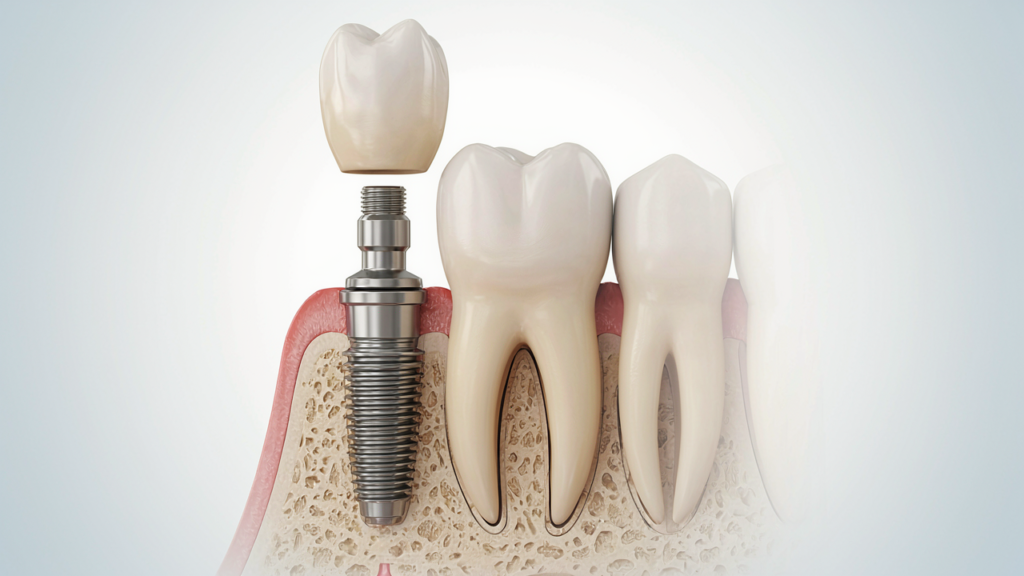
According to Mayo Clinic, a dental implant is a metal post that replaces the root portion of a missing tooth and can support an artificial tooth, such as a crown.
But how do you know whether you may need a dental implant?
Here are 5 common signs that it may be time to discuss dental implant treatment with your dentist.
1. You Have One or More Missing Teeth
The most obvious sign that you may be a candidate for a dental implant is simply having a missing tooth.
A tooth can be lost because of:
- Severe tooth decay
- Gum disease
- Dental trauma or an accident
- A fractured or severely damaged tooth
- Failed previous dental treatment
- Tooth extraction
- Other oral health conditions
If a tooth cannot be saved, leaving the space untreated is not always the best long-term approach.
The American Dental Association has also discussed single-tooth implants as an option for patients who have lost a tooth.
A dental implant can replace the missing tooth root and provide support for a dental crown. This creates a replacement designed to look and function more like a natural tooth.
At The Dental Crowns, dental implants are offered as part of the clinic’s surgical dentistry services. You can learn more about the treatment on the Dental Implants service page.
Why replacing a missing tooth matters
A missing tooth can create an empty space between your remaining teeth. Depending on the location of the missing tooth, you may notice changes in chewing, speech or the way your teeth come together.
Mayo Clinic notes that dental implants may be considered for people with one or more missing teeth, provided other clinical factors are appropriate.
2. You Are Finding It Difficult to Chew Properly
Do you avoid chewing on one side of your mouth because of a missing tooth?
Difficulty chewing can be another reason to discuss tooth replacement with a dentist.
When a tooth is missing, the remaining teeth may have to take on more of the chewing workload. Depending on the location and number of missing teeth, this may make eating certain foods less comfortable.
A properly planned dental implant can provide a stable foundation for a replacement crown.
Unlike a removable denture, an implant is placed into the jawbone and is designed to support a replacement tooth. The implant gradually integrates with the surrounding bone through a process called osseointegration.
This is one reason dental implants are frequently considered when patients want a fixed solution for a missing tooth.
Other tooth replacement options
A dental implant is not automatically the right treatment for every patient.
Depending on your oral health and the condition of your surrounding teeth, your dentist may also discuss:
- Dental bridges
- Partial dentures
- Complete dentures
- Other restorative treatments
For example, dental bridges treatment can be used to bridge the space created by a missing tooth.
The best option depends on your individual dental condition, bone support, gum health, budget and treatment goals.
3. Your Remaining Teeth Are Starting to Shift
Another possible concern after tooth loss is movement of the surrounding teeth.
When there is an empty space in your mouth, the surrounding teeth may change position over time. This can alter your bite and make cleaning between teeth more difficult.
The American Dental Association identifies unusual spacing or migration of teeth as clinical findings that may require dental evaluation.
If you have noticed that your teeth appear to be moving after losing a tooth, it is worth scheduling a dental examination.
Your dentist can evaluate:
- The missing tooth area
- Your bite
- The position of nearby teeth
- Gum health
- Jawbone condition
- Overall oral health
Based on these findings, your dentist can explain whether a dental implant, bridge or another treatment may be appropriate.
Don’t wait until the gap becomes a bigger concern
A missing tooth may initially seem like a cosmetic issue, particularly when it is not visible when you smile.
However, tooth replacement is about more than appearance.
Replacing a missing tooth may help restore chewing function and maintain a more complete dental arch. The right treatment should be selected after a professional examination rather than based only on appearance.
4. You Are Concerned About Jawbone Changes After Tooth Loss
One of the major differences between dental implants and some other tooth replacement options is that an implant is designed to replace the root portion of the missing tooth.
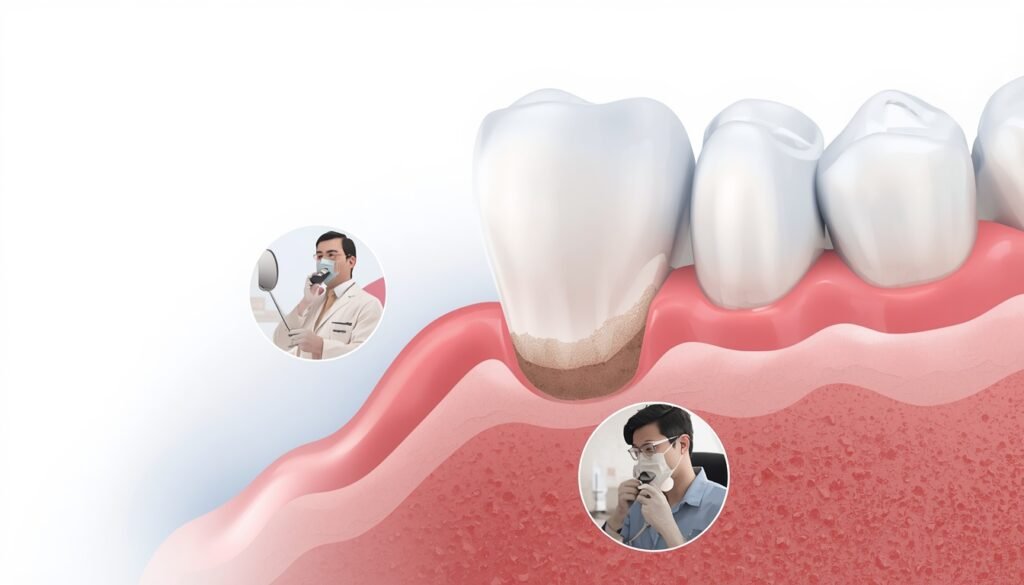
After tooth loss, the jawbone in the area no longer receives the same stimulation from a natural tooth root. Your dentist may therefore evaluate the amount and quality of bone available before recommending an implant.
Mayo Clinic explains that sufficient bone is needed to secure an implant, although a bone graft may sometimes be an option when additional bone is required.
This is why an implant consultation may include an assessment of your jawbone and surrounding tissues.
Does everyone have enough bone for an implant?
Not necessarily.
Your dentist may evaluate:
- Bone volume
- Bone density
- Gum health
- Existing infections
- The position of nearby teeth
- The location of nerves or other anatomical structures
- Your overall oral health
In some cases, additional treatment may be required before implant placement.
Therefore, if you have had a missing tooth for a long time, it is a good idea to get an evaluation rather than assuming that an implant is automatically possible—or impossible.
5. You Want a Fixed, Natural-Looking Replacement for Your Missing Tooth
If you are uncomfortable with a removable tooth replacement and want a fixed option, dental implants may be worth discussing with your dentist.
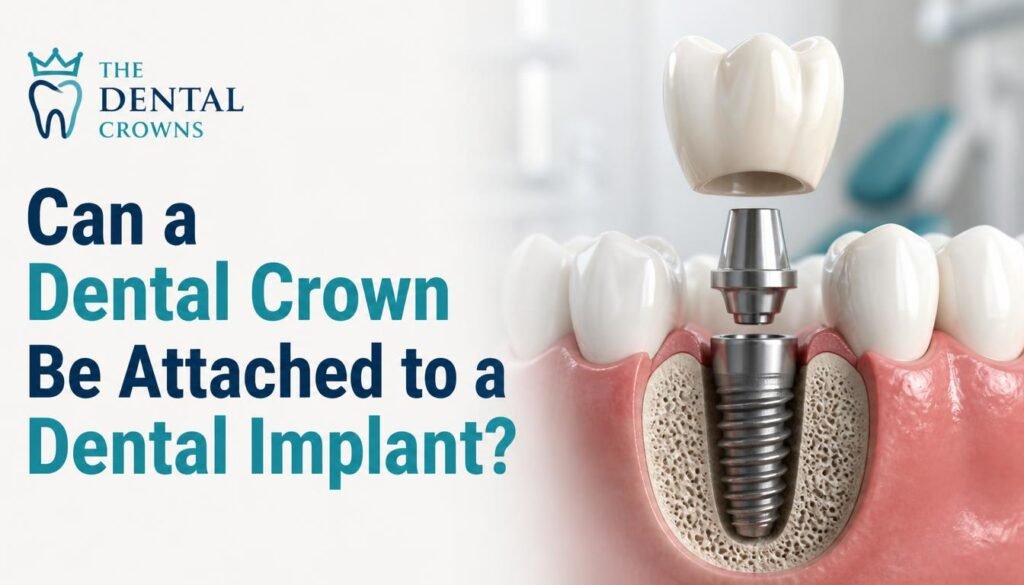
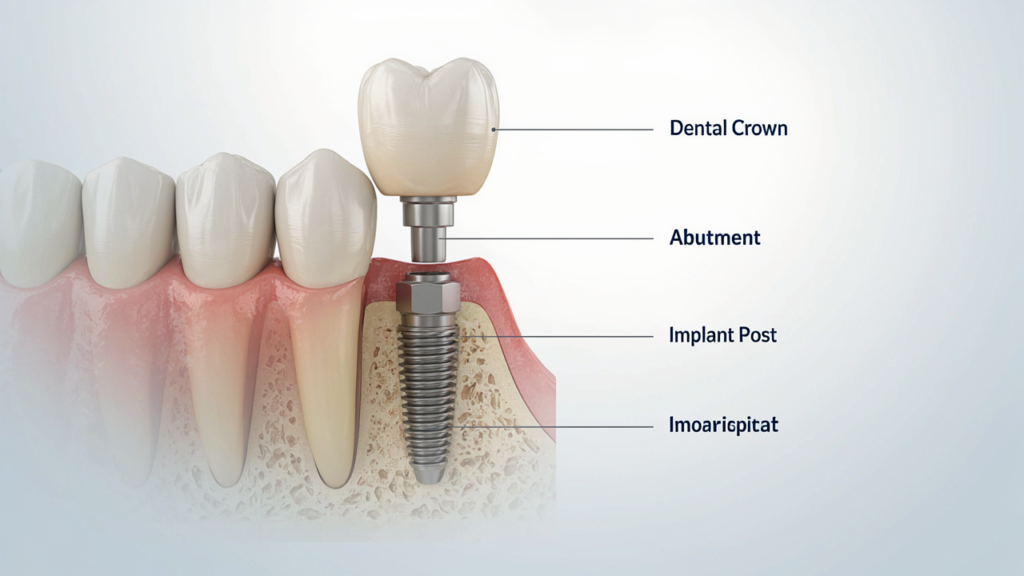
A typical implant restoration consists of:
- Dental implant – the post placed into the jawbone.
- Abutment – the connector between the implant and replacement tooth.
- Dental crown – the visible tooth-shaped restoration.
The crown is designed to restore the visible portion of the missing tooth.
Mayo Clinic explains that an implant can provide a stable foundation for a replacement tooth because the bone heals around the implant.
For patients interested in restoring both appearance and function, this can make implants an attractive tooth replacement option.
If you are also considering different crown materials, you can explore porcelain crown treatment as part of your discussion with your dentist.
Dental Implant vs Dental Bridge: Which Is Better?
If you have a single missing tooth, you may be wondering:
“Should I get a dental implant or a dental bridge?”
There is no single answer that is suitable for every patient.
A dental implant replaces the missing tooth root and can support a crown. A traditional dental bridge, on the other hand, uses neighboring teeth to support the artificial tooth.
Both can be useful tooth replacement options, but the right choice depends on factors such as:
- Condition of neighboring teeth
- Jawbone health
- Gum health
- Number of missing teeth
- Treatment timeline
- Budget
- Long-term goals
- Overall oral health
For a more detailed comparison, read Dental Implants vs Bridges: Which Is Better for a Missing Tooth?.
Dental Implant vs Dentures for Missing Teeth
Dentures are another common option for replacing missing teeth.
They may be considered when a person has multiple missing teeth or has lost all teeth in an arch.
However, implants and dentures work differently.
Dental implants:
- Are placed into the jawbone
- Can support crowns, bridges or implant-supported dentures
- Provide a fixed foundation
- Replace the root portion of a missing tooth
Dentures:
- Are removable dental appliances
- Can replace several teeth or an entire arch
- Do not require an implant for conventional denture treatment
There is no universally “best” option for everyone.
The right solution depends on your oral health, number of missing teeth, jawbone condition, preferences, treatment requirements and budget.
You can also read our detailed guide on dentures treatment in Noida to understand how dentures compare with other tooth replacement options.
What Happens During a Dental Implant Consultation?
If you think you may need a dental implant for a missing tooth, the first step is a professional dental examination.
Your dentist may assess:
1. The Missing Tooth Area
The dentist examines the gap and surrounding tissues to understand the condition of the area.
2. Your Gums
Healthy gums are an important part of successful dental treatment. Gum problems may need to be addressed before implant placement.
3. Your Jawbone
The dentist determines whether there is sufficient bone to support the implant.
4. Your Remaining Teeth
Nearby teeth are evaluated to determine whether they are healthy and how they affect your treatment plan.
5. Your Bite
Your bite and chewing pattern can influence how the replacement tooth should be designed.
6. Your Overall Oral Health
The dentist may consider existing dental problems, oral hygiene and other factors before recommending treatment.
Mayo Clinic notes that candidates for implants generally need adequate bone, healthy oral tissues and the ability to heal appropriately.
How Long Does Dental Implant Treatment Take?
Dental implant treatment is not necessarily completed in a single appointment.
The overall timeline can vary depending on:
- Bone condition
- Need for additional procedures
- Healing
- Implant integration
- Gum health
- Type of restoration
- Individual treatment requirements
Mayo Clinic explains that bone healing around the implant can take several months before the final artificial tooth is placed.
This is why your dentist should provide an individualized treatment timeline rather than promising the same duration for every patient.
Are Dental Implants Safe?
Dental implants are widely used to replace missing teeth, but like any surgical procedure, implant treatment can have potential risks and complications.
Mayo Clinic lists possible complications including infection, damage to surrounding structures, nerve-related symptoms and sinus problems in certain upper-jaw cases.
Your dentist should discuss the potential benefits, limitations and risks before treatment.
Regular dental check-ups and good oral hygiene are also important for maintaining your implant and surrounding tissues.
How to Care for a Dental Implant
Once your implant treatment is complete, maintaining good oral hygiene is essential.
Your dentist may recommend:
- Brushing twice a day
- Cleaning between your teeth
- Using appropriate interdental cleaning tools
- Regular dental check-ups
- Professional dental cleaning when required
- Avoiding habits that can damage your teeth or restoration
- Following your dentist’s post-treatment instructions
Mayo Clinic recommends keeping implants, artificial teeth and surrounding gum tissue clean and attending regular dental check-ups.
Remember, an implant is not a reason to stop caring for your natural teeth.
Your remaining teeth and gums still need daily attention.
5 Signs You May Need a Dental Implant: Quick Checklist
You may want to discuss dental implant treatment with your dentist if:
- You have one or more missing teeth.
- You are having difficulty chewing because of the missing tooth.
- Your surrounding teeth appear to be shifting.
- You are concerned about changes in the jawbone around the missing tooth.
- You want a fixed, natural-looking replacement option.
These signs do not mean that you definitely need an implant.
Only a qualified dental professional can determine whether an implant is appropriate for you after examining your teeth, gums and jawbone.
Why Choose The Dental Crowns for Dental Implant Treatment in Noida?
Choosing an implant dentist is an important part of your treatment journey.
The Dental Crowns is a dental clinic in Sector 79, Noida, offering general, cosmetic and surgical dental services, including dental implants.
The clinic’s listed services include:
- Dental implants
- Dental bridges
- Dentures
- Dental crowns
- Root canal treatment
- Laser dentistry
- Tooth extraction
- Wisdom tooth extraction
- Smile makeovers
- Braces
- Veneers
- Teeth whitening
The clinic is located at Shop No. 16, 1st Floor, Civitech Stadia, Sector 79, Noida, Uttar Pradesh 201301.
If you are searching for dental implants in Noida, an in-person consultation can help you understand whether an implant, bridge, denture or another treatment is appropriate for your situation.
Frequently Asked Questions About Dental Implants for a Missing Tooth
Can one missing tooth be replaced with a dental implant?
Yes. A single missing tooth can be replaced using an implant-supported crown when the patient is clinically suitable for implant treatment. The implant replaces the root portion, while the crown replaces the visible tooth.
Is a dental implant better than a bridge?
Not necessarily for everyone. Implants and bridges have different advantages and requirements. Your dentist should consider your neighboring teeth, jawbone, gums, oral health, treatment goals and budget before recommending an option.
How long can I leave a missing tooth untreated?
There is no universal timeline that applies to every patient. The effects of leaving a missing tooth can depend on its location, your oral health and other factors. It is better to have the area evaluated by a dentist rather than waiting for symptoms to appear.
Does a dental implant look like a natural tooth?
The visible part of an implant restoration is usually a custom-made crown designed to resemble a natural tooth. Your dentist can discuss the shape, shade and appearance of the final restoration.
Is dental implant surgery painful?
Some discomfort, swelling or soreness can occur after implant surgery. Mayo Clinic notes that patients may experience discomfort, swelling, bruising, pain or minor bleeding after the procedure.
Your dental professional will explain pain-control and aftercare instructions based on your treatment.
Can I get an implant if I have bone loss?
Possibly. Adequate bone is important for implant support, but some patients may be candidates for bone grafting or other procedures before implant placement.
What if I don’t want a dental implant?
You may have other tooth replacement options, depending on your situation. Dental bridges and dentures may be considered in appropriate cases.
How much does a dental implant cost in Noida?
Dental implant costs vary according to the implant system, crown material, number of teeth, bone condition, additional procedures and individual treatment requirements. A consultation is the best way to receive a personalized estimate.
Final Thoughts
A missing tooth should not be ignored simply because it does not hurt.
If you have difficulty chewing, notice changes around the missing tooth or want a fixed replacement that looks and functions naturally, a dental implant for a missing tooth may be worth discussing with your dentist.
However, dental implants are not automatically the right solution for everyone. Your dentist needs to assess your gums, jawbone, remaining teeth, bite and overall oral health before recommending treatment.
If you are considering replacing a missing tooth, The Dental Crowns in Sector 79, Noida provides dental implant treatment and other tooth replacement options to help patients understand their choices and plan appropriate dental care.
Book a consultation with The Dental Crowns to find out whether a dental implant is right for your smile.