Root canal treatment is performed to remove infected or inflamed pulp from inside a tooth, clean and disinfect the root canal system, and seal the canals with a suitable filling material. However, finishing the root canal procedure does not mean the tooth should be left without a proper restoration.
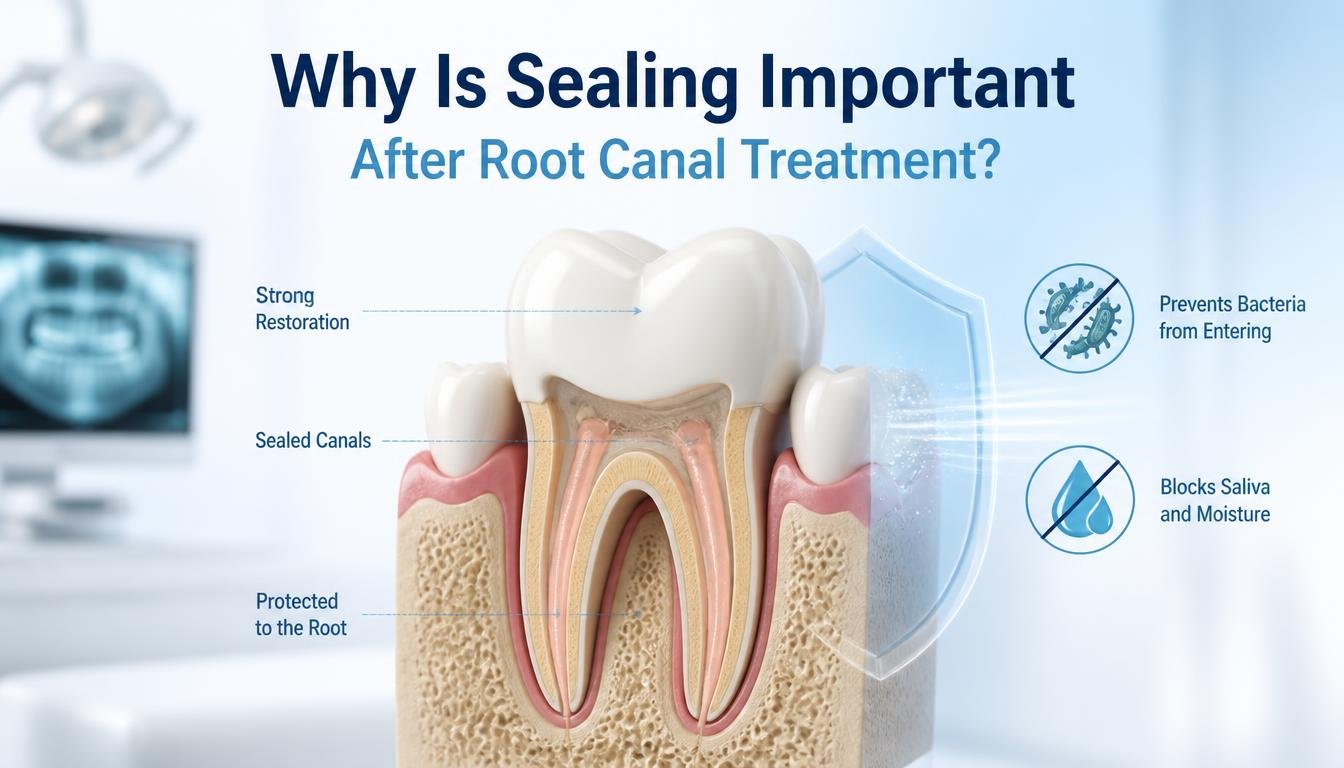
Sealing is one of the most important parts of protecting a root-canal-treated tooth because it helps prevent bacteria, saliva, food particles, and other contaminants from entering the treated tooth again.
The American Association of Endodontists explains that after root canal treatment, the tooth is restored with a filling or crown to protect it and allow it to continue functioning. It also notes that delayed restoration or a restoration that does not prevent contamination can contribute to problems after treatment.
For patients considering root canal treatment in Noida, understanding the importance of proper sealing and final restoration can help protect the treated tooth for the long term.
Quick Answer: Sealing after root canal treatment helps close the treated tooth and root canal system from the oral environment. A properly sealed restoration reduces the opportunity for bacteria and saliva to contaminate the treated area and also helps protect the remaining tooth structure from further damage.
What Happens During Root Canal Treatment?
Before understanding why sealing is important, it helps to understand what happens during root canal treatment.
A root canal may be recommended when the pulp inside a tooth becomes inflamed or infected because of deep decay, cracks, trauma, repeated dental procedures, or other causes.
During treatment, the dentist generally:
- Examines the affected tooth.
- Uses appropriate imaging when necessary.
- Provides local anaesthesia.
- Creates access to the inside of the tooth.
- Removes infected or inflamed pulp.
- Cleans and disinfects the root canal system.
- Shapes the canals appropriately.
- Fills and seals the canals.
- Places a temporary or permanent restoration as clinically appropriate.
- Plans the final restoration if additional protection is needed.
The goal is to eliminate infection and preserve the natural tooth whenever possible.
Painless Root Canal Treatment in Noida
What Does “Sealing” Mean After Root Canal Treatment?
The word “sealing” can refer to different stages of restoring a root-canal-treated tooth.
Inside the tooth, the cleaned root canals are filled with a suitable root canal filling material and sealer. The access opening is then restored so that the tooth is protected from the oral environment.
The final restoration may be:
- A dental filling
- An onlay
- A dental crown
- Another restoration recommended by the dentist
The appropriate option depends on the amount of healthy tooth structure remaining, the location of the tooth, chewing forces, cracks, previous restorations, and other clinical factors.
So, sealing is not simply about closing a hole in the tooth. It is about creating an effective barrier between the treated tooth and the bacteria-rich environment of the mouth.
Why Is Sealing Important After Root Canal Treatment?
1. It Helps Prevent Bacterial Contamination
The mouth naturally contains many types of bacteria.
After root canal treatment, the cleaned internal space needs to remain protected from new contamination. If the restoration does not provide an adequate seal, bacteria and saliva may gain access to the treated area.
This can potentially compromise the result of treatment.
The American Association of Endodontists identifies restoration problems that allow salivary contamination as one possible factor associated with disease or symptoms returning after root canal treatment.
That is why proper sealing should be considered an essential part of the overall treatment process.
2. It Helps Protect the Tooth From New Infection
Root canal treatment removes the infected or inflamed pulp and cleans the internal canal system.
However, a treated tooth still exists inside the oral environment.
If bacteria are able to enter the tooth again through a defective, loose, cracked, or damaged restoration, reinfection can occur.
A properly planned restoration helps create a barrier and supports the long-term protection of the treated tooth.
“root canal treatment and restoration”
3. It Protects the Root Canal Filling From Exposure
The root canals are cleaned and filled during root canal treatment.
The filling material placed inside the canals is intended to remain protected from the oral environment.
If the tooth is not properly restored, the restoration can become damaged or the tooth can become exposed to contamination.
This is one reason your dentist may recommend completing the permanent restoration promptly after the endodontic treatment when clinically appropriate.
4. It Helps Protect the Remaining Tooth Structure
A tooth requiring root canal treatment may already have lost significant structure because of:
- Deep tooth decay
- Large fillings
- Cracks
- Fractures
- Previous dental procedures
- Trauma
The amount of remaining healthy tooth structure is an important consideration when deciding how the tooth should be restored.
A suitable restoration can help protect the remaining structure from everyday chewing forces.
This is particularly important for teeth that experience substantial biting pressure.
5. It Can Reduce the Risk of Leakage Around the Restoration
Even when root canal treatment has been performed properly, the final restoration plays an important role.
A restoration that fits appropriately and remains intact helps separate the treated tooth from the oral environment.
Over time, restorations can become worn, cracked, loose, or damaged. These problems should not be ignored because they can allow bacteria and fluids to reach areas that need protection.
If your filling or crown becomes loose or damaged after root canal treatment, contact your dentist for an evaluation.
6. It Helps Restore Normal Tooth Function
Root canal treatment addresses the infected or inflamed pulp, but the tooth still needs to function during chewing.
A suitable final restoration can help restore:
- Tooth shape
- Chewing function
- Structural support
- Protection
- Appearance, when appropriate
Depending on the tooth’s condition, a dentist may recommend a filling, onlay, crown, or another restoration.
Is a Dental Crown Always Needed After Root Canal Treatment?
No. A dental crown is not automatically required after every root canal treatment.
The appropriate restoration depends on the individual tooth.
Your dentist may consider:
- Which tooth received root canal treatment
- How much natural tooth structure remains
- Whether the tooth has large existing fillings
- Whether cracks are present
- The amount of chewing pressure on the tooth
- The location of the tooth
- Your bite
- Your overall oral health
For some teeth, a filling or another conservative restoration may be sufficient.
For other teeth, particularly those with substantial structural loss, a dental crown may be recommended.
Why Are Back Teeth Often Given Extra Protection?
Molars and premolars are exposed to significant chewing forces.
If a back tooth has lost a considerable amount of natural structure because of decay, a large filling, a crack, or root canal treatment, your dentist may recommend a crown or another protective restoration.
The decision should be based on an examination rather than simply assuming that every root-canal-treated tooth requires a crown.
What Happens If a Root Canal Tooth Is Not Properly Sealed?
An inadequately sealed or damaged restoration may allow bacteria and saliva to enter the treated tooth.
Potential problems can include:
- New infection
- Persistent or returning symptoms
- Tooth decay
- Damage to the restoration
- Tooth fracture
- Need for additional dental treatment
- Possible root canal retreatment
The American Association of Endodontists notes that a loose, cracked, or broken restoration can expose a previously treated tooth to new infection.
This does not mean every restoration problem will automatically cause treatment failure, but it does mean that damaged restorations should be evaluated promptly.
Can a Root Canal Tooth Get Infected Again?
Yes.
Root canal treatment has a high success rate, but a previously treated tooth can sometimes develop problems again.
Possible reasons include:
- Complex canal anatomy
- Canals that were not treated
- Persistent or new infection
- Inadequate sealing
- Delayed permanent restoration
- A loose or cracked restoration
- New decay
- Tooth fracture
If a previously treated tooth develops pain, swelling, tenderness, or other unusual symptoms, your dentist or an endodontist should evaluate it.
How Long Can a Root Canal-Treated Tooth Last?
A root-canal-treated tooth can potentially function for many years and, with appropriate care, may last a lifetime.
However, longevity depends on several factors, including:
- Quality of the original root canal treatment
- Adequacy of the final restoration
- Amount of remaining tooth structure
- Oral hygiene
- Dental decay
- Bite forces
- Presence of cracks
- Regular dental examinations
- Patient habits
The American Association of Endodontists states that with proper care, many teeth that have undergone root canal treatment can last a lifetime.
Important: No dentist can guarantee that an individual treated tooth will last for a specific number of years.
What Should You Do After Root Canal Treatment?
Following your dentist’s instructions is important after treatment.
1. Avoid Excessive Chewing on the Tooth Until the Final Restoration
If your dentist has placed a temporary restoration and scheduled a follow-up appointment, avoid putting unnecessary pressure on that tooth until the permanent restoration is completed.
2. Maintain Good Oral Hygiene
Continue brushing twice daily and cleaning between your teeth as recommended by your dental professional.
3. Attend the Follow-Up Appointment
Do not skip the appointment for the final restoration simply because your tooth feels better.
The absence of pain does not mean that the tooth no longer needs protection.
4. Report Any Problems
Contact your dentist if you experience:
- Increasing pain
- Swelling
- Persistent sensitivity
- A loose temporary filling
- A loose crown
- A cracked restoration
- Pain when biting
- A bad taste around the tooth
- Any unusual symptoms
How Soon Should a Tooth Be Restored After Root Canal Treatment?
The timing depends on the condition of the tooth and your dentist’s treatment plan.
Some teeth may receive a permanent restoration immediately, while others may require a temporary restoration before the final restoration is placed.
The important point is that the tooth should not remain inadequately protected for longer than necessary.
Your dentist will determine the appropriate timing based on:
- Tooth condition
- Remaining tooth structure
- Infection status
- Type of restoration
- Bite
- Treatment complexity
Does Sealing Make Root Canal Treatment Successful?
Sealing is an important part of the overall treatment process, but it is not the only factor determining success.
Successful root canal treatment involves several components, including:
- Correct diagnosis
- Proper cleaning and shaping of the canals
- Effective disinfection
- Appropriate canal filling and sealing
- Adequate coronal restoration
- Proper follow-up
- Good oral hygiene
- Protection from tooth fracture and new decay
Therefore, it is better to think of sealing as one essential component of protecting the result of root canal treatment, rather than a guarantee of success on its own.
Root Canal Sealing vs Dental Crown: What’s the Difference?
These two terms are sometimes confused.
Root Canal Sealing
Root canal sealing involves sealing the cleaned and filled root canal system and restoring the access opening to prevent contamination.
Dental Crown
A dental crown is a custom-made restoration that covers the visible portion of a tooth.
A crown may be recommended after root canal treatment when the tooth needs additional structural protection.
In simple terms:
Root canal treatment deals with the inside of the tooth, while the final restoration helps protect and restore the tooth from the outside.
What Are the Signs That a Sealed Root Canal Tooth Needs Attention?
Contact your dentist if you notice:
Persistent Pain
Pain that does not improve or begins again after treatment should be evaluated.
Swelling
Swelling around the tooth or gum may indicate a problem requiring professional assessment.
Pain While Biting
Pain when biting may have several possible causes and should not be ignored.
Loose Crown or Filling
A loose restoration can compromise the protection of the treated tooth.
Cracked Restoration
A crack may create a pathway for bacteria to enter.
New Sensitivity
Unexpected or persistent sensitivity should be discussed with your dentist.
Bad Taste or Discharge
An unusual taste or discharge around the treated tooth may require prompt dental evaluation.
Can Good Oral Hygiene Replace Proper Sealing?
No.
Brushing and flossing are essential for oral health, but they cannot replace a properly placed dental restoration.
Oral hygiene helps control plaque and reduce the risk of new decay around the tooth.
However, if a restoration is loose, cracked, broken, or otherwise compromised, professional dental treatment may be required.
That is why both professional restoration and daily oral hygiene are important after root canal treatment.
Root Canal Treatment and Restoration in Noida
If you are looking for root canal treatment in Noida, it is important to consider the complete treatment process rather than focusing only on the root canal procedure itself.
At The Dental Crowns, patients can discuss root canal treatment, dental crowns, restorative dentistry, and other dental treatment options with dental professionals.
The clinic is located at Civitech Stadia, Sector 79, Noida, serving patients from nearby areas including Sector 74, Sector 75, Sector 76, Sector 77, Sector 78, and Sector 79.
You can explore the clinic’s dental services to understand the available treatment options.
Why Choose Professional Follow-Up After Root Canal Treatment?
A root canal is not simply a procedure that ends when the canals are filled.
Follow-up helps your dentist assess:
- Healing
- Restoration condition
- Tooth structure
- Bite
- Gum health
- Any recurring symptoms
- Whether additional treatment is necessary
Regular dental examinations can also help identify decay, cracks, or restoration problems before they become more serious.
Frequently Asked Questions
1. Why is sealing important after root canal treatment?
Sealing helps prevent bacteria, saliva, and other contaminants from entering the treated tooth. It also helps protect the root canal filling and remaining tooth structure.
2. Is sealing necessary after every root canal?
The treated tooth needs an appropriate restoration to protect it, but the exact restoration varies. Your dentist may recommend a filling, onlay, crown, or another restoration depending on the tooth.
3. Do I always need a crown after root canal treatment?
No. Whether you need a crown depends on the tooth’s remaining structure, location, chewing forces, cracks, previous restorations, and other clinical factors.
4. Can a root canal tooth get infected again?
Yes. A previously treated tooth can develop new problems because of reinfection, inadequate sealing, new decay, cracks, complex canal anatomy, or other factors.
5. What happens if I delay my permanent restoration?
Delaying restoration can leave the tooth vulnerable to contamination or fracture. Your dentist should advise you about the appropriate timing for your specific tooth.
6. Can I eat normally after root canal treatment?
Your dentist may recommend avoiding heavy chewing on the treated tooth until the permanent restoration is completed, particularly if a temporary filling has been placed.
7. Why does my root canal tooth hurt after treatment?
Some tenderness can occur after root canal treatment. However, persistent, severe, or worsening pain should be evaluated by your dentist.
8. How do I know if my dental crown is properly sealed?
Your dentist evaluates the fit, margins, bite, surrounding tissues, and overall condition of the restoration. If the crown feels loose or you notice pain, swelling, or an unusual taste, arrange a dental examination.
9. Can a filling be used instead of a crown?
Sometimes. The appropriate restoration depends on the amount of remaining tooth structure and the clinical requirements of the tooth.
10. When should I contact a dentist after root canal treatment?
Contact your dentist if you experience persistent or worsening pain, swelling, a loose or broken restoration, pain while biting, or other unusual symptoms.
Final Takeaway: Why Is Sealing Important After Root Canal Treatment?
Sealing is important after root canal treatment because it helps protect the treated tooth from bacterial and salivary contamination while supporting the restoration and long-term function of the tooth.
A root canal removes infection from inside the tooth, but the treatment does not eliminate the need to protect the tooth afterward.
Depending on the tooth’s condition, your dentist may recommend a filling, onlay, dental crown, or another restoration.
The best approach is to complete the recommended restoration on time, maintain good oral hygiene, attend follow-up appointments, and contact your dentist if you notice pain, swelling, a loose restoration, or other unusual symptoms.
If you have recently undergone root canal treatment in Noida and are unsure whether your tooth needs a filling, crown, or another restoration, schedule a professional dental evaluation rather than delaying the final restoration.
The information in this article is for general education and does not replace an examination or diagnosis by a qualified dental professional.